34% of candidates said they still hadn't heard from an employer two months after applying. Recruiter communication is therefore a two-way filter: employers assess candidates, while candidates assess what an employer's silence, timing, and clarity reveal about the organization.
A polished careers page can't compensate for an opaque hiring process. Before you meet a hiring manager, recruiter communication already signals how the company handles ownership, deadlines, transparency, and respect for people's time. The useful question isn't only, “How do I get a response?” It's also, “What does this response pattern tell me about where I might work?”
Table of Contents
- The Hidden Cost of Hiring Silence
- How to Start a Conversation With a Recruiter
- Follow-Up Strategies That Respect the Process
- Using Communication as a Vetting Tool
- Navigating AI and Automated Responses
- When to Walk Away From an Opportunity
The Hidden Cost of Hiring Silence
The application “black hole” is not just a frustrating metaphor. In a 2022 worldwide survey of nearly 200,000 candidates, 34% said they hadn't heard back from an employer two months after applying, according to SHRM's reporting on candidate resentment. Only 58% reported receiving an automated acknowledgment after submitting an application, and just 7% said they were informed that they hadn't received the job.
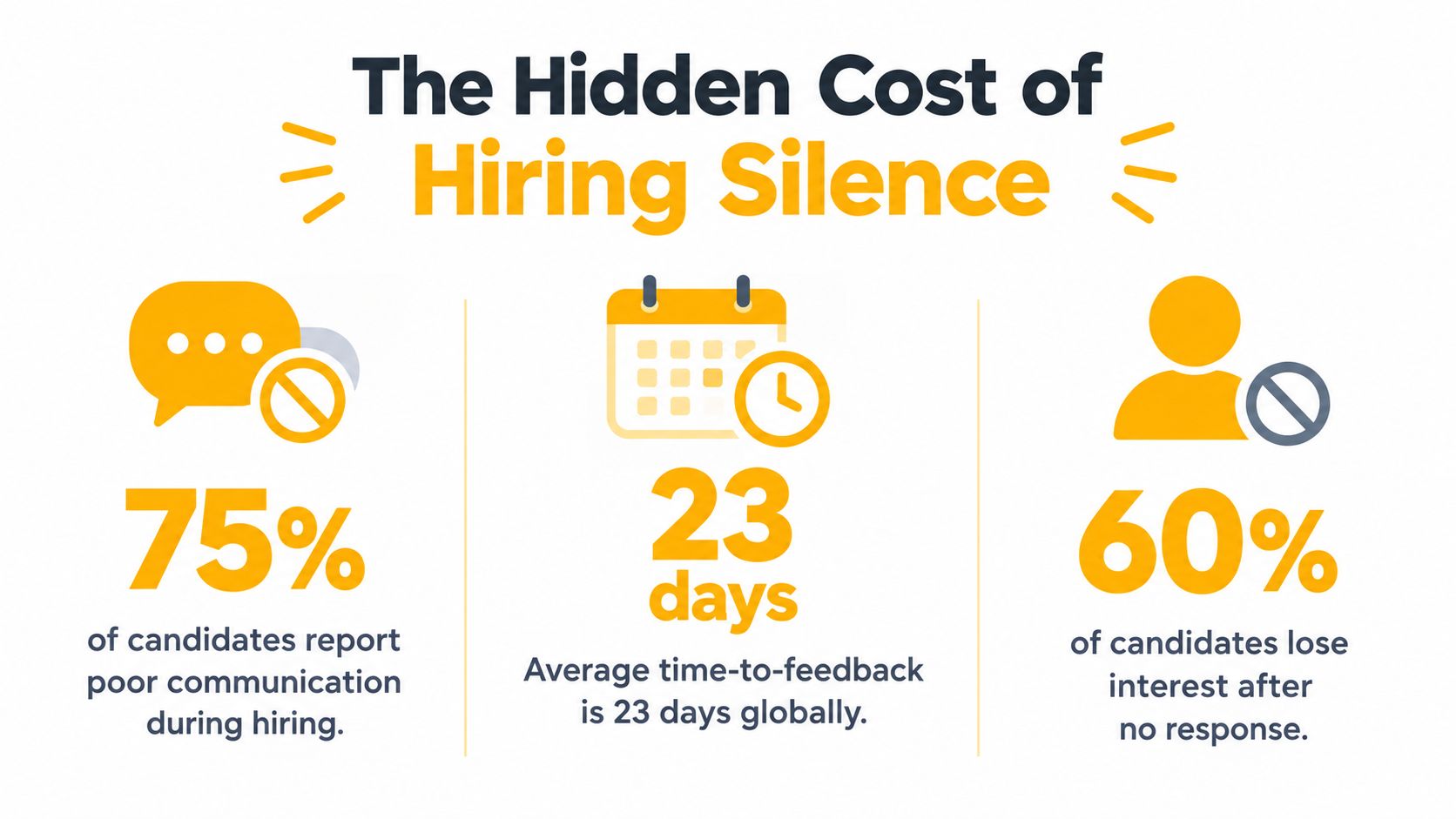
Those figures change how you should interpret silence. A missing reply may feel like an individual judgment about your qualifications, but the wider pattern points to a structural weakness in high-volume hiring. Applicant-tracking systems can standardize confirmations and status updates, yet teams can still leave those controls unused or fail to assign anyone responsibility for the next message.
Acknowledgment is not closure
Candidates need two different forms of communication. Acknowledgment confirms that an application entered the process. Closure tells the candidate what happened when the process ended. An automated receipt can satisfy the first need while leaving the second completely unaddressed.
That distinction matters because candidates form opinions before an interview. If an employer can't send a basic confirmation or rejection notice, you have limited evidence that the company manages commitments consistently. You shouldn't treat one delayed email as conclusive proof of a poor workplace, but repeated silence is relevant information.
SHRM's research also found that roughly one-quarter of candidates had been asked for feedback about their recruiting experience at any stage. Among employers that requested feedback, 40% did so only after candidates were hired, while 20% sought feedback throughout every recruitment stage. The gap suggests that many organizations evaluate the candidate experience after the people who remain have already succeeded, rather than learning from applicants who encountered friction.
Practical rule: Treat silence as an observable process signal, not as a verdict on your professional value.
Track the date you applied, the confirmation you received, every follow-up, and any stated next step. A structured record, such as the approach described in this guide to checking job application status, helps separate facts from assumptions. You may discover that the employer acknowledged the application but never closed it, or that a recruiter gave a timeline and repeatedly missed it. Those are different experiences, and your decision should reflect the difference.
How to Start a Conversation With a Recruiter
A recruiter's inbox rewards relevance, not volume. Your first message should make three things obvious quickly: which role or capability you're discussing, why you're a plausible match, and what small action you want next.
Start with the role context. If you're responding to a specific vacancy, name it. If you're making a broader introduction, identify the function and level you're targeting. Then connect yourself to one requirement you can support with evidence, rather than listing your entire career.
A concise LinkedIn message
Use this structure:
Hi [Name], I'm interested in the [Role] position at [Company]. My work in [specific skill or domain] includes [brief evidence of relevant responsibility or result]. The role's focus on [specific requirement] looks closely aligned with my background. Would you be open to a short conversation about the team's priorities?
This works because it reduces the recruiter's search effort. You aren't asking them to infer your fit from a generic profile, and you aren't demanding a call before they understand your purpose.
If someone introduced you, lead with that connection. Don't imply an endorsement that wasn't given. Write, “I saw the role through [Name], who suggested I contact you,” only when that's accurate.
A practical email version
Subject lines should identify the role and your professional angle:
Subject: [Role] candidate with [relevant capability]
Hello [Name],
I'm reaching out about the [Role] opening. I've worked on [specific responsibility] in [relevant setting], and I'm particularly interested in the position because of [credible reason tied to the role].
I've attached my résumé and included [portfolio or relevant work sample]. If the search is active, would you let me know whether my background fits the current requirements? I'm available [give a clear availability window].
Best,
[Name]
Don't hide essential information behind excessive personalization. A recruiter needs a clear role, a credible match, and a defined request more than a long paragraph about the company's mission.

Avoid sending repeated messages across several channels on the same day. That creates activity without improving your candidacy and can make the recruiter manage your persistence instead of your qualifications. One focused message, followed by a measured check-in, gives the recipient a reasonable way to respond.
Follow-Up Strategies That Respect the Process
Timing should reflect the stage you've reached, not anxiety alone. An application sitting in an ATS has a different status from an interview process where a recruiter promised an update. Your follow-up should refer to the last meaningful event and ask for the next concrete signal.
Candidate expectations are faster and more explicit than many employer practices. In a 2023 survey of 600 job seekers, 95.5% wanted employers to acknowledge receipt of an application, 81.8% preferred notification when they were no longer under consideration, and 66.1% wanted a response within 24 hours, according to iHire's candidate communication data.
Match the message to the stage
After submitting an application: First check for an automated confirmation and record its date. If there's no acknowledgment, send one concise note through the stated recruiting channel:
Hello [Name], I applied for [Role] on [date] and wanted to confirm that my application reached the appropriate team. I remain interested because of [specific fit]. Please let me know if any additional information would be useful.
After a recruiter screen: Refer to what you discussed and ask about the next decision point:
Thank you for speaking with me about [Role]. I'm still interested, particularly because of [specific aspect discussed]. You mentioned [next step or timing]. Is that still the expected process, and is there anything else I can provide?
After an interview: Send a thank-you message promptly, then follow up if the promised date passes. Don't send a generic “just checking in.” Ask whether the role remains active and whether the timeline has changed.
I'm following up on the [Role] interview from [date]. You mentioned an update by [date], so I wanted to ask whether the decision timeline has changed. I'm still interested, and I'd appreciate knowing whether I remain under consideration.
After extended silence: Make the message easy to close. A candidate deserves clarity, and a recruiter deserves a clear opportunity to answer without inventing a status.
I'm closing the loop on my application for [Role]. If the position is still active, please let me know the current timeline. If the team has moved forward with another candidate, I'd appreciate confirmation so I can update my records.
The practical approach to job application follow-up is disciplined rather than performative. Keep a record of dates, commitments, and responses. If the employer provides a specific next-update date, wait until that date has passed before writing. If no timeline exists, a professional follow-up can establish one.
A follow-up should create clarity, not merely prove that you're still available.
Don't confuse a recruiter's response with progress. “We received your message” is acknowledgment, not a substantive status update. The useful reply identifies the current stage, the person responsible for the next action, and a realistic time for another update.
Using Communication as a Vetting Tool
Candidate experience becomes useful evidence when you record it consistently. The question isn't whether one recruiter answered quickly. It's whether the employer repeatedly communicates in a way that respects your time and gives you enough information to make decisions.
Assess four signals:
- Response time: Did the employer acknowledge your application, answer after an interview, or leave you waiting without explanation?
- Clarity: Did the message identify your stage and explain what happens next?
- Ownership: Did someone provide a named or identifiable point of contact, or did every question disappear into a generic mailbox?
- Closure: Did the company notify you when the process ended?
This framework helps you avoid two bad conclusions. First, fast automation doesn't automatically mean a thoughtful process. Second, one delay doesn't prove that the entire company is dysfunctional. Look for patterns across stages, especially after direct contact with a recruiter or hiring manager.
Build a decision record
Create a simple log with these fields:
| Field | What to record |
|---|---|
| Application date | When you submitted and through which channel |
| Last meaningful contact | The most recent human or substantive update |
| Promised action | What the employer said would happen next |
| Actual outcome | Response, rejection, progression, or silence |
| Your decision | Continue, follow up, pause, or withdraw |
A 21-day window can serve as a practical transparency rule for considering silence actionable after the last relevant contact, while still allowing for uncertainty about the employer's internal cause. It isn't proof that a role was canceled, that a recruiter acted deliberately, or that an applicant was rejected. It's a boundary for deciding how much attention the opportunity receives.
Silence also affects whether you want to interact with the employer as a customer or applicant later. In iHire's 2023 Job Seeker Report, 38.7% of respondents said they'd be less likely to interact with a brand in the future after applying for a job and receiving no response, as reported in the report's findings on candidate expectations.
That makes recruiter communication a culture signal, but not a complete culture diagnosis. Use it alongside the quality of the job description, consistency of interviewers, compensation clarity, and how the company handles reasonable questions. The purpose is to allocate your time intelligently, not to label an organization from one imperfect interaction.
Navigating AI and Automated Responses
Automation can remove administrative delays, but it can also make accountability harder to see. An acknowledgment with a requisition number confirms that a system received your application. It doesn't tell you whether a human reviewed your résumé, whether the role is still open, or whether anyone owns the next decision.
Technology-hiring research found that only 14% of surveyed tech professionals trusted fully AI-driven hiring, compared with 46% for hybrid AI-human approaches, according to Dice's research on trust in technology hiring. Candidates prioritized clear requirements, prompt communication, human review of applications, salary transparency, and explanations of evaluation criteria.
Separate automation from accountability
| Signal | What it tells you | What it doesn't tell you |
|---|---|---|
| Automated receipt | Your submission entered a workflow | Whether anyone reviewed it |
| Scheduling link | The employer has configured a process | Whether the hiring team is aligned |
| Personalized recruiter note | Someone appears to have engaged with your profile | Whether the role is approved or active |
| Status update with a date | The team has stated an expectation | Whether it will meet that commitment |
Ask direct, neutral questions when automation appears central:
Is AI used to screen or rank applications for this role?
Does a human review applications before candidates are declined?
Who owns follow-up if the automated workflow doesn't reflect my situation?
How can I request clarification if I believe the system missed relevant experience?
You don't need to accuse the employer of using automation improperly. You need enough disclosure to understand the process and decide whether it deserves further investment. If a company can explain the workflow, identify human oversight, and provide an escalation path, automation may reduce friction. If it hides behind generic messages and offers no owner, the technology has become a barrier rather than a service.
Keep screenshots or copies of automated updates, especially when they contain a stated timeline. A technical process can still create a real obligation to communicate clearly. When the record shows an acknowledgment but no substantive movement, follow up about status rather than assuming the system rejected you.
When to Walk Away From an Opportunity
Walking away doesn't require certainty about an employer's motives. It requires a reasonable boundary around your time. CareerPlug's 2024 Candidate Experience Report found that 53% of candidates had been ghosted by a potential employer, while 31% said an employer responded to their application and then stopped communicating before scheduling an interview, as documented in the report.
Use a simple decision test:
- Persist: The employer responds, explains the delay, confirms that the role remains active, and gives you a credible next-update date.
- Reduce investment: The employer sends vague replies, misses one commitment, or leaves the process ambiguous. Send one clear follow-up and continue other searches.
- Withdraw: The employer repeatedly misses stated dates, stops responding after meaningful contact, or asks for additional work without providing status or ownership.
- Record the outcome: Preserve the dates and messages, then use these hiring red flags to compare the pattern with other opportunities.
Silence isn't always malicious. A hiring freeze, approval delay, or internal change may explain it. You don't need to prove which explanation is true before deciding that the process no longer earns priority.
GhostedBy makes candidate experience visible through aggregated response and ghosting outcomes, while its private application board keeps stages, dates, conversations, and results together. Check the company record before applying, track what happens after you submit, and visit GhostedBy to make recruiter communication part of your evidence-based job search.