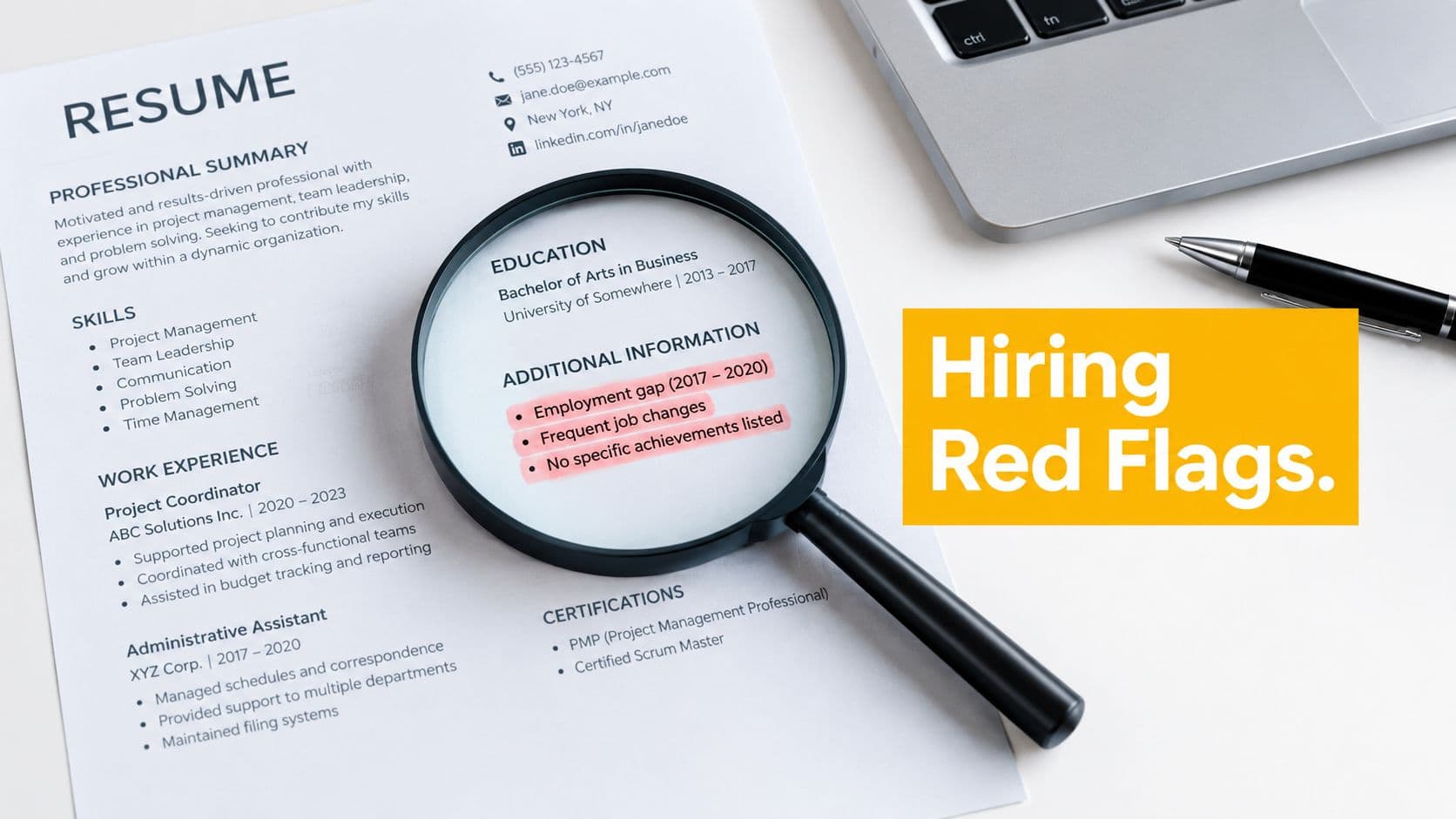
One delayed email doesn't tell you much. Repeated silence, shifting expectations, and contradictory answers do. That pattern is the hiring red flag, because it gives you something you can verify, document, and compare against what the company told you.
Candidates should keep the original job description, save dates and promises, and write down every meaningful contact. That record matters when you need to decide whether a slow process is merely messy or part of a broader pattern. It also helps you compare your experience with aggregated candidate outcomes, including public ghosting records where they exist, instead of relying on a gut feeling alone.
The strongest warning signs are usually visible in the process itself. You can see them in unanswered follow-ups, role changes, delays with no explanation, and the way different people inside the company describe the same job. A single one of those can have an innocent explanation. Two or three together usually don't.
Table of Contents
- 1. No Response After 21 Days
- 2. High Ghosted Rating Percentage
- 3. Rapid Role Re-posting
- 4. Vague or Changing Job Descriptions
- 5. Overly Long Hiring Process Without Transparency
- 6. Ghosting After Interviews
- 7. Rejection Without Feedback
- 8. Inconsistent Communication or Contradictory Information
- 8 Hiring Red Flags Comparison
- Turn Warning Signs Into a Decision
1. No Response After 21 Days
Silence after your last meaningful contact is the clearest hiring red flag because it gives you a simple test. If 21 days pass after an application or after the last real exchange, you're no longer dealing with a slow process, you're dealing with a company that has chosen not to answer. GhostedBy uses that same 21-day window for applications that count as ghosted after the last relevant contact, which is a useful benchmark because it turns a vague wait into a documented outcome.

What the silence is telling you
A company can miss a day or two without meaning much. Three weeks without a response is different, especially after an interview or a promised follow-up date. Public reporting has shown that employer ghosting is common enough to be a recurring candidate-experience risk, with 53% of job seekers saying they had been ghosted by an employer in the past year in a 2026 Criteria report reported by Fortune, up from 38% in 2024 and 48% in 2025 (Fortune's report on the three-year high in employer ghosting). That doesn't mean every delay is malicious. It does mean silence is often the first measurable sign that a process has already stalled.
Practical rule: keep the date of your last contact, then set a reminder for day 21. If you still haven't heard back, document the outcome and move the role into the “closed unless proven otherwise” column.
How to verify and act
Save the last contact date: Use the application date or the most recent email from the company.
Track the outcome: Mark whether the company replied, delayed, or went silent.
Compare across companies: If one employer does this once, that's a miss. If it happens across multiple candidates, it points to a pattern.
Check the company record before applying: If a company already shows repeated silence, think twice before investing more time.
A candidate who interviewed with a startup and heard nothing after the final round doesn't need to keep guessing forever. At day 21, the process has already told them something useful.
2. High Ghosted Rating Percentage
A high ghosted percentage matters because it turns a private annoyance into a company-level signal. If candidates who apply or interview never hear back, the issue isn't just timing. It's the process. GhostedBy's model shows this kind of outcome as an aggregated record, which is more useful than one person's memory because it reflects repeated candidate experiences rather than a single bad day.
Why recruiters ghost candidates is worth reading if you want the employer side of the pattern, but the candidate-side question is simpler, how many people get a response.
How to read the number without overreading it
A company with a high ghosted rate is telling you something about the reliability of its hiring process. If the percentage is high and the outcome count is substantial, you can treat it as a stronger warning than an isolated complaint. If the count is small, the signal is weaker and worth treating more cautiously.
A ghosted rate above 50% is a serious reason to pause, especially if you're choosing where to spend your job-search time. That kind of record suggests the company has a communication problem that candidates are repeatedly experiencing, not one candidate who had an awkward week.
A rating is only as useful as the behavior behind it. If the percentage drops over time, that can reflect a real process change. If it stays high, the company is teaching you how it handles people before you ever get inside.
How to verify and act
Compare similar employers: Look at companies in the same industry or size range.
Check the outcome count: More outcomes make the percentage more meaningful.
Watch for movement: A company that improves from one period to the next may be changing how it hires.
Use it before you apply: That's where the signal saves the most time.
A large enterprise with a high ghosted rating is not a place to assume communication will magically improve once you get in the room. A startup that improved its rating after changing its process deserves a different read, because the record shows actual change, not just a static reputation.
3. Rapid Role Re-posting
A job that disappears and reappears in a short span is one of the easier hiring red flags to verify because the posting history often leaves a trail. The company may say the role is still open, but repeated reposting usually means something isn't landing. Offers are being declined, new hires aren't staying, interviews aren't getting to yes, or the expectations are too messy to satisfy.
What repeated posting usually means
A role posted once can be normal. The same role posted, closed, then posted again soon after deserves scrutiny. That pattern can point to poor retention, unrealistic requirements, or a hiring manager who doesn't know what they want. None of those are fatal on their own, but they're all expensive for the candidate.
Search the role title and company name with date filters. If the same posting keeps surfacing, save it. Compare the language too. If the description changes between reposts, the company may be adjusting the job to match whoever they can find rather than defining the job clearly first.

What to ask when you interview
Ask whether the role has been open before: That question is direct and useful.
Ask what happened to the previous candidate: The answer can reveal whether the issue is fit, compensation, or internal churn.
Compare the posting versions: If the requirements keep expanding, the company may be searching for a unicorn.
Treat repeat posting plus silence as a stronger warning: One signal can be noise. Two together usually aren't.
A marketing manager role posted three times in nine months says more than a polished careers page ever will. If the role stays open while the company keeps changing the description, the problem is probably inside the process, not in the candidate pool.
4. Vague or Changing Job Descriptions
A vague job description is a warning because it gives the company room to redefine the job later. If the posting reads like it could describe five different roles, you're not seeing clarity, you're seeing avoidance. The same goes for a description that changes between your application and the interview.
Why this matters before you accept anything
When a company can't say what the role is, you can end up carrying responsibilities nobody discussed. That doesn't always mean bad intent. Sometimes the team is just confused. The outcome for you is similar either way, though, because you're likely to land in a role that doesn't match the version you agreed to.
Save the original posting before you apply. If the recruiter later describes something narrower, or the hiring manager starts adding adjacent duties, you have something to compare against. That comparison is more useful than trying to remember the original text from memory.
Useful question: “Walk me through a normal day in this role.”
The answer often exposes whether the job is actually defined or just assembled from leftover tasks.
How to spot the mismatch
You might see a title that says one thing while the responsibilities point in every direction. A product role that includes strategy, customer support, and data analysis may really be three jobs wearing one badge. A backend posting that turns into a frontend and customer-facing role by interview three is another version of the same issue.
Ask for a written role description or charter before accepting an offer. If the company can't provide one, or keeps revising it, that's useful evidence. It doesn't prove bad faith, but it does prove the role isn't settled.
5. Overly Long Hiring Process Without Transparency
A long hiring process is only a red flag when the company cannot explain it. Some roles need extra interviews, more stakeholders, or tests. The warning sign is process friction without a reason you can verify. If no one can say how many rounds there are, what each one is for, or when you should hear back, you are being asked to wait without enough evidence to judge the wait.
The difference between thorough and opaque
A transparent process can still move slowly. An opaque one feels slower because you have to guess what is happening next. That uncertainty has a cost. You keep your calendar open, keep checking email, and keep the role active in your mind even when the company gives you little to work with.
Purdue's guidance on candidate experience says employers should tell candidates in advance what tests or assessments will be used, why they were chosen, how long each will take, and what the candidate will need to do, while also providing feedback after testing and communicating throughout selection (Purdue's candidate experience guidance). That standard matters because it gives candidates something concrete to plan around.
The same question applies to broader hiring practices, including how consistently a company handles timelines and updates. A useful reference is this overview of company hiring practices, which helps separate ordinary delay from a process that offers no trackable structure.
What to ask and record
Ask about the full process early: Find out how many rounds there are and what each round tests.
Ask for a timeline: A written timeline gives you more to compare against than a verbal promise.
Note every delay: If the company slips once, record it. If it slips again, look for a pattern.
Compare what they said to what happened: Repeated mismatch is evidence, not a random miss.
A company that says “several rounds” and stops there is making you carry the uncertainty for them. If it cannot explain its own hiring timeline, there is little reason to expect clearer communication after you start.
6. Ghosting After Interviews
Ghosting after interviews is a stronger warning than silence after an application because the company has already asked for more of your time. The key question is not whether a recruiter got busy. It is whether the employer can close a process it started.
Recruiter ghosting is common enough to show up in employer surveys, and candidate no-shows are part of the same pattern. Glider's summary of candidate ghosting research notes that employers report being ghosted by candidates and that the problem has intensified in recent years (Glider's summary of candidate ghosting research). GhostedBy's guide on how long to wait after an interview is useful here because it separates ordinary delay from a silence that has gone past a reasonable window.

A final-round interview should produce one of three outcomes. You get a decision, a delay with a specific explanation, or a rejection. When none of those appears, the company is telling you how it handles closure.
That signal gets stronger if the promise was concrete. “We'll be in touch soon” is vague but still usable; “We'll reply by Friday” and then silence creates a record you can compare against. Write down the name of the person who made the promise, the date, and the wording. If the story changes from one contact to the next, the issue is no longer delay, it is inconsistency.
How to respond
Follow up once after the promised date, briefly and professionally. If there is still no answer, treat the silence as a decision about their process, not your candidacy.
What matters is the pattern you can document. A company that cannot manage post-interview communication may still hire well, but it is showing you that its internal coordination breaks down at the point where candidates are most exposed.
7. Rejection Without Feedback
A rejection without feedback still closes the loop, but it also shows how a company handles closure. A form email can be routine in a high-volume process. It becomes more revealing after several interview rounds, when the employer has already asked for time, attention, and trust.
The main question is not whether every candidate should get coaching. It is whether the company can give even a short explanation once it has made a decision. A complete absence of detail often points to weak communication norms, and that pattern can surface elsewhere, in status updates, internal handoffs, or how bad news is delivered.
What the response tells you
After a rejection, send one polite request for feedback. If the company answers with a specific reason, it has shown some willingness to be direct. If it does not reply, that silence is also evidence. You now know how much follow-through they are likely to offer when the answer is inconvenient.
The strongest warning signs are the ones that repeat. A single generic rejection is common. A company that always uses the same template, ignores feedback requests, or changes its tone depending on stage is giving you a record of where communication drops off.
Repeated form rejections: One template can be normal, but a pattern across rounds suggests the company treats closure as a checklist item.
No reply to a feedback request: That tells you the rejection is final and the company is unlikely to explain itself later.
Different treatment by stage: Personalized early messages and generic final ones can show where attention disappears.
No distinction between candidates: Identical language for every applicant suggests the company is not adjusting its process to the person in front of it.
A candidate who reaches a late-stage interview and receives a one-line rejection has not learned that the company is bad. They have learned what it does with closure. That matters because a hiring process reveals more through its exits than its opening pitch.
8. Inconsistent Communication or Contradictory Information
Contradictions are one of the clearest hiring red flags because they leave a record. The recruiter says one thing, the hiring manager says another, and HR adds a third version. That inconsistency usually means the company has not aligned on the role, the process, or who is responsible for answering basic questions.
A polished pitch can hide gaps. Conflicting details are easier to verify. If one person says the role is fully remote and another later mentions monthly in-person meetings, that is a concrete change in expectations. If you are told the job reports to one leader and later hear it sits under a dotted-line setup to another team, that changes what the role involves.
What to verify before you accept
Write down who said what, and when. That gives you a simple record if the story shifts again. Then ask for clarification in plain language. “I heard X from the recruiter and Y from the hiring manager. Can you clarify?” is direct without being confrontational.
The key is to separate a fixable mismatch from a pattern. A company may correct one inconsistency quickly, especially if different people are speaking from partial information. The warning sign grows when the answers keep changing, nobody can explain the difference, or the burden falls on you to reconcile the process.
Reporting structure: Confirm who the role answers to.
Location requirements: Get remote, hybrid, or office expectations in writing.
Compensation details: Ask for the stated range and any conditions that affect it.
Offer letter language: Check that the written offer matches what was discussed.
A contradictory process does not automatically mean a bad employer. It does show how the company handles uncertainty. If the mismatch is resolved cleanly, that is one thing. If the explanations keep moving, you have evidence that the confusion may continue after you start.
8 Hiring Red Flags Comparison
| Item | 🔄 Implementation complexity | ⚡ Resource requirements | ⭐ Expected outcomes (quality) | 📊 Ideal use cases | 💡 Key advantages / Tips |
|---|---|---|---|---|---|
| No Response After 21 Days | Low, simple threshold to apply | Low, candidate reports / calendar reminder | ⭐⭐⭐⭐, clear indicator of ghosting patterns | Quickly decide when to follow up or move on | 💡 Note last contact date; set day-21 reminder; check company rating |
| High Ghosted Rating Percentage | Medium, requires aggregation & thresholds | Medium, needs ≥5 outcomes and updates | ⭐⭐⭐⭐⭐, strong predictive signal of poor communication | Screening companies before applying at scale | 💡 Use with outcome count; compare within industry |
| Rapid Role Re-posting | Medium, requires monitoring posting history | Low–Medium, job-board checks or candidate reports | ⭐⭐⭐, moderate signal of hiring/retention problems | Evaluating turnover risk or role stability | 💡 Google posting history; ask why role reopened |
| Vague or Changing Job Descriptions | Low, observable from posting vs interviews | Low, save postings and notes | ⭐⭐⭐, signals role-scope mismatch risk | Early-stage roles or poorly-scoped positions | 💡 Screenshot original posting; request a written role charter |
| Overly Long Hiring Process Without Transparency | Medium–High, many stages to track | High, candidate time + coordination costs | ⭐⭐, often negative for candidate experience | Assessing company process maturity / time investment | 💡 Ask for number of rounds and timeline; request written schedule |
| Ghosting After Interviews (Not Just Applications) | Low, silence after engagement is obvious | Low, follow-up attempts documented by candidate | ⭐⭐⭐⭐, strong signal of poor communication discipline | Final-stage candidates deciding whether to wait | 💡 Confirm next-step owner/date; follow up once then move on |
| Rejection Without Feedback | Low, template rejections are easy to spot | Low, one-way communication from employer | ⭐⭐, provides closure but no development value | Managing closure and energy after a process | 💡 Reply professionally asking for feedback; track responders |
| Inconsistent Communication or Contradictory Information | Medium, multiple stakeholders to reconcile | Medium, requires documentation & clarifying conversations | ⭐⭐⭐, indicates internal misalignment risk | Roles requiring cross-team alignment or clarity | 💡 Document statements, ask for written confirmation of key details |
Turn Warning Signs Into a Decision
The most useful response to hiring red flags is a simple sequence. Save the original posting. Record the dates and promises you were given. Ask one clear follow-up question when something doesn't match. Then set your own point where waiting stops being useful.
That point matters because not every delay is a permanent warning. A recruiter can miss a follow-up, a hiring manager can get pulled into another priority, and a process can drift once without meaning much. One recoverable mistake is still a mistake, but it's not the same as a repeated pattern of silence or contradiction. The repeated pattern is what you can trust.
If the company has a public candidate record, check it before you decide how much more time to give them. Aggregated outcomes are more useful than rumors because they show what happens across candidates, not just in one conversation. A record with repeated silence, weak follow-up, or poor closure is worth treating as evidence, especially when your own experience matches it.
When a process goes bad, document your result too. That helps the next candidate make a better call, and it gives you a cleaner view of your own job search. GhostedBy is one place that makes those outcomes visible, with company-level records built from reported candidate experiences. If you're comparing employers before applying, or trying to understand a process that already went quiet, visit GhostedBy and check whether the pattern you're seeing is already in the record.