A reported 75% of job applications received no employer response in a 2025 Ghosting Index, meaning only about one in four produced any reported reply. That figure needs context because response rates vary by source, platform, and definition, but it still changes the central question. The problem isn't just how to write a better follow-up email. It's how to interpret an ambiguous job application status, decide when waiting has stopped being rational, and use past hiring outcomes to choose where to invest your time.
A company portal may say “under review” for weeks. An automated acknowledgment may arrive within minutes and create the impression that the process has started. Neither signal necessarily proves that a recruiter has assessed your application. Treating every status as evidence of progress turns a job search into passive waiting. Treating applications as a measurable pipeline gives you a more useful basis for action.
Table of Contents
- Understanding Your Job Application Status
- Decoding Common Applicant Tracking System Labels
- The Reality of Employer Silence and Ghosting
- Interpreting Status Updates Across Different Hiring Stages
- Tracking Your Applications and Managing the Wait
- Using Data to Evaluate Companies Before Applying
- Taking Control of Your Job Search Outcomes
Understanding Your Job Application Status
Hiring systems create an information gap. You submit documents, the employer receives them, and then the process often becomes invisible. You may not know whether the role remains open, whether your application passed an initial filter, whether a recruiter has seen it, or whether the requisition has stopped moving.
The response figures are inconsistent because “response” isn't a standardized job application status. One source may count an automated acknowledgment, while another counts only a substantive message from a recruiter or hiring team. Some measurements focus on individual job seekers, while others count applications across platforms. The 2025 Ghosting Index summary reports approximately 20–25% response rates on Indeed, 3–13% on LinkedIn, and 2–5% on company career websites, alongside the finding that 75% of applications received no employer response.
Those differences don't make the data useless. They show why you need to define the signal before interpreting it. “Received” means the system accepted a submission. “Acknowledged” means an automated or human confirmation arrived. “Contacted” means a person communicated about the role. “Advanced” means you moved to another hiring stage. These are separate outcomes, not interchangeable labels.
Build a status record that separates signals
A practical application record should include:
- Submission date: When you applied, not when you saved the vacancy.
- Source: The company portal, a job board, a recruiter, or a referral.
- Portal label: The exact wording currently shown by the employer.
- Human contact: The date and substance of the last recruiter or hiring-team message.
- Stage: Application, screening, interview, assessment, negotiation, or offer.
- Outcome: Advanced, rejected, withdrawn, closed, or unresolved.
This structure prevents an automated acknowledgment from being mistaken for active consideration. It also makes silence measurable. If the only event after submission is a system-generated email, the application hasn't produced evidence of human engagement.
Practical rule: Count a system acknowledgment as confirmation of receipt, not as proof that your application is under substantive review.
A missing reply isn't evidence that you performed poorly. It may reflect application volume, an internal pause, a changed hiring priority, or a process that was never closed properly. You can't infer which explanation is true from silence alone. You can, however, record the silence accurately and apply a consistent decision rule instead of allowing uncertainty to consume your attention.
Decoding Common Applicant Tracking System Labels
Applicant tracking system labels describe workflow states, but they rarely explain the human action behind those states. The same wording can represent different internal events across employers, so read the label as a limited signal rather than a promise.
Application received
This usually indicates that the portal accepted your submission and stored your documents. It confirms a technical event, not a hiring decision. A received application may still be waiting for a recruiter, recruiter coordinator, hiring manager, or screening workflow.
Check whether you received only a generic email or a message that names a contact and explains next steps. The first is administrative confirmation. The second is stronger evidence of human involvement, although it still doesn't guarantee progression.
Under review
“Under review” sounds active because it uses the language of evaluation. In practice, the label can cover a broad range of situations, including an application waiting in a queue, a recruiter review, a hiring-manager review, or a system state that hasn't been updated.
Don't translate it into “a recruiter likes my profile.” Ask what changed since submission. If there has been no human message, interview invitation, screening request, or other stage transition, the portal hasn't provided evidence of momentum. Keep the role open in your tracker, but don't reduce your search activity because of this label.
In progress
This status generally means the application remains attached to an open workflow. It doesn't establish that the employer is actively making decisions today. A role may be moving through internal approvals, waiting for interview availability, or paused while priorities change.
Treat “in progress” as unresolved. Record the last meaningful contact and look for a defined next step. If the employer gave you a timeline, use that commitment as the reference point. If it didn't, use your own waiting rule rather than repeatedly refreshing the portal.
No longer under consideration
This is the clearest negative label because it indicates that the employer has closed your candidacy in the system. It still may not explain why. The useful action is administrative: record the rejection, save any feedback, and stop allocating follow-up effort to that application.
A similar outcome may appear as “position filled,” “ requisition closed,” “not selected,” or “withdrawn.” The wording differs, but the decision rule is the same when the portal clearly indicates closure.
Read status changes as evidence, not reassurance
A genuine update changes the record. Examples include a recruiter asking for availability, a screening call being scheduled, an interview being completed, an assessment being issued, or a rejection being communicated. A label that remains unchanged provides less information than candidates often assume.
Use this translation:
| Portal wording | What it confirms | What it doesn't confirm |
|---|---|---|
| Application received | The system accepted the submission | A person reviewed it |
| Under review | The application hasn't been marked closed | You're shortlisted |
| In progress | The workflow remains unresolved | The role is actively moving |
| Interview scheduled | A human stage transition occurred | You'll receive an offer |
| No longer under consideration | The application is closed | The reason for rejection |
The portal is one data source. Your private record should combine it with emails, calls, interviews, assessments, and dates. That combined history is more informative than a reassuring label displayed without context.
The Reality of Employer Silence and Ghosting
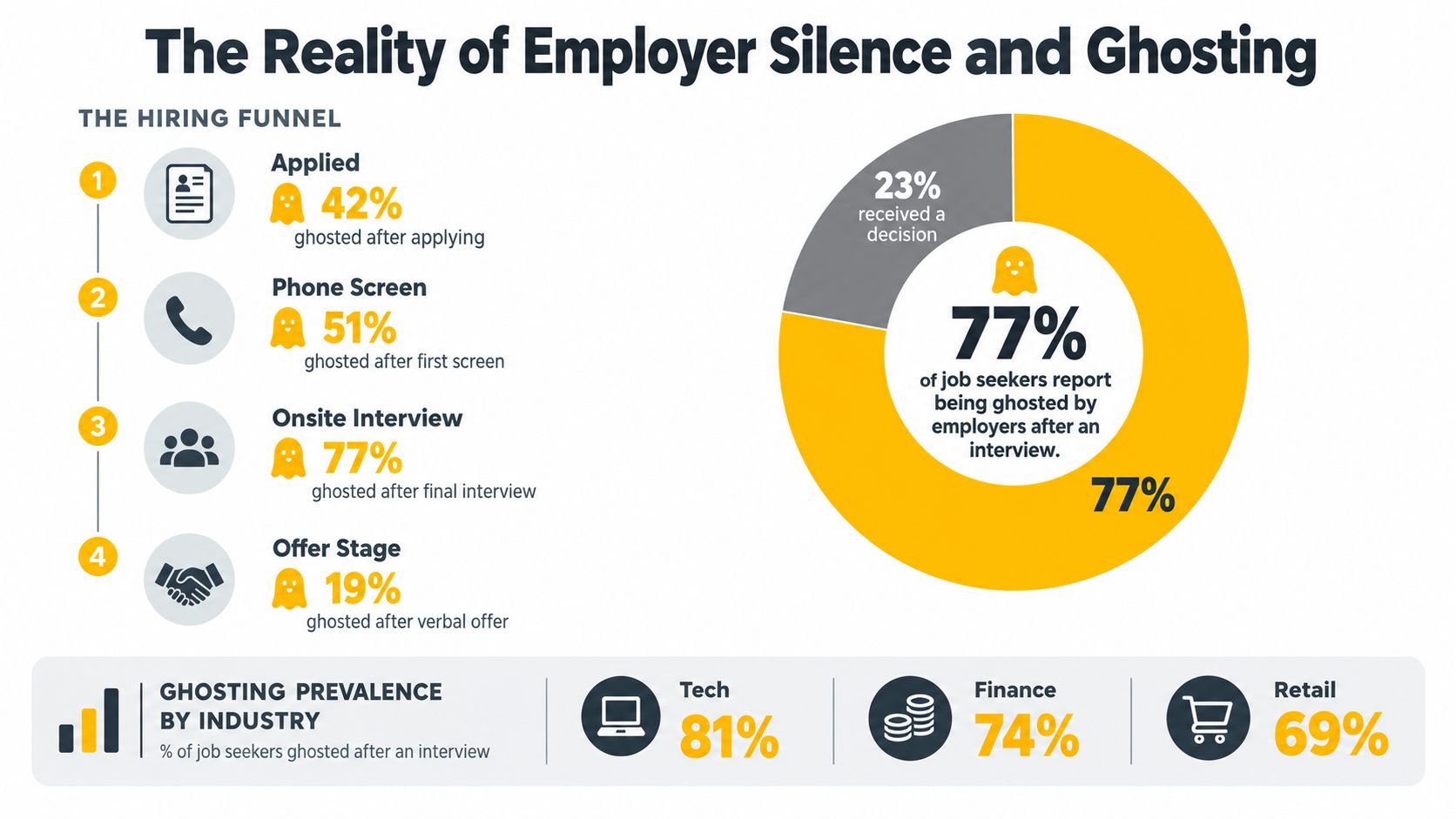
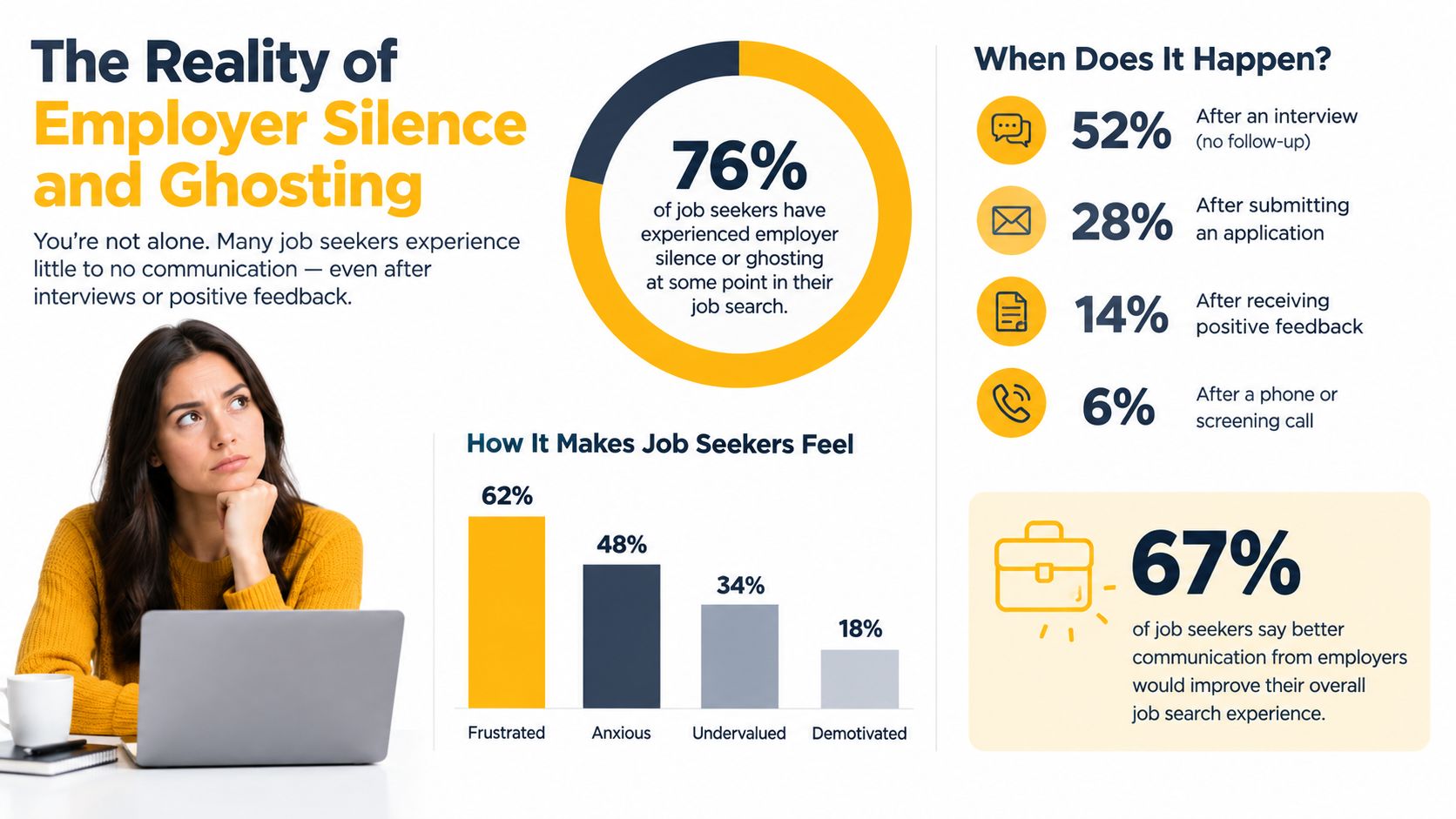
Employer ghosting occurs throughout the hiring funnel, but silence doesn't carry the same meaning at every stage. In an October 2025 iHire survey of 1,024 candidates, 53% reported being ghosted by a potential employer at some point in their job search. Among respondents identifying where the silence occurred, 28% said it happened after submitting an application, the largest selected stage. The same survey reported 20% after one interview and 16% after an initial phone screen. These figures are documented in iHire's candidate ghosting survey.
The distribution produces a useful insight. The application stage creates the largest pool of silence because it sits at the top of the funnel, where employers may receive many submissions and communicate with relatively few candidates. Later-stage ghosting affects fewer people in absolute terms but creates a sharper breach of expectation. Someone who has completed an interview has supplied more time, information, and effort than someone who has only uploaded a résumé.
Silence is a funnel problem, not one event
CareerPlug's 2024 Candidate Experience Report found that 53% of candidates had been ghosted by a potential employer. It also reported that 31% received a response to an application and were then ghosted before an interview was scheduled, while 45% of candidates who ghosted an employer did so after interviewing. The CareerPlug candidate experience report supports a stage-based record rather than a single “ghosted” flag.
A company may fail to close a requisition, delay a decision while prioritizing another candidate, or avoid a rejection because the team wants to preserve flexibility. Those possibilities explain why silence happens, but they don't convert silence into a positive signal. The candidate still lacks a usable decision, and the application remains operationally unresolved.
Silence after an application is uncertainty. Silence after an interview is uncertainty plus an unfulfilled expectation of communication.
That distinction matters for your records. A candidate who has heard nothing after applying should keep applying elsewhere while waiting for evidence. A candidate who has completed interviews should record the last promised update, the date of that commitment, and whether the employer has crossed the candidate's defined closure threshold.
The figures shouldn't be combined into one universal probability. The iHire result covers ghosting anywhere in the funnel, while the stage percentages describe where respondents experienced it. Other surveys use different samples and definitions. The defensible conclusion is narrower and more useful: employer silence is common, concentrated at multiple funnel stages, and poorly represented by a single portal label. For a broader explanation of employer communication failures, see why recruiters ghost candidates.
Interpreting Status Updates Across Different Hiring Stages
The same number of silent days means different things depending on the last meaningful event. After a cold application, the employer may have no direct relationship with you and no obligation to provide an individual update. After an interview, the employer has created a clearer expectation, especially if someone described the next step or promised a decision date.
Use the funnel stage to classify the silence before deciding what to do.
After submitting an application
An acknowledgment confirms delivery. It doesn't show that the employer has selected your profile for review. If the portal still says “received” or “under review,” keep the application in an active queue, but continue pursuing other roles.
A single, concise follow-up can be reasonable when you have a relevant contact or when the posting gave a review timeline that has passed. The message should ask about the process rather than demand a decision. If there is no human reply after that contact, downgrade the opportunity from active to unresolved. Don't let an unchanged portal status justify repeated messages.
After a phone screen or first interview
This is a stronger signal because a person has evaluated your background and invested time in a conversation. Record what the interviewer said about next steps, who owns the decision, and any date or period they mentioned.
If that expected update passes, send one focused message tied to the conversation. Then classify the application according to your own elapsed-time rule. The absence of a rejection doesn't prove that you remain a finalist, and it doesn't prove that the employer has hired someone else. It proves only that the promised information hasn't arrived.
After an assessment or final round
Later-stage silence deserves a separate category because the employer has requested additional work or conducted a deeper evaluation. Record the assessment submission date, the final interview date, and the last contact from the hiring team. A generic “in progress” label shouldn't erase those events.
A process can remain open while another candidate receives an offer, while approvals are pending, or while the team reconsiders the role. You won't know which scenario applies without a direct update. Protect your time by treating the application as a possibility, not as a likely outcome.
Apply elapsed-time windows consistently
Long delays are common enough to function as a candidate-experience signal. Benchmark research covering 240,000 candidates, as reported by SHRM and summarized by FirstHR's candidate experience metrics overview, found that 36% of U.S. candidates still hadn't heard from an employer one to two months after applying. The same benchmark indicated that companies receiving the strongest ratings either advanced candidates or rejected them within three to five days.
These findings don't create a universal deadline for every vacancy. They do show why elapsed time belongs in your job application status record. Separate “waiting within the employer's stated timeline” from “waiting without a defined next step.” The first can remain active. The second needs a closure date, even if the employer never supplies one.
Tracking Your Applications and Managing the Wait
A reliable tracker should answer three questions immediately: What did I apply for? Where am I in the process? When did someone last communicate with me? If you need to search through an inbox to reconstruct those answers, your record is too fragile.
Create one private board with a row for each role. Include the company, title, source, application date, portal label, contact name, current stage, last-contact date, next action, and outcome. Keep “rejected,” “withdrawn,” “closed,” and “ghosted” separate. They describe different endings and produce different information about the employer and your own decisions.
Use a waiting rule instead of emotional estimation
The 21-day ghosting window gives unresolved applications a defined endpoint: silence can count as ghosting after 21 days without a response following the last relevant contact. That rule should be applied to the stage you reached. If an interview took place, the relevant contact is the interview or the most recent substantive update, not necessarily the original submission.
A practical workflow looks like this:
- Log the event immediately. Add the submission, screening call, interview, assessment, or recruiter message on the day it occurs.
- Set the next review date. Base it on the employer's stated timeline when one exists. Otherwise, use your standard waiting rule.
- Send one purposeful follow-up. Ask for the next step or current timeline, and record the date sent.
- Close the loop when the window expires. Mark the role unresolved or ghosted according to your chosen definitions, then stop treating it as active pipeline momentum.
- Keep the evidence. Preserve the portal label and communication history so your later company-level analysis is based on records rather than memory.
Separate job-search communication from daily email
An optional dedicated job-search inbox can keep recruiter messages, interview invitations, and automated updates together. The benefit isn't just tidiness. It makes it easier to match a message to the correct role and prevents an old application from appearing active just because a generic email remains unread.
A board also reduces the psychological distortion caused by waiting. You can see which applications have actual movement and which are being carried by hope. For a practical record structure, compare how to track job applications with your existing workflow.
A waiting rule is useful only when it changes behavior. If the deadline arrives and you keep treating the role as active, you've recorded a date without creating a decision.
Using Data to Evaluate Companies Before Applying
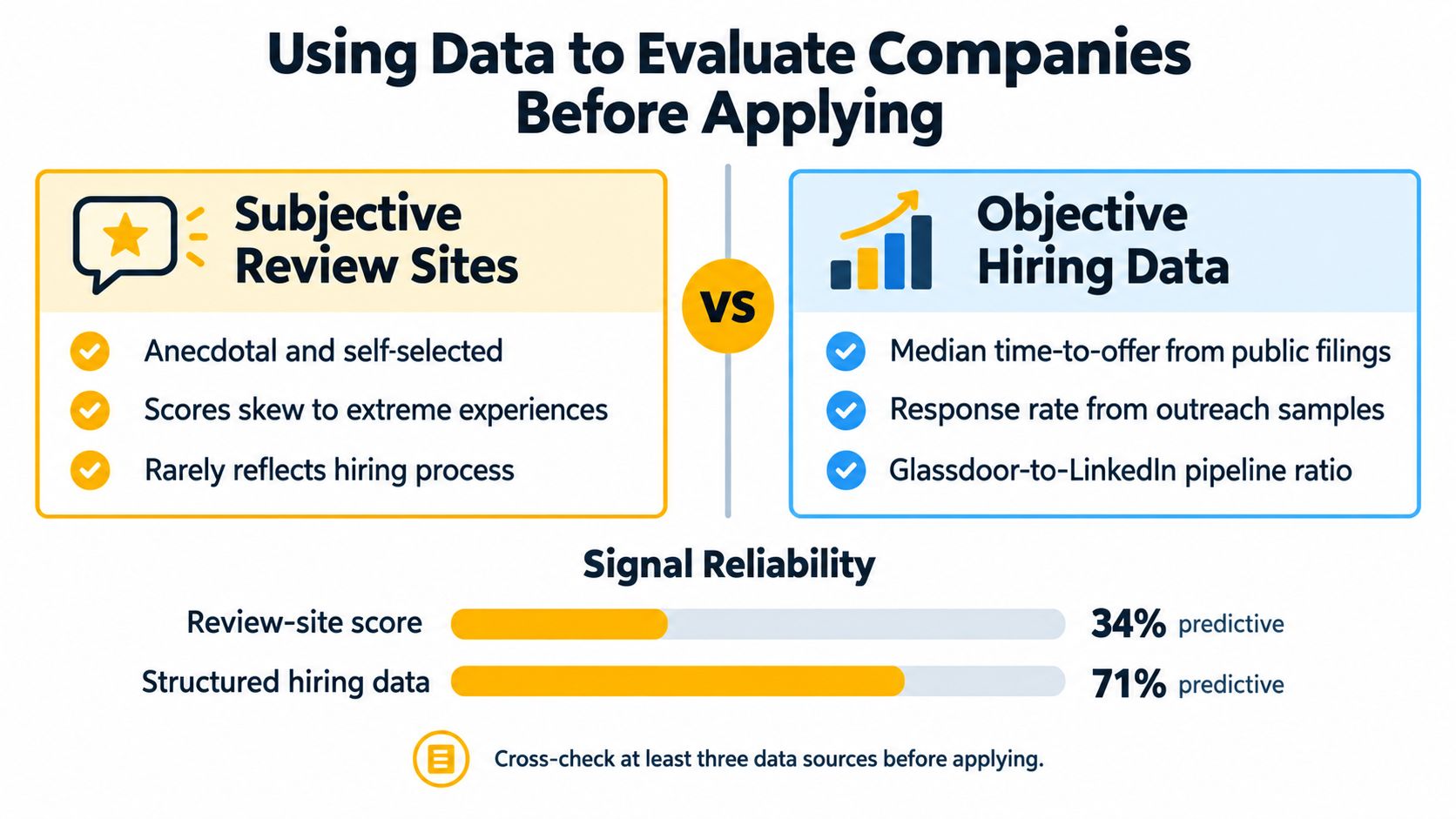
Anonymous employer reviews answer a culture question, but they often don't answer the candidate's operational question: Does this company communicate with applicants? A positive workplace reputation can coexist with a disorganized hiring process, while a negative review may describe an isolated team or a single unusual experience.
Outcome data provides a different lens. Instead of asking whether employees like the company, ask how candidates describe what happened after applying. Did the company acknowledge applications, move candidates through stages, close processes, or leave people without a decision? Those outcomes relate directly to the time and uncertainty you face.
Judge the record before judging the employer
A company-level record becomes more useful when it preserves context:
- Stage separation: Silence after applying shouldn't be blended with silence after a final interview.
- Source context: Applications from a career site may behave differently from applications through a job board.
- Minimum sample threshold: A percentage based on one or two reported outcomes can mislead, so display counts until enough eligible outcomes exist.
- Clear definitions: “Response” should distinguish an automated acknowledgment from a substantive update.
- Private evidence: Individual applications and identities should remain separate from the public aggregate.
The 2025 Ghosting Index report illustrates why channel and sample context matter. It cites an overall finding that 75% of job applications received no employer response, while also presenting different estimated response rates by platform. Those figures shouldn't be used to predict your personal result from one application. They should encourage you to compare company-level outcomes with the source and stage attached.

Turn company research into a decision filter
Before applying, look for a record that answers four practical questions:
- Is there enough evidence to interpret the pattern? A small count should remain a small count, not a confident percentage.
- Are outcomes defined consistently? A company that sends automated acknowledgments shouldn't be treated as fully responsive if candidates never receive a substantive update.
- Do the outcomes match the stage? An employer may communicate well with interviewed candidates but rarely update people at the application stage, or the reverse.
- Can you compare companies on the same basis? Consistent categories are more useful than emotional narratives with different standards.
This approach doesn't tell you to reject every company with an unresolved application. It lets you price uncertainty into your search. You might still apply to a company with limited data because the role is unusually relevant, but you can avoid treating its process as dependable without evidence. For more on structured candidate outcomes and company-level records, review candidate experience data.
The strongest conclusion isn't that review sites have no value. It's that written opinions and hiring outcomes answer different questions. Use culture information to assess the workplace, and use response records to assess the process that gets you there.
Taking Control of Your Job Search Outcomes
A passive job search asks employers to define reality for you. An active pipeline records what happened, distinguishes evidence from assumption, and gives every application a next action or an end state.
That shift changes how you allocate effort. A role with a recruiter conversation, a scheduled interview, and a documented next step deserves more attention than a portal label that hasn't changed since submission. A role that has crossed your waiting threshold can remain in your history without occupying your mental bandwidth.
Close the loop on your own records
Report outcomes consistently, including positive ones. A response, rejection, process closure, withdrawal, and period of silence each adds information. Aggregated reporting can help candidates see company-level patterns that disappear when every experience remains private and isolated.
Use this final checklist:
- Record every stage transition, not only applications.
- Separate automated messages from human updates.
- Log the last relevant contact after each interview or assessment.
- Apply one waiting rule consistently across comparable applications.
- Keep unresolved roles out of your active forecast once the rule expires.
- Compare company records by stage, source, and sample size.
- Continue applying while an employer has not provided a decision.
Candidates can't force a hiring team to communicate. They can refuse to let an ambiguous job application status control their schedule. A disciplined record turns ghosting from a private frustration into a measurable outcome, while transparent company data makes it easier to invest time where the process shows signs of respect.
GhostedBy lets candidates check company response and ghosting patterns, privately track roles and hiring stages, and report whether an application received a response, closed, or went silent. Visit GhostedBy to replace uncertain waiting with a documented job application status record.