An average cold online application generates only about 2–3% recruiter contact, so roughly 97–98 out of 100 applications receive no human response. An organized job search improves your odds by turning applications, follow-ups, conversations, and employer behavior into a trackable pipeline instead of a pile of unanswered tabs and emails.
That reality changes what “working harder” means. Sending more applications can feel productive, but volume without records makes it difficult to know which sources work, when to follow up, or whether a company has a pattern of disappearing. The practical advantage comes from managing the process with enough structure to make better decisions while preserving your energy for the roles that deserve it.
Table of Contents
- Why Organized Job Search Exists
- Setting Up a Private Application Board
- Tracking Sources and Channel Performance
- Building Follow-Up Routines That Work
- Using Employer Responsiveness as a Signal
- Weekly Job Search Operating Rhythm
Why Organized Job Search Exists
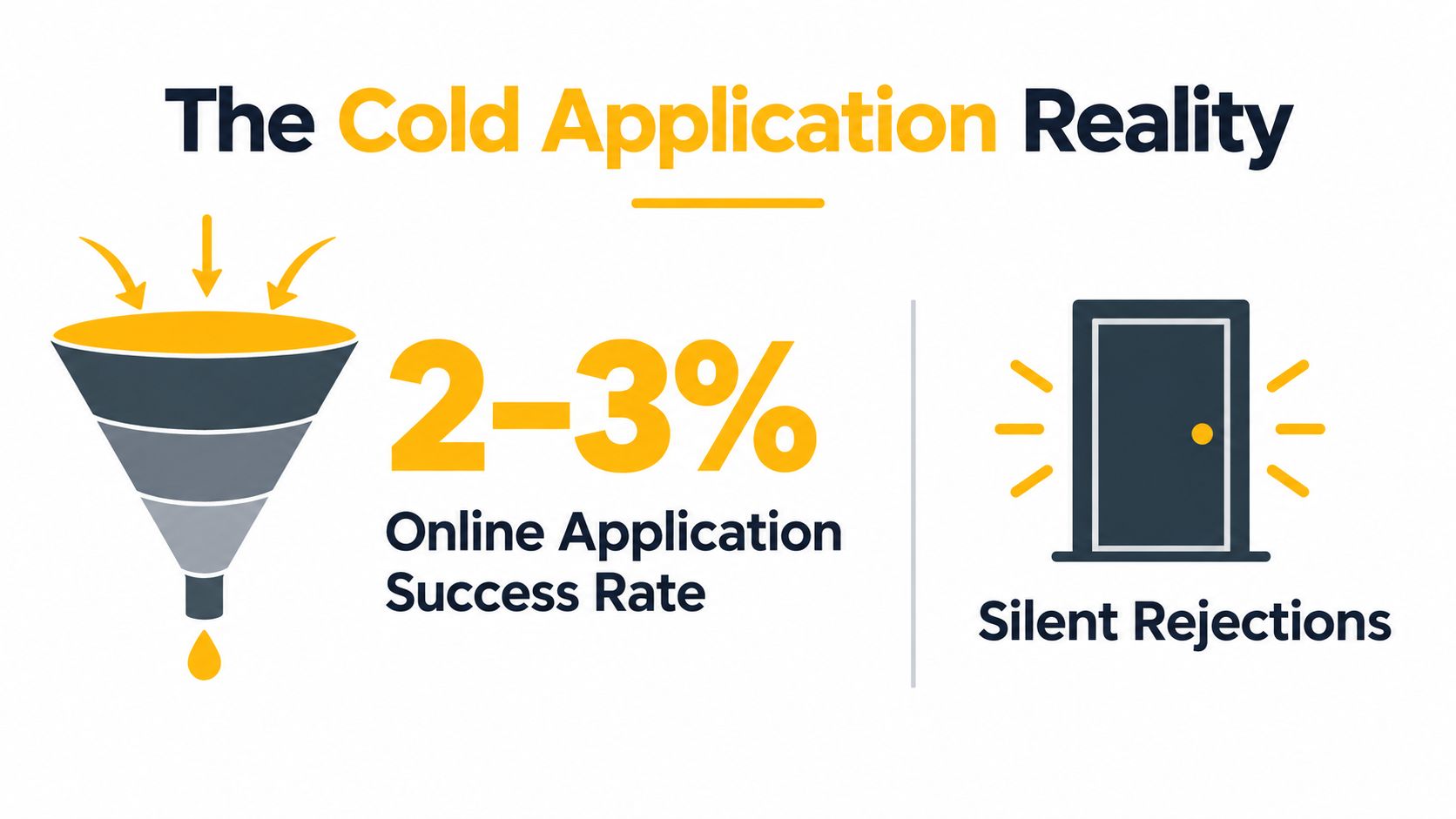
A single posting can attract about 250 applications, yet only 1–4 candidates receive an offer. That produces an end-to-end conversion rate of roughly 0.5–1.5% from application pool to hire, according to LoopCV's application benchmark guide. As noted above, recruiter contact is already rare. The larger point is operational: an application is only one event in a pipeline, not proof that the search is progressing.
Those figures do not make every application equally weak. They show why an unstructured search breaks down. Without separating a referral from a generic job-board submission, or a new application from one awaiting a response, you cannot tell which choices improve results. You are left with a crowded inbox, scattered documents, and less confidence about what to do next.
Practical rule: Treat every application as a pipeline event, not a completed task.
The wider labor market adds pressure. The International Labour Organization's 2024 world jobs gap estimate put the gap at 402 million people, including 186 million unemployed, 137 million temporarily unable to work, and 79 million discouraged workers who had stopped looking. Employer workload is also high. A 2026 recruitment benchmark shared by Suraj Kumar reported an average of 291 applications processed per hire, up from roughly 100 in early 2021, while the global median time to hire was 38 days.
What scattered searching hides
A search spread across bookmarks, LinkedIn messages, email threads, downloaded resumes, and inconsistent spreadsheets creates predictable blind spots:
- Timing disappears: You forget when an application was submitted and miss a sensible follow-up window.
- Context gets lost: You cannot quickly recall the resume version, referral, or hiring manager connected to a role.
- Silence stays ambiguous: You cannot tell whether an employer is slow, inactive, or has not replied.
- Effort becomes misleading: A high application count can conceal weak sources, poor tailoring, or stalled stages.
An organized job search does not guarantee an offer. It gives you a defensible basis for choosing where to spend the next hour. Track source, tailoring, follow-up, and stage progression, then stop repeating actions that create activity without useful evidence.
Setting Up a Private Application Board
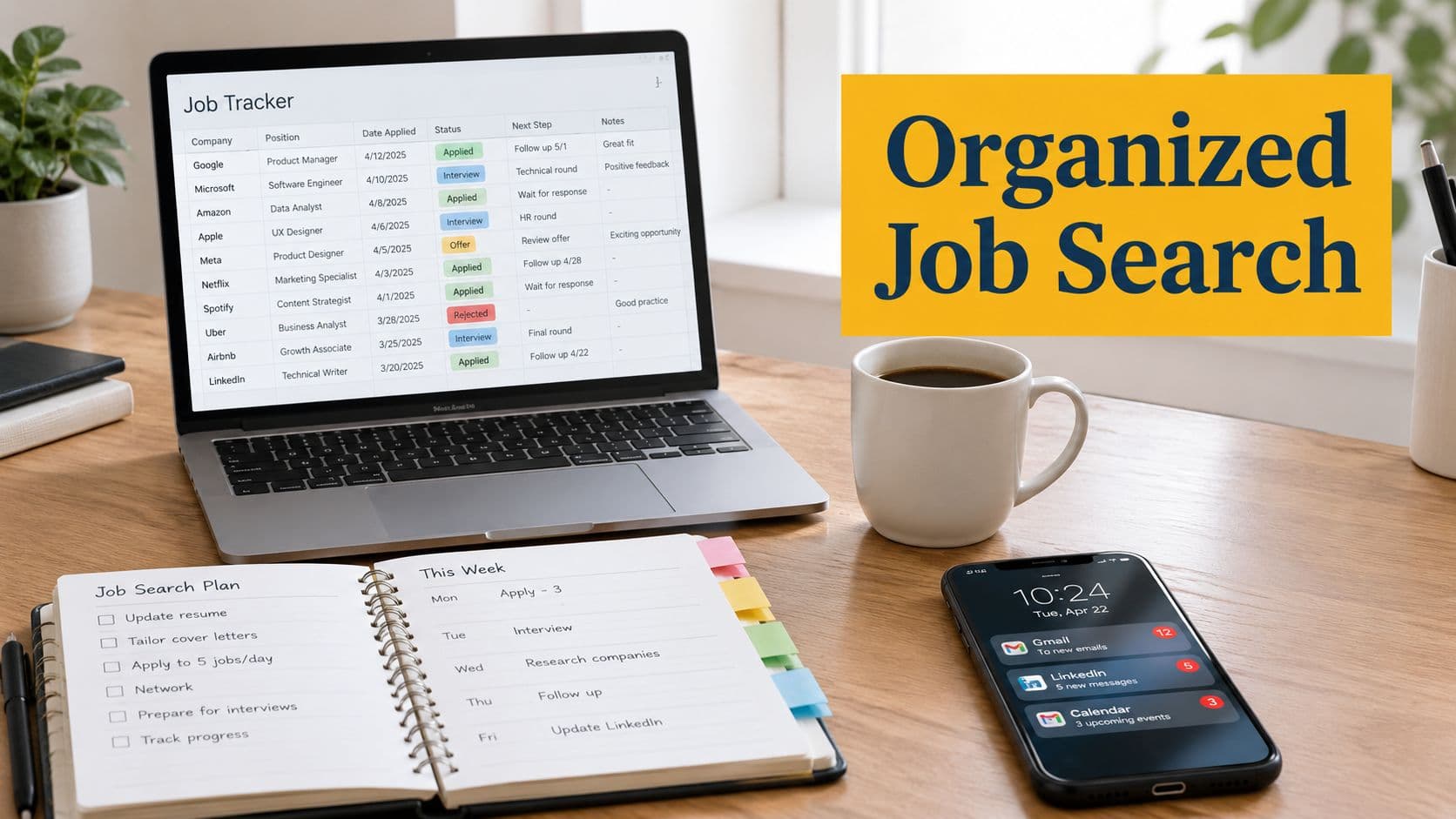
Start with one private application board. It can live in Notion, Airtable, Google Sheets, Trello, or a dedicated job-search product. The platform matters less than the discipline: every active opportunity must have one record, and every record must use the same core fields.
Create these columns before you begin adding roles:
- Company and role: Use the exact employer name and job title.
- Application URL and source: Record the page where you applied and whether the lead came from Google, a company career site, LinkedIn, a recruiter, a referral, or an aggregator.
- Date submitted: Use a real date, not “last week.”
- Resume version: Note the file or tailoring angle you used.
- Current stage: Choose controlled labels such as saved, applied, recruiter contact, screening, interview, final stage, offer, rejected, withdrawn, or closed without response.
- Next action and due date: Every active row needs a next step, even if that step is “wait until follow-up date.”
- Outcome and notes: Store the response, interview details, compensation context, and reason for withdrawal where known.
The board should answer three questions immediately: What is active? What happens next? What have I learned? If it can't, you've built an archive rather than an operating system.

Add the communication layer
A separate job-search email can reduce clutter, but only if you review it consistently. An optional Agentic Inbox can connect job-related messages to the correct application, which prevents a recruiter reply from sitting in an unrelated personal thread. The useful principle isn't automation for its own sake. It's preserving the relationship between the message, the employer, the role, and your next action.
For candidates who want a ready-made structure, this guide to tracking job applications provides a practical reference for keeping roles, stages, dates, and outcomes together. Whether you use that approach or build your own board, establish a hard rule:
If it isn't recorded, it didn't happen in your job search.
Don't create twenty status labels. Too much detail makes maintenance harder and encourages skipped updates. A compact pipeline is easier to trust, especially when you're managing several employers at different speeds. Update the row immediately after applying, after every call, and after every meaningful email. Record the next action before moving to another task.
Tracking Sources and Channel Performance
A tracked search can contain 179,363 saved jobs and 32,082 customized resumes, yet still hide which channels deserve your time. Applications differ by source, intent, and route into an employer's hiring system. If your board records only the company and submission date, you measure activity rather than performance.
In Huntr's Q2 2026 tracked data, interview rates varied by application source, according to CareerAgents' analysis of the dataset:
| Application Source | Interview Rate |
|---|---|
| Google-sourced applications | 7.91% |
| Employer career sites | 6.42% |
| ATS-domain submissions | 5.29% |
| Job boards and aggregators | 3.82% |
| 3.36% |
The highest listed rate was more than twice the lowest. That doesn't prove Google is the better route for every profession, and it doesn't make LinkedIn useless. It shows why your records should guide channel allocation. A source may help you discover suitable roles while performing less well as the final application route.
Compare like with like
Add enough context to each application for a fair comparison. Record whether the submission was customized or sent quickly, whether it came through a referral or a cold application, and what your team counts as an interview. Otherwise, one label combines different levels of effort and different outcomes.
Review the board for answers to practical questions:
- Which sources produce recruiter contact?
- Which sources produce interviews instead of acknowledgments?
- Which employers move candidates beyond the initial screen?
- Which resume versions appear in the strongest outcomes?
- How long does each channel take to produce a meaningful response?
The median time from the first saved job in a tracked search to a recorded first offer was 82 days in the Huntr Q2 2026 dataset, as noted in the same CareerAgents analysis. Historical notes therefore matter. One quiet week cannot tell you whether a channel works, especially when employers move at different speeds.
Raw volume remains useful when a role category is broad and the available pool is large. Once your board has enough history, shift effort toward sources that produce progression. Keep discovery channels where they help, but judge the final route by recruiter contact, interviews, and advancement. The aim is not to apply everywhere. Each application should produce evidence you can use to refine the next one.
Building Follow-Up Routines That Work
Follow-up fails when candidates treat it as a vague intention. Put the date on the application record when you submit, then make the next action visible before the role disappears beneath newer entries.
Independent career guidance summaries report that 57% of job seekers never follow up after applying, while follow-up within roughly one to two weeks is associated with an approximately 20% lift in callback rates, according to Huntr's Q2 2026 job-search trends research. The exact outcome will vary by role and employer, but the operational lesson is stable: silence after applying shouldn't automatically end the process.
Use a restrained schedule:
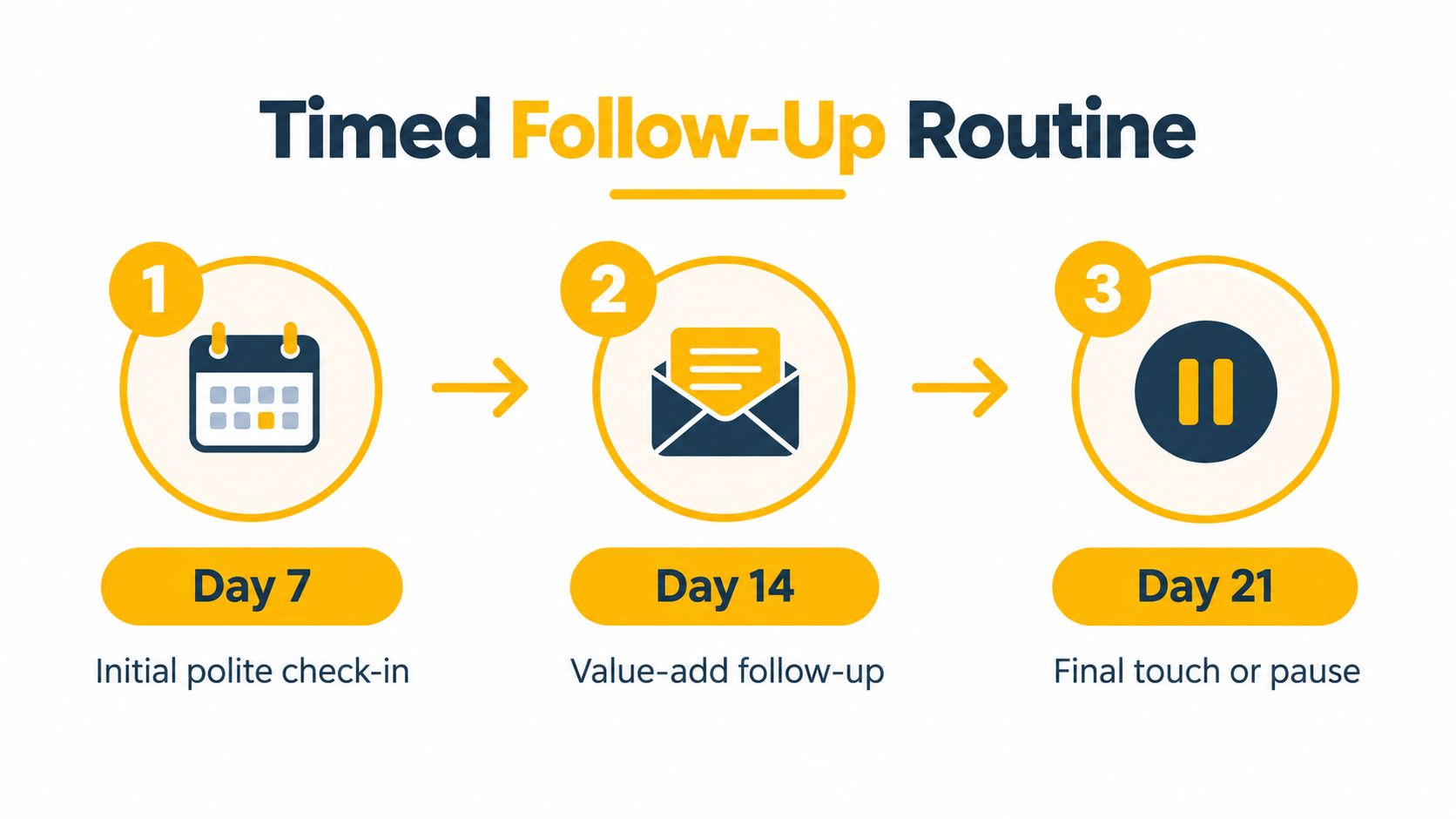
- Day 0: Submit the application and save the job description, resume version, source, and contact details.
- Day 5 to Day 7: Send a brief, polite check-in if you have a relevant contact or an appropriate channel. Confirm interest and add one useful piece of context.
- Around Day 14: Send a second message only when you can add value, such as a relevant project, answer, or clarification.
- Day 21: Mark the opportunity for a pause or closure unless the employer has given you a different timeline.
The last step protects your attention. A follow-up routine shouldn't turn into repeated nudging that consumes your week or damages your judgment.
Keep both sides of communication intact
Candidates can become part of the ghosting problem through disorganization. An Indeed report based on surveys of 4,516 job seekers and 4,517 employers found that 61% of U.S. job seekers said they had ghosted between two and four employers in the previous 12 months. That may reflect overloaded searches, uncertainty, or poor inbox management, but the professional consequence is the same: a recruiter or hiring team is left without closure.
A dedicated email, clear reminders, and a single conversation record reduce accidental silence. Use this practical job-application follow-up framework to write messages that are short, specific, and easy to answer. If you've accepted another offer, withdrawn interest, or need more time, record that outcome and communicate it promptly.
Using Employer Responsiveness as a Signal
Candidates usually evaluate employers by compensation, role scope, brand, and interview questions. They should also evaluate responsiveness. A company that repeatedly leaves applicants without closure is giving you information about how its hiring process operates, even if the role description looks attractive.
In iHire's 2025 State of Online Recruiting Report, 59.0% of candidates identified applying without hearing back as a top challenge, while 59.7% identified ghosting as a top frustration, as reported in iHire's candidate and employer findings. A separate Fortune report citing Criteria's 2026 findings reported that 53% of job seekers experienced ghosting within the last year, with 48% ignored in 2025 compared with 38% in 2024.
These numbers don't tell you whether a particular vacancy is worth pursuing. They do justify treating employer behavior as a search input rather than a private annoyance.

Make the signal useful
Don't rely on one anecdote or a frustrated forum comment. Compare aggregated outcomes, then apply judgment. A company with limited information shouldn't be treated the same as one with a consistent record of responses or silence.
Before investing time in a customized application, check:
- Available outcome history: Is there enough candidate-reported information to provide context?
- Process consistency: Do candidates report movement after screening, or frequent disappearance?
- Communication quality: Does the employer give timelines and update them?
- Your opportunity cost: Would another application, referral conversation, or interview preparation use your time better?
GhostedBy's shared-record model makes this information visible through aggregated company-level outcomes rather than written reviews. Candidates can check a company's record, privately track applications, and report whether the employer responded, closed the process, or went silent. The record uses verified contributors, keeps individual application details private, and shows a percentage only after five eligible outcomes, so a small sample remains identifiable as limited context. See what candidate experience means in practice before deciding how much weight to give any employer signal.
The contrarian point is simple: silence is not neutral data. It shouldn't automatically disqualify an employer, but it should influence how much unpaid effort you're willing to invest and whether you keep the role active in your mental queue.
Weekly Job Search Operating Rhythm
A board stays useful only when it reflects reality. Set a recurring weekly review and keep it short enough that you won't avoid it.
Use the same sequence each time:
- Update stages: Move every active application to its real current state.
- Check communication: Review the dedicated inbox and reconnect any messages that aren't attached to a role.
- Send due follow-ups: Complete only the messages whose dates have arrived.
- Audit sources: Look for channels producing contact or interviews, not just applications.
- Review employer signals: Check whether new outcome information changes where you spend effort.
- Close stale records: Mark withdrawals, rejections, pauses, and unanswered processes clearly.
This rhythm separates maintenance from emotional reaction. You won't need to re-read every old email when deciding what to do next, and a quiet employer won't consume attention that belongs to an active conversation.
The best organized job search feels almost boring. That is a feature. Your system should make the next action obvious, preserve communication continuity, and give you enough evidence to adjust course without treating every unanswered application as a verdict on your ability.
GhostedBy lets candidates keep applications, stages, dates, conversations, and outcomes in one private board while checking aggregated company response and ghosting records before applying. Visit GhostedBy to bring employer responsiveness into the same organized job-search workflow as your applications and follow-ups.