
Candidate experience is how job seekers are treated across the full hiring cycle, from sourcing to onboarding, and the most visible sign of it now is whether a company responds or ghosts. In Greenhouse's 2024 State of Job Hunting Report, 61% of job seekers said they had been ghosted after a job interview, and 18% to 22% of jobs posted on the Greenhouse platform in any given quarter were classified as ghost jobs, which makes silence a measurable hiring outcome, not just a feeling.
You might be sitting on your phone right now, waiting for an update after an interview that seemed to go well. That wait is where candidate experience becomes real, because it's no longer about polished language or a nice careers page, it's about whether a company closes the loop when it said it would.
Core idea: candidate experience is the sum of every candidate's observations and reactions across the hiring cycle, and that includes the moments when nobody replies.
Table of Contents
- Introduction to What Candidate Experience Really Means
- Understanding the Core Concept Behind Candidate Experience
- Why Candidate Experience Matters for Trust and Reputation
- Key Aspects That Shape How Candidates Feel Treated
- How to Measure Candidate Experience With Response and Ghosting Data
- Real World Examples of Candidate Experience Made Visible
- What Good Candidate Experience Looks Like Going Forward
Introduction to What Candidate Experience Really Means
A lot of people hear candidate experience and think it means being polite in interviews. That's too narrow. The term covers the entire hiring journey, and the experience is shaped by what happens before a candidate applies, while they wait for updates, during interviews, and after decisions are made.
The confusion usually starts because hiring feels personal, but the process is operational. One recruiter's timely follow-up can create trust, while one silent hiring team can undo it in a day. That's why candidate experience now matters as a process outcome, not just a brand impression.
A useful way to think about it is like a restaurant reservation. The menu matters, but so do the confirmation email, the wait time, the seating, and whether anyone checks on you after the meal. Hiring works the same way, each touchpoint changes how the whole process feels.
Candidate experience is also different from employer branding. Branding is the promise, but experience is what candidates live through. A company can write warm copy and still leave applicants in the dark, and that gap is exactly where trust breaks down.
If you're trying to judge a hiring process, the right question isn't only “Did they seem nice?” It's “Did they communicate clearly, did they treat my time with respect, and did they finish the process cleanly?” Those are the signals that turn a vague impression into a reliable standard.
Understanding the Core Concept Behind Candidate Experience
Think of candidate experience as a chain of small handoffs. If one link is weak, the whole chain feels weaker, even if the rest is solid. A candidate doesn't experience sourcing, application, interview, selection, and onboarding as separate departments, they experience one continuous journey.
The five-stage cycle
The cycle starts with sourcing, where a person first sees the role. Then comes the application, where they decide whether the process feels worth their time. After that, the interview stage tests whether the company can communicate, prepare, and show respect under pressure.
Selection is where the organization makes decisions and explains them, or fails to explain them. Onboarding is the final handoff, and it matters because the relationship doesn't magically improve once an offer is signed. The whole cycle is connected, which is why a weak response after interviews can color everything that came before it. A candidate may forget a polished job ad quickly if the follow-up disappears.
The easiest analogy is customer service in a bank. If the lobby looks good but nobody answers the phone, people still leave frustrated. Hiring works the same way, the visible front end matters, but reliability across the full path matters more.
A single vague update can be forgivable. Repeated silence turns the process into a trust problem.
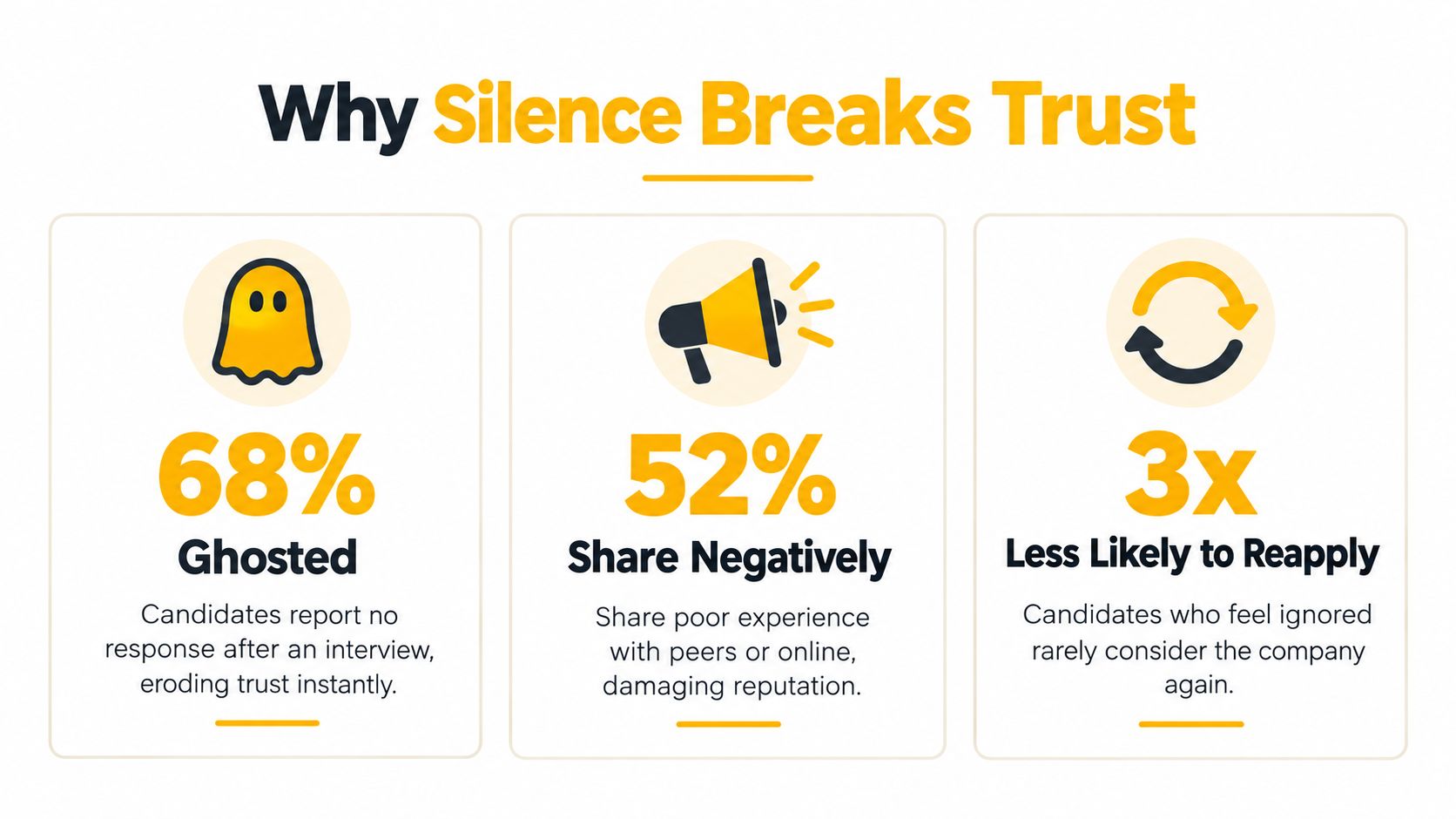
That is why the concept isn't just about satisfaction. It's about whether the company behaves in a way that makes the next step feel real. When candidates can't tell whether a process is genuine, their reaction is shaped by uncertainty, not excitement.
Why Candidate Experience Matters for Trust and Reputation
A candidate who waits for a reply is not just waiting for news. They are watching for a pattern. If communication stops after an interview, the company's reliability becomes visible in the same way a broken checkout line becomes visible in a store, slow, confusing, and hard to trust.
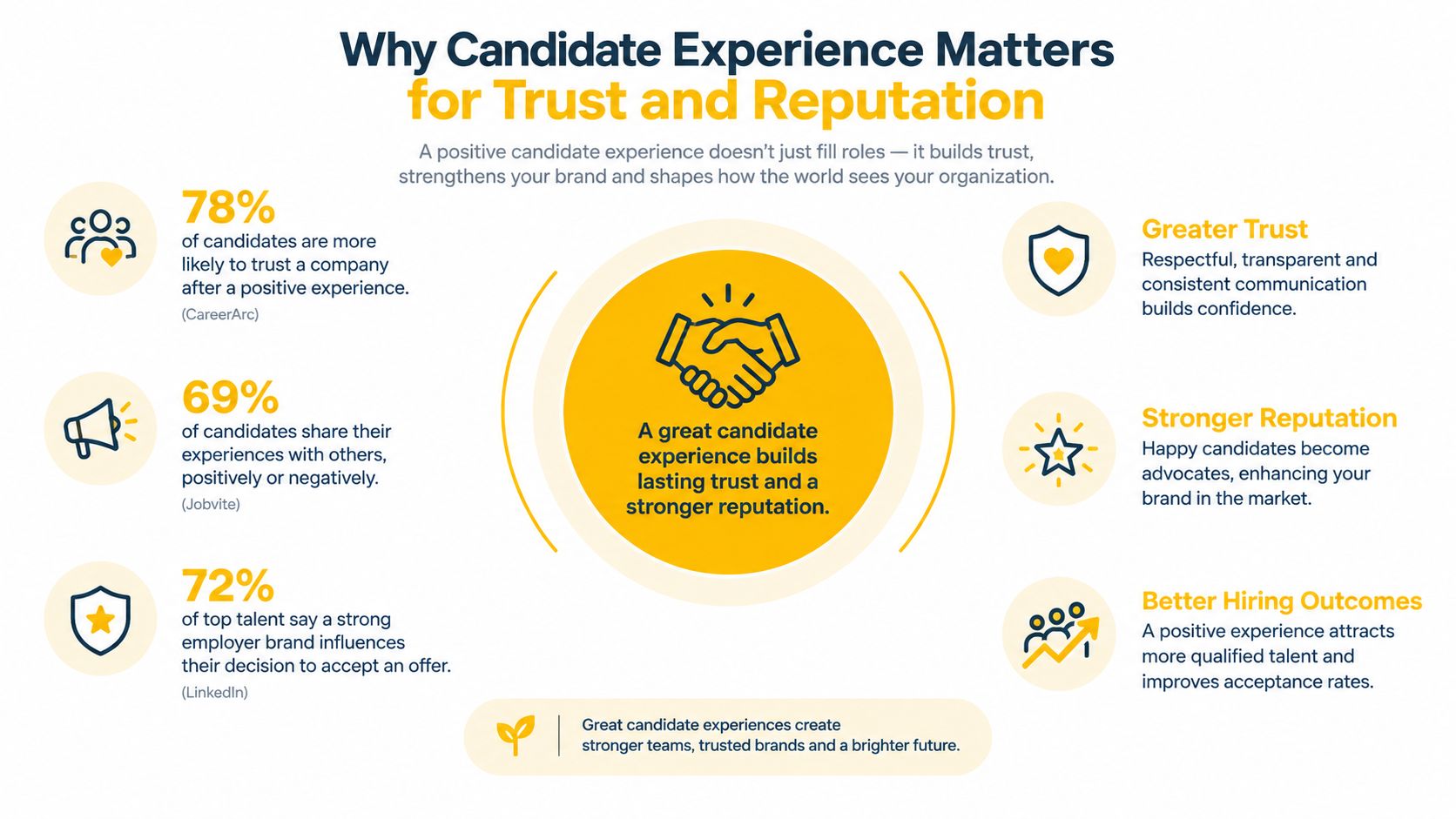
Greenhouse's 2024 State of Job Hunting Report shows how that pattern feels from the candidate side. 61% of job seekers said they had been ghosted after a job interview, and historically underrepresented candidates reported even higher rates of post-interview ghosting at 66% versus 59% for white candidates (iHire summary of the Greenhouse report). That is not just a brand impression. It is communication reliability that candidates can compare across employers.
What silence does to future behavior
Silence changes what people do next. In a 2026 survey summarized by SelectionLab, 64.6% of candidates had been ghosted during an application at some point, 22.3% said they would never apply to that company again, and only 4.2% shared the experience online (SelectionLab summary). Most of the impact stays out of public view, which is why the reputational cost is easy to underestimate. The candidate may not post about it, but they still decide whether the company deserves another try.
The pattern also reaches beyond a single hiring team. Indeed's ghosting research, based on surveys of 4,516 job seekers and 4,517 employers, found that 61% of U.S. job seekers had ghosted two to four employers in the prior 12 months, while 37% of Canadian and 36% of U.K. job seekers said the same (Indeed ghosting research summary). On the employer side, about 80% of hiring managers said they had ghosted candidates by stopping communication without explanation. The behavior runs both ways, so trust breaks down from either side of the process.
Employer reviews and hiring reputation also shape how candidates interpret silence. Once that reputation exists, every quiet inbox feels like proof.
Why high-volume hiring makes this harder
High application volume makes silence more likely, because follow-up breaks down when process design is weak. A recruiter can be polite and still leave candidates unsure if anything is happening. The issue is not tone alone. It is whether updates arrive on a dependable rhythm that people can trust.
That is why candidate experience belongs in hiring metrics, not just employer branding. It shapes whether applicants believe the pipeline is real, whether they return later, and whether the team sounds credible when it says a role is open.
Key Aspects That Shape How Candidates Feel Treated
A candidate's experience is built from small moments that add up. A job post can look promising, then lose credibility if the first reply takes too long. An interview can go well and still leave a bad impression if the next step is unclear. Candidates notice these gaps because they are trying to read the process the way a tenant reads a lease, line by line, for signs of what happens next.

Communication reliability beats polished language
Tone matters less than follow-through. A company can sound friendly and still leave people guessing, while another can use plain language and keep its word. Candidates usually forgive simple wording before they forgive silence.
The company hiring practices guide is useful here because hiring behavior shows up in patterns, not slogans. If updates only appear when someone remembers to send them, the process feels random. If updates arrive on a steady rhythm, the process feels organized and dependable.
Genuine roles and transparent steps
A role also has to be real. Ghost jobs and vague hiring steps create a different kind of frustration, because candidates may invest time in openings that were never clearly actionable in the first place. Greenhouse platform data showing 18% to 22% of jobs in any quarter were classified as ghost jobs points to that problem without any polish around it.
A few practical signals usually shape how the process feels:
- Clear timelines: Candidates should know when the next update is expected.
- Stage visibility: People want to see where they are in the process instead of guessing.
- Consistent follow-up: One missed reply can happen, repeated silence becomes a pattern.
- Real openings: If a role is not being filled, the candidate's time is being spent on fiction.
Practical rule: if a candidate cannot tell what happens next, the process already feels unreliable.
That is why hiring operations should treat communication like a service promise. A recruiter does not need perfect scripts to create trust. They need clear steps, honest openings, and response habits that candidates can rely on.
How to Measure Candidate Experience With Response and Ghosting Data
Candidate experience gets clearer when you stop treating it as a mood and start measuring outcomes. The most useful measures are the ones that show whether communication happened, when it happened, and what happened after the last relevant contact.
A simple way to count silence
Ghosting metrics matter because they make silence comparable across companies. GhostedBy defines an application as ghosted after 21 days without a response following the last relevant contact, and it requires five eligible outcomes before a Ghosted Rating percentage appears. That threshold keeps the record from swinging wildly on tiny sample sizes.
| Metric | What It Measures | Why It Matters |
|---|---|---|
| Response rate | How often a company replies after a candidate reaches out or advances | It shows whether communication is reliable |
| Ghosting rate | How often candidates report no response after the last relevant contact | It turns silence into a countable outcome |
| Stage drop-off | Where candidates stop hearing back in the process | It helps teams see which stage is leaking trust |
| Outcome count | How many eligible results exist before a percentage is shown | It keeps the comparison fair and stable |
The table works because it separates feeling from evidence. A review might say a process felt bad, but a record of outcomes tells you whether the problem happened once or repeatedly. That difference matters if you're comparing employers before you apply.
Subjective reviews versus aggregated outcomes
Written reviews can be emotional, selective, and hard to compare. Aggregated outcomes are less personal, but they're easier to use when you want a consistent signal. That's the central tradeoff: comments explain the story, while counts show the pattern.
Tracking job applications also helps you preserve your own record of response patterns, which is useful because memory gets fuzzy fast during a long search. If you log who replied, when they replied, and where the process stopped, you can spot whether silence is random or structural.
A good metric doesn't just describe the past. It helps you decide where to invest your time next.
The best measurement systems don't try to capture every emotion. They capture repeatable outcomes, and that's enough to reveal whether a company closes the loop or leaves candidates guessing.
Real World Examples of Candidate Experience Made Visible
A candidate opens two company profiles on the same day. One shows a Ghosted Rating built from reported outcomes, a clear record of replies, and a private board that keeps the search organized. The other offers only a polished careers page and a few vague testimonials. The difference is simple, one company feels attractive, the other is easier to compare.
Candidate experience becomes clearer when it is measured like communication reliability, not brand polish. A hiring process is a lot like a store checkout line, if the clerk disappears halfway through, the line still exists, but no one knows whether to wait. Response windows and ghosting rates make that silence visible.
What visible records add
GhostedBy turns individual reports into company-level patterns. Contributors verify their email address before their outcomes affect the public record, individual identities stay private, and company information appears only in aggregate. That structure gives candidates something more useful than a single frustrated comment, it shows whether silence is rare or repeated.
The private board also solves a practical problem. Job searches scatter dates, stages, and follow-ups across inboxes, notes, and memory. Keeping everything in one place makes it easier to see which employers answer within the window they set and which ones leave candidates waiting without explanation.
A concrete comparison
A candidate reviewing two similar employers might see one company with 47 eligible outcomes and a 34% ghosting rate, and another with 52 outcomes and a 12% ghosting rate. If both records use the same 21-day window and the five-outcome threshold, the comparison is much easier to trust. The candidate is no longer guessing from tone or branding, they are comparing communication behavior.
That kind of record changes the planning conversation. A role with a strong salary and title still deserves scrutiny if the response pattern is weak. A role with less shine can look more credible if the company closes the loop consistently.
Two practical questions usually matter most:
- Can I see enough outcomes to trust the pattern?
- Does this company respond often enough to make the process predictable?
These examples show why candidate experience is not just a feeling after the interview. Once response windows, ghosting rates, and company-level outcomes are visible, employers can be compared on follow-through, not just on presentation.
What Good Candidate Experience Looks Like Going Forward
Good candidate experience is less about sounding polished and more about closing the loop reliably. A company can write great job ads, run friendly interviews, and still create a bad experience if it leaves people waiting without explanation. The standard is not perfection, it's follow-through.
The easiest way to evaluate a company is to ask a few direct questions before you invest more time. Do they explain the process clearly? Do they respond when they say they will? Do they make the next step visible enough to trust? If the answers are fuzzy, the experience will probably be fuzzy too.
That's where the whole picture comes together. Candidate experience starts as a full-cycle concept, becomes measurable through response and ghosting data, and becomes actionable once the record is visible. When hiring teams treat silence as a process failure, candidates spend less time guessing and more time making informed choices.
Transparency helps both sides. Candidates waste less effort on dead-end applications, and employers build a pipeline that feels credible instead of opaque.
If you want to see how response patterns and ghosting outcomes look in practice, GhostedBy lets candidates check company records, track applications privately, and report what happened after they applied. It gives this topic a measurable layer, which helps you compare employers before you spend more time on a role.