Submitting more applications isn't automatically a better job-search strategy. A large controlled study cited by job-search statistics reporting found that only 24% of applications received any employer contact within 30 days, while only 4 to 6 out of every 100 applicants are interviewed and 1 is hired. More volume without better decisions can leave you with a crowded inbox, duplicated applications, and no clear view of which opportunities are still active.
A more deliberate search treats each application as part of a measurable pipeline. You evaluate a company's responsiveness before investing your time, prioritize targets by likely candidate experience, record every stage, follow up at a defined point, and close inactive applications instead of waiting indefinitely. This protects your attention while giving you useful data for the next round.
The following job search tips work as a connected system, not isolated tricks. You can use GhostedBy optionally to check aggregated candidate outcomes, organize applications privately, connect job-search emails, and report what happens after you apply. The aim isn't to predict every hiring decision. It's to make your own decisions faster and with better evidence.
Table of Contents
- 1. Check Company Ghosting Ratings Before Applying
- 2. Organize All Applications in One Private Tracking Board
- 3. Report Application Outcomes to Build Collective Candidate Visibility
- 4. Set the 21-Day Ghosting Window as Your Follow-Up Deadline
- 5. Use a Dedicated Job-Search Email for Clean Communication Tracking
- 6. Create a Target Company List and Prioritize by Response Rate
- 7. Follow Up Strategically at Day 10 to 14 Before Ghosting Sets In
- 8. Track Interview Dates and Outcomes to Identify Response Patterns
- 9. Diversify Applications Across Response-Rate Tiers for Sustained Momentum
- 10. Document Everything and Build Your Own Hiring Insights Record
- Top 10 Job Search Tips Comparison
- Turn a Scattered Search Into a Manageable System
1. Check Company Ghosting Ratings Before Applying

Before you tailor a resume or write a cover letter, investigate how the employer communicates with candidates. A company's Ghosting Rating shows the share of reported outcomes in which candidates received a response versus being left without one. That makes candidate experience a practical input alongside role fit, compensation, location, and mission.
The rating shouldn't determine your decision on its own. A dream role may still justify applying to an employer with a weaker record, while a highly responsive company may offer poor work conditions or limited progression. The useful comparison is between otherwise similar targets. If two employers offer comparable opportunities, responsiveness can help you decide where to spend your limited preparation time first.
GhostedBy uses aggregated outcomes rather than written reviews or subjective employer scores. Individual applications and identities remain private, while verified contributor reports can contribute to a company-level record. You can learn more about the value of candidate experience data before building this check into your routine.
Practical rule: Treat a Ghosting Rating as a risk signal, not a verdict. Look at the available outcome count, compare similar employers, and combine the result with the factors that matter most to you.
Make the process repeatable. Search each target company before applying, note the rating and outcome context in your board, then decide whether the opportunity belongs in your highest-priority group.
2. Organize All Applications in One Private Tracking Board

A job search becomes difficult to manage when applications live across browser tabs, saved documents, personal notes, and several email folders. Use one private board to record the employer, role, source, application date, current stage, last contact, next action, and final outcome. The board turns memory into an operating system for your search.
Silence is common. Greenhouse's 2024 State of Job Hunting Report found that 61% of U.S. job seekers said they'd been ghosted after a job interview, up 9 percentage points from April 2024. Historically underrepresented candidates reported an even higher rate, 66% versus 59% for white candidates. Those findings make post-interview tracking just as important as application tracking.
Update the board within 24 hours of every application, email, screening, and interview. Add a next date rather than leaving an item with an indefinite status. A weekly review can then separate active opportunities from applications that need a follow-up or a closure decision.
The application tracking approach described by GhostedBy can help you keep stages, dates, and outcomes together privately. Whether you use a dedicated tool or a spreadsheet, the essential feature is consistency.
Use clear stages such as:
- Applied: Record the exact submission date and job-posting source.
- Contacted: Save the recruiter's name, message, and requested action.
- Interviewing: Log each conversation and the next expected decision.
- Closed: Mark the result as response, rejection, offer, withdrawal, or silence.
3. Report Application Outcomes to Build Collective Candidate Visibility
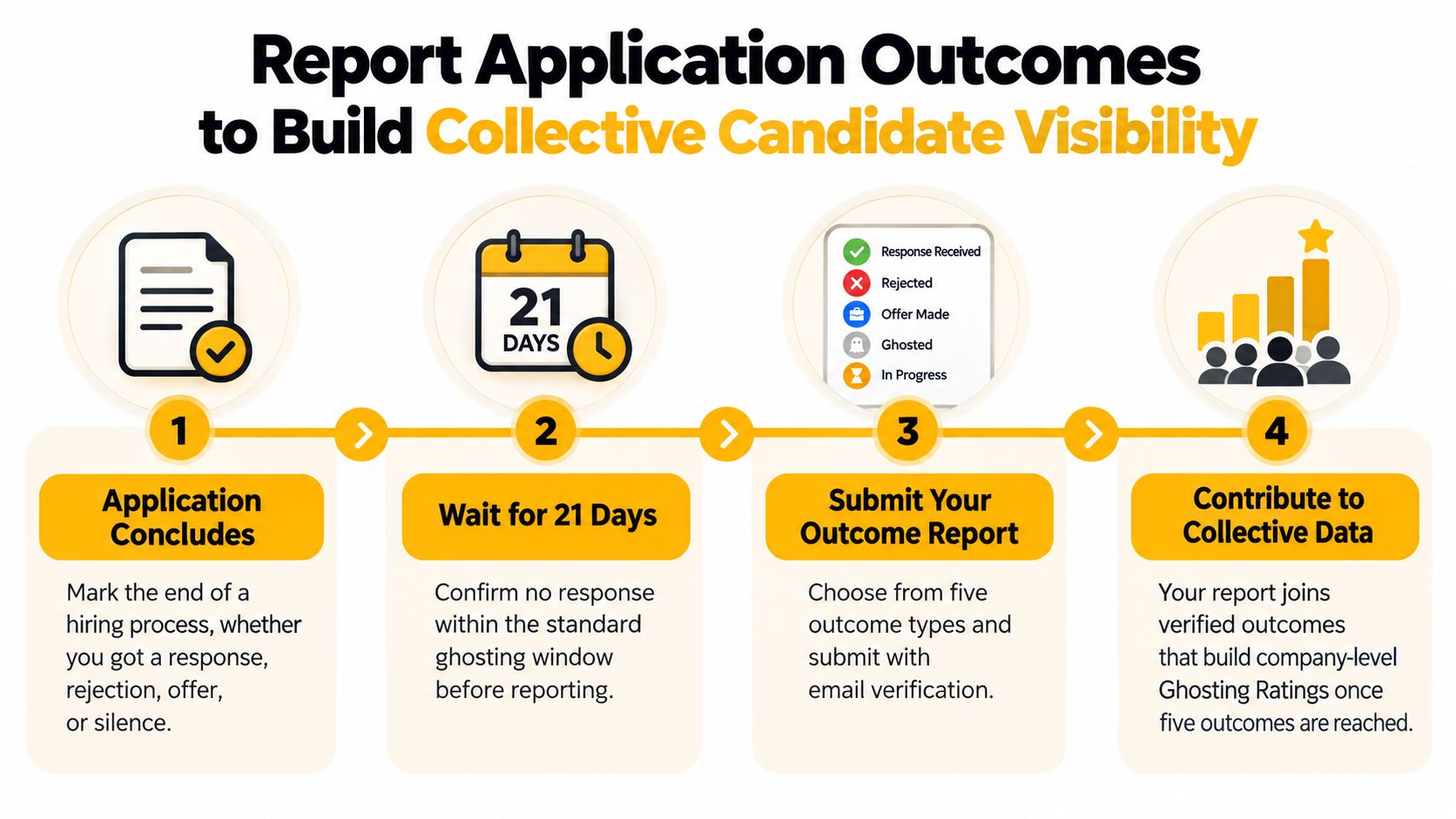
Hiring silence usually disappears into a candidate's personal inbox. Reporting what happened creates a broader record that can help other people evaluate employers before they invest time. The outcome could be positive, negative, incomplete, or unresolved. Each category adds more useful context than an application that vanishes from your notes.
GhostedBy's model is based on structured outcomes, not anonymous written reviews. Contributors verify their email address before their outcomes can affect the public record, and individual identities, roles, applications, and dates remain private. Companies need five eligible outcomes before a Ghosted Rating percentage appears, so a small record can be viewed with more caution.
Report soon after the process ends. Dates and communication history are easier to recall immediately, and a prompt report gives you a clean psychological endpoint. You're not trying to punish an employer or reward one. You're recording whether the process produced a response and helping distinguish an isolated experience from a broader pattern.
A positive response is data too. Reporting a timely rejection or a clear close prevents the public record from reflecting only bad experiences.
Use a simple reporting routine:
- Confirm the last contact: Identify the message, interview, or decision that ended the active process.
- Record the outcome accurately: Don't label an application ghosted while a stated decision date is still open.
- Submit both good and bad experiences: Balanced reporting makes company-level patterns more useful.
- Close your private record: Add what you learned and move your attention to active prospects.
For situations that become silent after advanced interviews, guidance on being ghosted after a final-round interview provides relevant context. Reporting turns an uncertain experience into a documented decision.
4. Set the 21-Day Ghosting Window as Your Follow-Up Deadline
Silence becomes harder to interpret when you haven't decided what it means. GhostedBy uses a 21-day window after the last relevant contact. If no response arrives during that period, you can classify the application as ghosted, report the outcome, and stop treating it as an active prospect.
The clock should begin from the latest meaningful interaction, not always from the original application. If you applied, completed a screening, and then interviewed, the interview is the relevant starting point for the next waiting period. This distinction prevents you from closing a process too early while still giving you a consistent boundary.
A 2025 iHire survey found that 53% of candidates said they'd been ghosted by an employer, with application-stage silence the most frequently reported point at 28%. The same survey recorded ghosting after multiple interview rounds at 11%, after a skills assessment at 9%, and after salary or benefits negotiation at 4%. The funnel can go quiet at any stage, so every stage needs its own date.
Set the deadline when you apply or finish an interview. Then use a day-20 reminder to decide whether one final follow-up is worthwhile.
- Before day 21: Ask for a clear timeline and offer any missing information.
- On day 21: Mark the opportunity inactive if there's still no relevant response.
- After closure: Report the outcome and redirect your effort.
5. Use a Dedicated Job-Search Email for Clean Communication Tracking
Recruiter messages are easier to manage when they don't compete with personal mail, receipts, newsletters, and unrelated work correspondence. Create a professional address for job searching, such as a firstname.lastname format, and use it consistently on applications and professional profiles. This gives every hiring conversation a common home.
A dedicated inbox also improves the quality of your tracking. You can search by employer, preserve complete message threads, and identify whether a recruiter has asked for a response or supplied a decision timeline. Check it at planned times rather than refreshing constantly. The goal is controlled visibility, not another source of distraction.
AI is already part of many candidates' workflows. Across a 1,645-person U.S. survey, 40.7% of job seekers reported using AI tools including ChatGPT, Perplexity, and Gemini to make their search more efficient, while 31.5% of non-users said they planned to try AI. The iHire survey findings support using AI as a workflow layer, not as a substitute for judgment.
You can use an optional inbox assistant to connect job-related emails to the right application board entry. Keep control over what gets sent, saved, or drafted, and review generated text before responding.

Keep the address active after accepting an offer so late-stage hiring communication and onboarding messages don't get lost.
6. Create a Target Company List and Prioritize by Response Rate
Start with a defined set of employers instead of searching the entire market without a ranking system. Include companies you admire, employers recommended by your network, and organizations whose roles match your skills and constraints. Divide them into dream targets, strong fits, and credible alternatives, then add a candidate-experience signal to each entry.
This approach reflects how candidates now discover opportunities across channels. A large U.S. recruiting survey found that 79.5% of workers rely on general job boards, while 53.8% use industry-specific or niche boards, up from 49.2% the prior year. The iHire State of Online Recruiting 2025 survey indicates that a multi-channel search can widen coverage, but it also creates more opportunities for duplicate submissions and missed follow-ups.
Track each source separately. A referral, a niche board, a company careers page, and a general job board may produce different levels of contact. You don't need to assume which channel works best. Record applications, responses, interviews, and offers by source, then direct more preparation time toward channels that produce meaningful progress for your profile.
A practical priority score can combine:
- Role fit: Does the job match your capabilities and core requirements?
- Candidate experience: Does the company show a stronger response pattern than comparable targets?
- Access: Do you have a referral, recruiter contact, or relevant connection?
- Evidence: Has this employer or channel produced useful responses in your own record?
Refresh the list when your outcomes change. Priority is a working decision, not a permanent label.
7. Follow Up Strategically at Day 10 to 14 Before Ghosting Sets In
A follow-up works best when it has a defined purpose. Send one between days 10 and 14 after applying or interviewing, while the process is still inside your 21-day closure window. The message should make it easy for the recipient to answer, not force them to reread your entire application.
Refer to something specific. You might mention a business challenge discussed in the interview, a relevant project, or a capability that connects directly to the role. Then ask for the next expected step or offer to provide information that would help the hiring team make a decision.
A short message is usually enough:
I'm still very interested in the role and enjoyed learning about the team's work on [specific topic]. Could you share the expected timing for the next step, and let me know if any additional information would be useful?
Avoid turning the follow-up into a second cover letter. You're checking process status and clarifying timing, not adding every achievement you couldn't fit into the original application. A concise message also gives you a clean record of your last relevant contact, which matters when you apply the 21-day rule.
Schedule the reminder as soon as you submit the application. Limit yourself to one follow-up unless the employer asks for more information or gives you a new date. If the company replies with a timeline, record that commitment in your board and calculate the next review date from the new contact.
A follow-up can reopen a stalled conversation, but it can't compensate for an inactive hiring process. Treat the response, or lack of one, as evidence about the opportunity.
8. Track Interview Dates and Outcomes to Identify Response Patterns
The exact interval between contacts often tells you more than a general impression of responsiveness. Record the date of every screening, interview, assessment, recruiter message, and decision. Then calculate the days since the last relevant contact so you can compare employers without relying on anxiety or memory.
Candidate ghosting occurs late in the funnel as well as early. LiveCareer's 2025 survey of 1,008 employed U.S. adults found that 25% had ghosted a potential employer during the hiring process. The reported points included 15% after submitting an application, 13% after a screening call or interview, and 8% after receiving a job offer, according to the survey summary from PIN.
Those figures create a useful two-way interpretation. You should evaluate employer communication, but also protect your own reputation by replying clearly when you're withdrawing, delaying, or declining. A candidate who wants a professional process should help maintain one.
Create a timeline for each serious opportunity:
- Interaction date: Record when the event happened, not when you remembered it.
- Elapsed time: Note how long the employer took to respond afterward.
- Expectation: Save any promised decision date or next step.
- Clock reset: Start a new waiting window after a meaningful contact.
- Outcome: Mark whether the process advanced, closed, or went silent.
Over several applications, patterns become visible. One employer may communicate consistently, while another may leave long gaps after every stage. Use that evidence to calibrate expectations and decide how much additional search activity to maintain while you wait.
9. Diversify Applications Across Response-Rate Tiers for Sustained Momentum
A search built only around dream companies creates a fragile pipeline. Those roles may be attractive, but their hiring processes can be slow or unresponsive. A stronger portfolio combines employers with a more reliable response pattern, good-fit companies with moderate uncertainty, and long-shot opportunities that deserve attention without controlling your entire week.
Think in three tiers:
- Tier 1, higher-response targets: Use these for credible opportunities and regular interview practice.
- Tier 2, strong-fit targets: Allocate substantial effort where role alignment is good but the process is less predictable.
- Tier 3, long-shot targets: Pursue ambitious opportunities while limiting the amount of time they can consume before evidence appears.
A balanced weekly allocation can be 40% to tier 1, 40% to tier 2, and 20% to tier 3, as a planning framework rather than a promise of results. Track actual responses and adjust the mix. If tier 1 produces no useful movement, the problem may be your targeting or materials, not only the employers' responsiveness.
Ghosting is widespread enough to justify this diversification. Fortune reported that in a 2026 survey, 53% of job seekers said they'd been ghosted by a potential employer in the past year, compared with 48% in 2025 and 38% in 2024. Those figures appear in Fortune's reporting on employer ghosting.
Don't interpret a tier 1 rejection as wasted effort. It can reveal which resume claims, interview answers, or role assumptions need refinement before you pursue the next tier. Momentum comes from keeping multiple decisions moving, not from waiting for one employer to validate your search.
10. Document Everything and Build Your Own Hiring Insights Record
Your application board tells you where each opportunity stands. Your personal hiring record explains what happened inside each stage. Save recruiter names, interview topics, feedback, promises, concerns, and your own assessment of the interaction. This private record becomes useful when you compare offers or prepare for a similar interview later.
The hiring process has a two-way drop-off problem. Independent research cited in 2026 found that 20% of candidates were ghosted after completing a full round of interviews. The same research reported that 83% of employers had been ghosted by a candidate, with 50% saying candidates skipped scheduled interviews and 22% saying candidates accepted offers and never showed up, as described by PRSA's discussion of hiring silence.
That context doesn't excuse employer silence. It does show why your own record should include communication quality on both sides. Note whether you replied promptly, asked clear questions, attended scheduled meetings, and withdrew professionally when the role stopped fitting.
Review your record weekly and look for repeated signals:
- Interview themes: Record recurring behavioral or technical questions and improve your examples.
- Process promises: Save start dates, compensation, benefits, and other details for offer verification.
- Communication patterns: Note who responded clearly, who changed timelines, and who stopped replying.
- Personal performance: Identify answers that felt strong and moments that need practice.
- Decision quality: Compare the role you wanted with the evidence you collected about the employer.
Keep the file confidential. It's an analytical tool for your decisions, not a public review archive.
Top 10 Job Search Tips Comparison
| Item | Implementation complexity 🔄 | Resource requirements ⚡ | Expected effectiveness ⭐ | Expected impact 📊 | Ideal use cases / Key tips 💡 |
|---|---|---|---|---|---|
| Check Company Ghosting Ratings Before Applying | Low 🔄 | Low ⚡ | ⭐⭐⭐⭐ | Faster prioritization; avoid time sinks 📊 | Pre-application screening; compare ratings and outcome counts 💡 |
| Organize All Applications in One Private Tracking Board | Medium 🔄 | Moderate ⚡ | ⭐⭐⭐⭐ | Better follow-ups; fewer lost opportunities 📊 | Active search with many apps; update within 24 hrs 💡 |
| Report Application Outcomes to Build Collective Candidate Visibility | Low 🔄 | Low ⚡ | ⭐⭐⭐ | Builds community data over time 📊 | Contributing to transparency; report promptly and accurately 💡 |
| Set the 21-Day Ghosting Window as Your Follow-Up Deadline | Low 🔄 | Low ⚡ | ⭐⭐⭐⭐ | Clear stop/start decision; reduces waiting anxiety 📊 | Use as closure rule; mark calendar and move on after 21 days 💡 |
| Use a Dedicated Job-Search Email for Clean Communication Tracking | Low 🔄 | Low–Moderate ⚡ | ⭐⭐⭐ | Fewer missed messages; cleaner thread history 📊 | High recruiter volume; use professional address and check regularly 💡 |
| Create a Target Company List and Prioritize by Response Rate | Medium 🔄 | Moderate ⚡ | ⭐⭐⭐⭐ | More strategic applications; higher ROI on effort 📊 | Build 20–30 targets; tier and refresh monthly; apply to low-ghosting first 💡 |
| Follow Up Strategically at Day 10–14 Before Ghosting Sets In | Low 🔄 | Low ⚡ | ⭐⭐⭐⭐ | Can reignite stalled conversations; increases replies 📊 | Stalled apps approaching 21 days; keep follow-up brief and ask timeline 💡 |
| Track Interview Dates and Outcomes to Identify Response Patterns | Medium 🔄 | Moderate ⚡ | ⭐⭐⭐⭐ | Reveals company behaviors; informs expectations & negotiations 📊 | Multiple interviews across companies; log dates immediately and compare timelines 💡 |
| Diversify Applications Across Response-Rate Tiers for Sustained Momentum | Medium–High 🔄 | High ⚡ | ⭐⭐⭐⭐ | Steady interview flow and better leverage 📊 | Allocate 40/40/20 across tiers; balance practice and dream roles 💡 |
| Document Everything and Build Your Own Hiring Insights Record | Medium–High 🔄 | Moderate–High ⚡ | ⭐⭐⭐⭐ | Rich personal dataset for negotiation and learning 📊 | Track recruiter names, feedback, promises; keep records confidential and review weekly 💡 |
Turn a Scattered Search Into a Manageable System
The best job search tips become useful only when they change what you do next. Start with company research before you apply, including candidate-experience signals where an aggregated record exists. Then decide whether the role belongs in your current priority tier. A strong match with poor communication evidence may still deserve an application, but you can limit preparation time and avoid treating it as your only prospect.
Give every application a stage and a next date. “Applied” isn't a useful status if it doesn't tell you when you'll check for contact, follow up, or close the record. Save the job description, resume version, recruiter messages, and interview notes in the same private system. That history lets you compare opportunities based on observed behavior rather than vague impressions.
Use one follow-up around days 10 to 14 after the latest relevant application or interview. Keep it short, specific, and easy to answer. Ask when you should expect to hear back, then record the response or promised timeline. If 21 days pass without relevant contact, make a clear decision. Mark the opportunity as ghosted or inactive, report the outcome where appropriate, and stop allocating active search time to it.
This boundary matters because silence is a measurable outcome, not an empty space. A report from LiveCareer stated that 18% to 22% of jobs posted on its platform were ghost jobs in any given quarter, a range it said had held since 2024, while the same source cited only 24% of applications receiving employer contact within 30 days. You can read that ghost-job and response-rate reporting as a reason to maintain multiple opportunities, not as a reason to stop applying.
Balance aggregated GhostedBy outcomes with role fit, personal priorities, compensation, flexibility, and the quality of the people you meet. Use the private board and dedicated email organization to reduce administrative friction. Report positive responses, clear rejections, and ghosting so future candidates can see more than subjective employer opinions.
Make the system concrete this week. Create or update your application board, choose the next small batch of target companies, assign each application a tier and next date, and schedule your first weekly review. At that review, close stale records, send the follow-up that is due, and use your outcome data to decide where the next batch of effort belongs.
GhostedBy lets candidates check aggregated company outcomes before applying, track applications privately, and report whether employers responded or went silent. Visit GhostedBy to add candidate-experience signals and clearer follow-up boundaries to your job-search workflow.