
61% of U.S. job seekers in a large 2024 Indeed survey said they had ghosted an employer at some point, while 89% of employers said candidate ghosting was a problem, which makes the issue measurable, cross-market, and impossible to dismiss as a fringe complaint Indeed ghosting in hiring insights and strategies. The more useful question isn't whether ghosting happens, it's whether the hiring process is producing candidate experience data that can be trusted as an operational record.
Candidate experience data is the set of structured outcome records that show what happened between a candidate and an employer. It tells you whether an application was acknowledged, whether interviews were scheduled, whether a process ended in an offer or rejection, and whether communication stopped long enough to count as silence.
That distinction matters because opinions and outcomes answer different questions. A survey can tell you how a person felt about the process, but outcome data tells you whether the process behaved as promised. A company can look warm and responsive in candidate feedback and still leave people waiting with no status update.
The analyst's job is to separate those two layers before drawing any conclusions. If you don't, a polite recruiter, a delayed panel, and a silent employer all collapse into the same vague impression. Once that happens, every later metric, from response rate to ghosting rate, starts to lose meaning.
Table of Contents
- What Candidate Experience Data Actually Means
- The Main Categories of Candidate Experience Data
- How Candidate Experience Data Is Collected and Verified
- How to Read Response and Ghosting Rates
- Where in the Funnel Ghosting Actually Happens
- What Candidate Experience Data Cannot Tell You
- A Practical Checklist for Reading Any Candidate Experience Record
What Candidate Experience Data Actually Means
Outcome records, not vibes
Candidate experience data starts with observable events. Someone applied, someone replied, someone scheduled an interview, someone closed the loop, or someone went silent. Those events are time-bound, and that's what makes them useful for analysis.
That's also why this data is different from Glassdoor-style commentary or post-interview sentiment surveys. Feedback captures how a person interpreted the process, while outcome records show whether the process delivered basic procedural signals on time. The difference sounds subtle until you try to compare employers, because a “friendly” process and a “responsive” process are not the same thing.
Practical rule: if the record can't be tied to a date, a stage, and a documented outcome, it's not candidate experience data, it's opinion.
Why the distinction changes the analysis
The separation keeps later metrics honest. A response rate based on actual communications means something very different from a satisfaction score based on memory or mood. When the two are blended, teams may celebrate good feedback while missing that many candidates never heard back.
A useful record answers three questions at once. What happened, when did it happen, and did the employer close the loop? If those answers aren't visible, the data may still be interesting, but it isn't operationally reliable.
That's why candidate experience data works best when it behaves like event data, not reputation data. It should be anchored to the hiring timeline, not to general impressions of whether the company seemed nice. The analyst's standard is simple, if the event can't be verified, it shouldn't be allowed to shape the company-level read.
The Main Categories of Candidate Experience Data
Candidate experience records usually fall into four buckets, and each bucket answers a different question. Mixing them together makes the overall picture look cleaner than it is, which is exactly how process failures stay hidden.
The four buckets that matter
| Category | What It Records | Unit of Measurement |
|---|---|---|
| Response data | Whether the employer acknowledged the candidate and how quickly | Application, touchpoint, or stage |
| Closure data | Whether the process ended with a clear outcome | Outcome event |
| Silence data | Gaps where communication stopped beyond the expected window | Days without contact |
| Stage-level outcome data | Where the candidate stopped moving forward in the funnel | Funnel stage |
Response data shows whether the process even started behaving like a process. Closure data tells you whether the organization ended the interaction. Silence data is the raw material behind ghosting, and stage-level outcome data shows where the breakdown occurred.
Those categories shouldn't be averaged away into one simple score. A team can respond quickly at the application stage and still disappear after final interviews. Another team may be slow at the beginning but consistent later. A single response rate hides both patterns.
Why each category needs its own denominator
Each bucket needs a different denominator to stay meaningful. Response data should be measured against the number of applications or touchpoints eligible for acknowledgment. Closure data should be measured against the set of active candidates who reached a point where closure was expected. Silence data should be measured against records that passed the communication window. Stage-level outcomes should only include candidates who reached that stage.
That structure turns candidate experience data into something you can compare across employers without flattening the funnel. It also prevents one noisy stage from distorting the whole record. If the denominator changes, the story changes, and that's the first thing an analyst should check.
How Candidate Experience Data Is Collected and Verified
A trustworthy record begins with structured submission. A candidate reports a specific application, employer, role, and timeline, including when they applied, when they last heard from the company, and what happened next. Without those fields, the record is just a complaint.
Verification is the difference between reporting and evidence
Verification narrows the field to outcomes that can be supported. That can include employer confirmation, email or portal evidence, and cross-checking the candidate's reported timeline against the documented hiring events. When those pieces line up, the record becomes much harder to dispute.
The point isn't perfection. The point is to block unverifiable claims from being treated like company-level facts. That's why a candidate report should be treated as input, not publication-ready truth, until it survives the verification layer.
Silence should be measured against a real communication expectation, not against a guess.
The 21-day window and the five-outcome threshold
The 21-day window is a safeguard against premature ghosting labels. Silence only counts after 21 calendar days have passed beyond the expected response point, which keeps legitimate slow-moving processes from being mislabeled as abandonment. This is especially important in hiring cycles where delays are common and a delayed reply isn't the same as no reply.
The five-outcome threshold is the other guardrail. A company-level percentage should only be published after there are at least five verifiable outcomes, which prevents one angry report or one unusual hiring event from creating a volatile rate.
These rules do something important together. They turn anecdote into signal. They also make candidate experience data more usable for operators, because the record is less about one person's frustration and more about a repeatable pattern that can be monitored over time.
For candidates tracking their own job search, a structured board helps keep this timeline straight. This application-tracking guide shows how to keep applications, stages, and outcomes organized without losing the chronology that makes the data credible.
How to Read Response and Ghosting Rates
Response rate and ghosting rate often get treated like opposites, but they're really two views of the same process. Response rate shows how often an employer gave any verified acknowledgment. Ghosting rate shows how often communication stopped without closure after the verification window.
Same denominator, different meaning
The cleanest way to read both metrics is to use the same base set of eligible applications. From there, response rate counts the share that received an acknowledgment, while ghosting rate counts the share that received no closure or contact after the defined silence window. If those denominators drift apart, the metrics stop being comparable.
A high response rate doesn't automatically mean a low ghosting rate. An employer can answer quickly at the start and then disappear later. That pattern is structurally different from a company that never replies at all, and the distinction matters because the funnel failure is not the same.
What each metric leaves out
Response rate says nothing about tone, specificity, or fairness. A generic rejection email and a thoughtful personal note both count as responses, even though they're not equivalent experiences. Ghosting rate also doesn't reveal why someone disappeared, only that the process crossed the silence threshold without closure.
That makes both metrics useful as leading indicators, not final verdicts. They tell you where the process is breaking, but not whether the communication was warm or whether the rejection was well handled. If you need those answers, you need deeper process data.
The 2023 Indeed ghosting report is a good reminder that late-stage silence isn't rare. It found 40% of job seekers said they had been ghosted after a second- or third-round interview, up from 30% in 2022, which shows that response metrics can deteriorate deep in the funnel Indeed ghosting report PDF. That's why a clean rate pair matters more than a single headline number.
For readers who want to look at one concrete stage, Ghosted after final round interview is the kind of case where a response rate alone can miss the point.
| Dimension | Response Rate | Ghosting Rate |
|---|---|---|
| Core meaning | Verified acknowledgment occurred | Verified silence continued past the window |
| What it measures | Contact | Non-response after expectation |
| Best use | Early funnel visibility | Process breakdown visibility |
| Main limitation | Doesn't show quality | Doesn't show reason |
Where in the Funnel Ghosting Actually Happens
Silence doesn't happen in one place, and aggregate rates hide that. The useful question is where candidates stop hearing back, because the stage tells you what kind of process failure you're looking at.
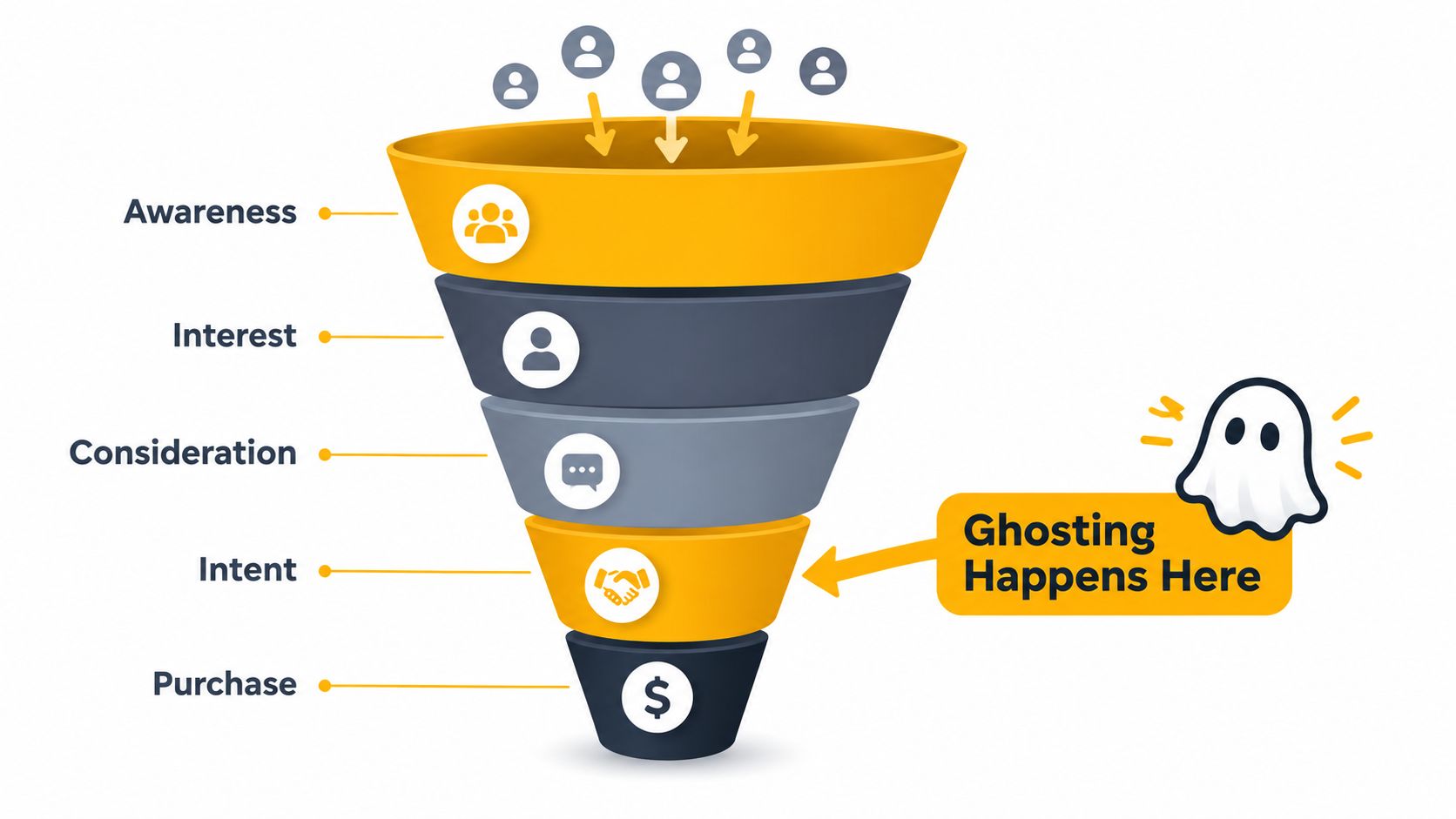
Four points where silence usually shows up
After application submission, silence often looks like no acknowledgment at all. After a recruiter screen, it looks like a stalled follow-up or a missing next-step email. After a technical or onsite interview, the gap usually becomes more visible because expectations are higher. After a final round or reference check, silence becomes especially costly because the candidate has already invested the most time.
The most useful metric here is stage-level ghosting. You divide the number of candidates who report silence at a specific stage by the number who reached that stage. That keeps the denominator honest and prevents early-stage volume from drowning out later-stage breakdowns.
The recent reporting on silence across multiple stages supports that approach. One independent survey found 67% of candidates felt ghosted after submitting applications, while later-stage silence still appeared after multiple rounds, skills assessments, and salary negotiation Virtual Vocations survey summary. The operational lesson is that silence is not a single event, it's a pattern that shifts by stage.
Why stage shape matters more than the headline rate
Two employers can have the same overall ghosting rate and very different problems. One may fail at first response, while the other handles screening well and then collapses near the end. Those are not interchangeable, because the fix is different in each case.
Stage-level analysis also helps teams avoid overreacting to tiny samples. A stage with very few verified outcomes can swing wildly, so it should be flagged as unstable instead of treated like a trend. That's a better standard than averaging everything into one number and pretending the shape doesn't matter.
A single percentage can tell you there's smoke. The funnel tells you where the fire started.
What Candidate Experience Data Cannot Tell You
Candidate experience data is strong on outcomes and weak on context. It shows what happened in the hiring process, but it can't always explain why it happened.
A response record can't distinguish between a generic rejection and a thoughtful one. Both are responses, but only one may leave the candidate feeling respected. That limitation matters because process metrics can look healthy even when the human experience is mediocre.
The data is also blind to internal disruptions. Requisition freezes, panel conflicts, and hiring manager turnover can all create silence that looks like neglect from the outside. Unless those events are recorded elsewhere, the candidate-facing record can't separate process failure from operational interruption.
It also can't measure fairness, bias, or interview quality by itself. Those questions require process logs, interviewer data, and often demographic analysis, which live in systems beyond the candidate-submitted outcome record. A clean ghosting rate is not a substitute for a fair hiring process.
The clearest way to say it is this. Candidate experience data is a record of reported behavior, not a full satisfaction score. It's useful because it captures what the company did, but it becomes misleading when people treat it like a complete evaluation of the hiring system.
For teams comparing candidate signals with internal process policies, GhostedBy's hiring practices overview shows how structured outcome records sit alongside broader employer behavior without pretending to explain everything.
A Practical Checklist for Reading Any Candidate Experience Record
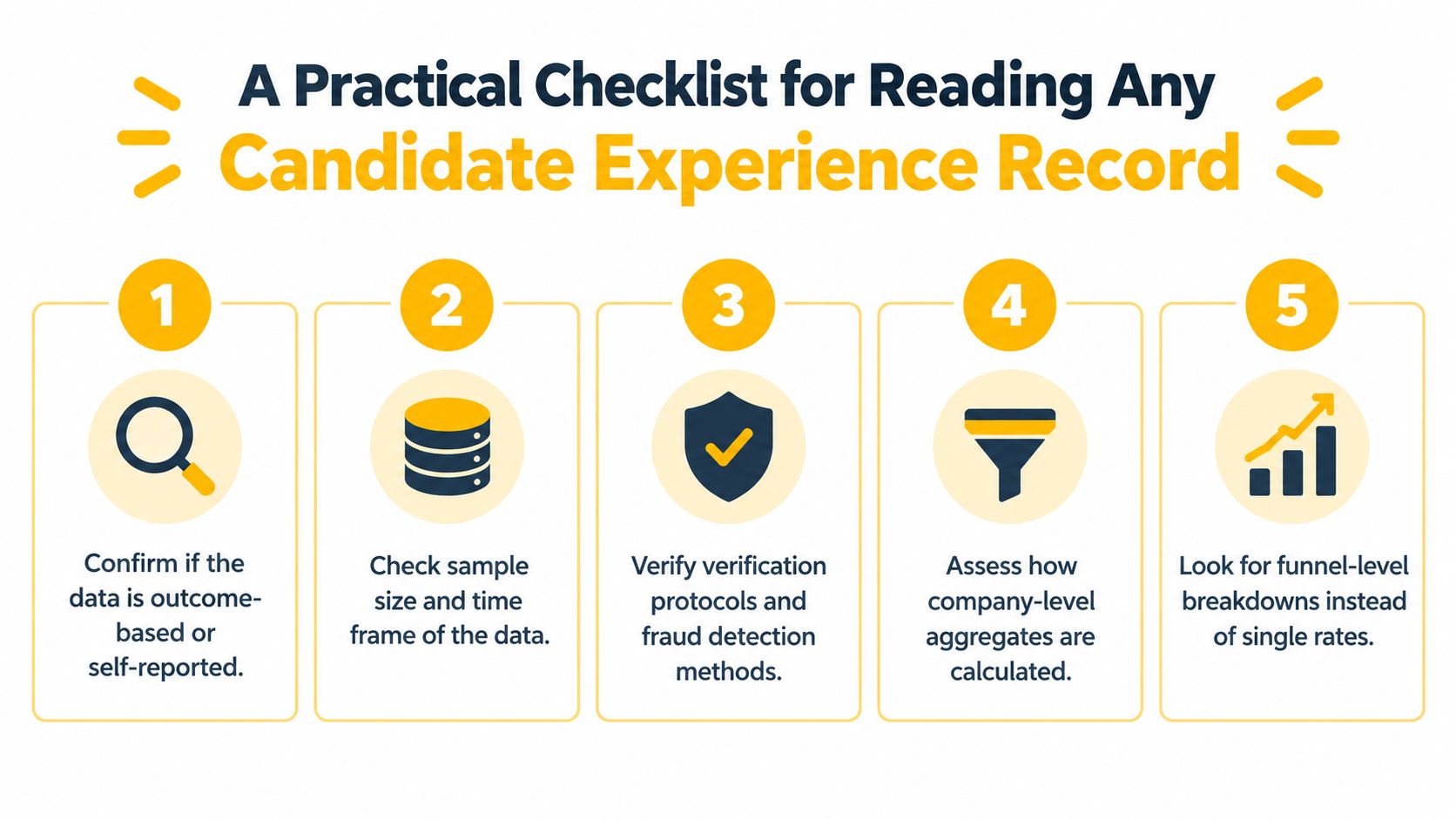
A good record should pass a simple analyst test before anyone acts on it. First, confirm that the data is outcome-based, not just opinion-based. Then check whether each event is tied to a specific application, employer, role, and date.
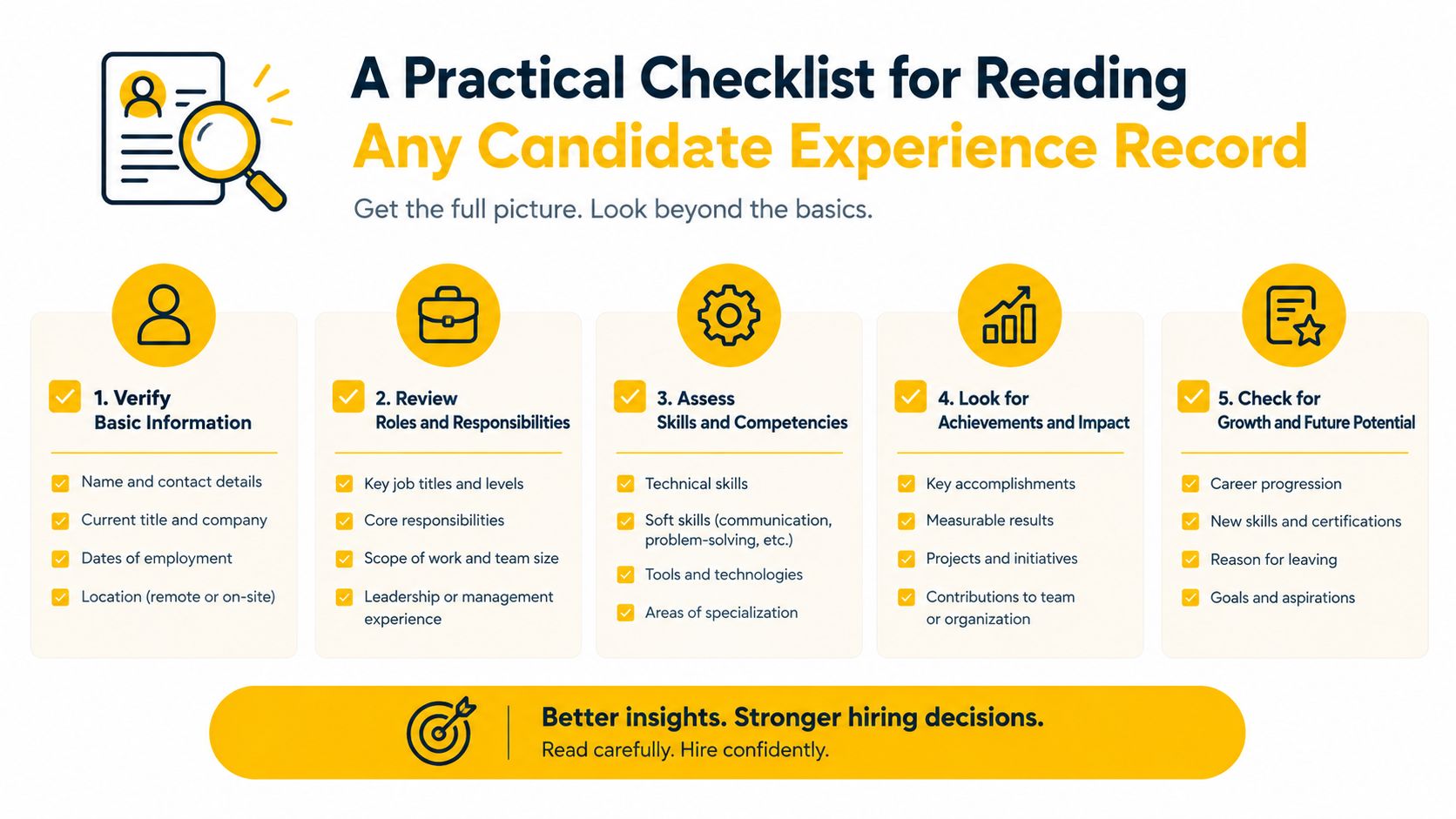
The working sequence
- Confirm the record type. If it's a survey response or a written review, treat it differently from verified outcome data.
- Check the sample size. A company-level percentage without enough outcomes is noise dressed up as certainty.
- Verify the silence rule. The 21-day window should be visible, not assumed.
- Inspect the funnel breakdown. Single rates hide where silence occurs.
- Read the exclusions. Internal hiring delays, interviewer behavior, and fairness indicators may sit outside the record.
The same checklist applies to company dashboards, candidate tools, and external scorecards. If response rate and closure rate aren't paired, the picture is incomplete. If the publication threshold isn't clear, the number may be unstable.
That standard is what makes candidate experience data usable instead of decorative. It gives candidates a way to compare employers and gives operators a way to spot where communication is breaking. It also keeps everyone honest about what the record can, and can't, prove.
GhostedBy makes that kind of record visible by turning reported hiring outcomes into company-level data with a 21-day silence window and a five-outcome publication threshold. If you want to see how structured candidate experience data works in practice, visit GhostedBy and review how response, closure, and ghosting are recorded before you apply.