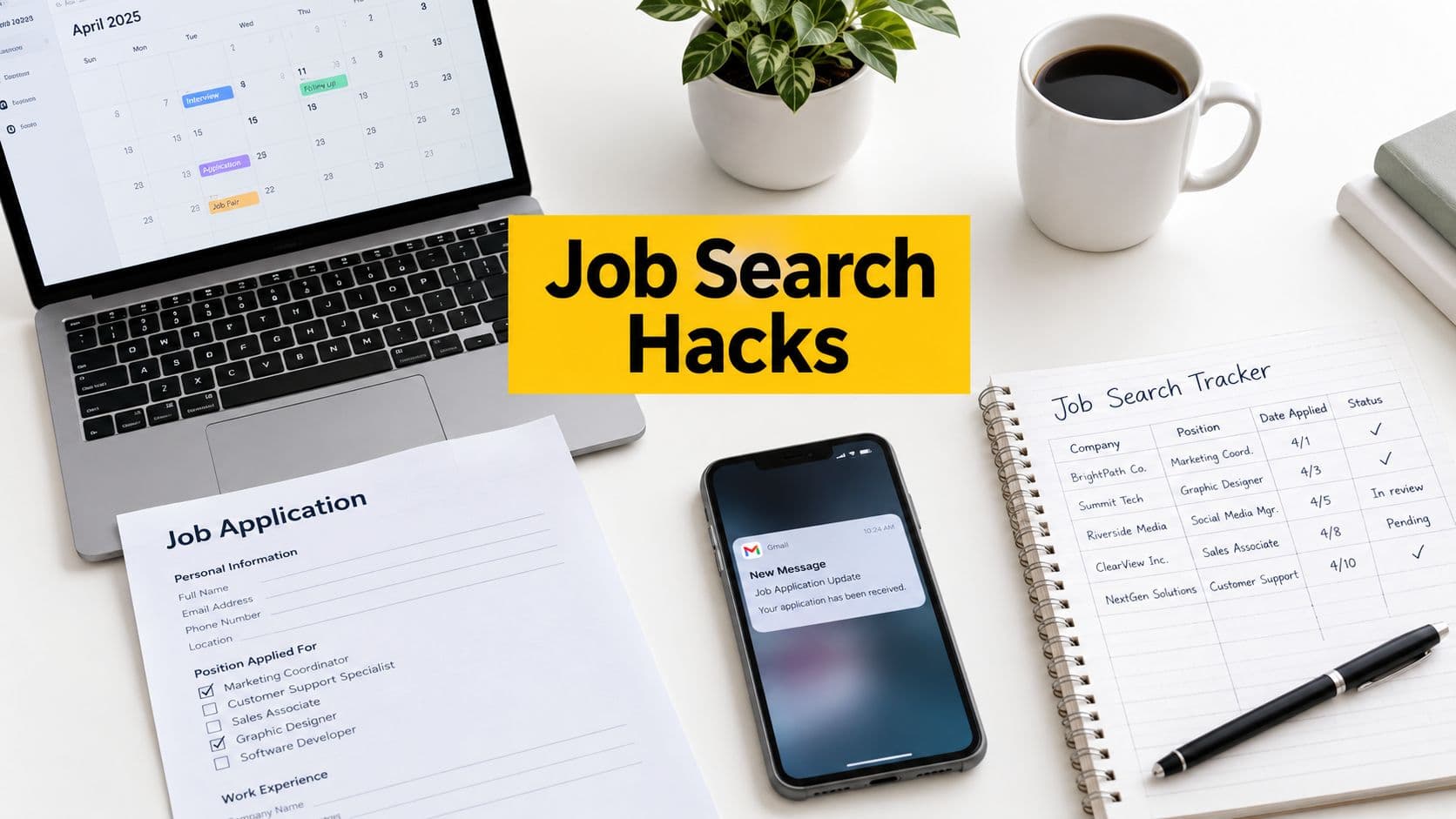
More applications don't necessarily mean more progress. A search can produce a crowded inbox, repeated forms, and little movement if you're spending time on low-fit roles, losing track of follow-ups, or learning nothing from silence.
Job search productivity is better measured by how well you direct limited time toward suitable opportunities, produce relevant materials, follow up at a sensible moment, and use each outcome to improve the next decision. That matters because search duration and application conversion remain uneven. Historical U.S. data show median unemployment search length rising from 5.2 weeks in 2007 to 10.4 weeks in 2010, then remaining at 10.0 weeks in 2011, while later reporting cited an average search duration of 19.9 weeks and a median of 8.7 weeks in April 2024. A 2026 survey reported an average of 28.5 weeks, or about 6.6 months, among respondents who had recently searched for work (career search duration data).
The practical answer is to treat your search as an operating system, not a sequence of applications. The eight tactics below create a workflow for recording decisions, screening companies, protecting focused work, standardizing repeatable tasks, and refining effort from response data. GhostedBy can support company screening, private application tracking, connected job-search email, and outcome documentation, but the system matters more than the tool.
Table of Contents
- 1. Application Tracking and Organization
- 2. Strategic Company Pre-Screening Before Application
- 3. Outcome Reporting and Documentation
- 4. Time-Blocking and Daily Job Search Schedule
- 5. Networking and Relationship-Building Strategy
- 6. Customized Application Materials and Targeted Communication
- 7. Skill Development and Continuous Learning Plan
- 8. Strategic Follow-Up and Persistence System
- 8-Point Job Search Productivity Comparison
- Turn Your Search Into a Feedback Loop
1. Application Tracking and Organization
An application tracker is the search's control panel. Without one, you'll rely on memory to answer basic questions: Did you apply already? Who replied? When should you follow up? Which version of your resume did you send?
Keep every opportunity in one private system, whether that's a spreadsheet, an ATS-style board, or a dedicated platform. Record the company, role, original posting, submission date, current stage, last contact, recruiter or hiring manager, email address, documents used, and next action. Add the final outcome, such as response, rejection, interview, offer, or silence. That last field turns administration into evidence.
A simple workflow works well:
- Capture quickly: Add the application within 24 hours so the role details and submission date remain accurate.
- Create the next action: Set a calendar reminder for a follow-up window, commonly one to two weeks after applying, while recognizing that employers vary.
- Keep evidence attached: Save the job-posting link, confirmation email, resume version, and relevant correspondence.
- Review by status: Use labels or Kanban columns such as Applied, Screening, Interview, Waiting, Closed, and Ghosted.
Practical rule: Every application should have a status, a next action, and an eventual outcome. If one is missing, the record is incomplete.
A tracker prevents duplicate effort, but its greater value is diagnostic. A weekly review may show that one source produces interviews while another produces silence, or that applications move further than rushed submissions. GhostedBy's guide to tracking job applications describes the same operational principle: keep roles, stages, dates, and outcomes connected instead of scattering them across inboxes and notes.
2. Strategic Company Pre-Screening Before Application
The fastest application is still wasted time if the employer is a poor target. Screening companies before applying changes the search from “Which roles can I submit to?” to “Where is this effort most likely to produce a useful conversation?”
Start with the company's candidate experience, not just its job description. Check the company website, hiring-related Glassdoor feedback, LinkedIn recruiter comments, and your own network. Look for repeated patterns, such as unclear process ownership, long periods without updates, or consistent reports of respectful communication. One negative account may reflect an individual recruiter or unusual hiring event. A repeated pattern deserves more weight.
GhostedBy's company culture research guide offers a useful pre-application lens. Candidates can check a company's reported Ghosted Rating and outcome counts before deciding whether to invest in an application. The record is based on aggregated outcomes rather than written reviews, and individual applications remain private. A percentage is shown only after five eligible outcomes, so smaller records should be treated as limited context rather than a definitive judgment.
Use a lightweight decision rule:
- Prioritize: Clear role fit, credible company information, and a candidate process that appears responsive.
- Investigate: Strong role fit but inconsistent or limited hiring data.
- Deprioritize: Weak fit combined with repeated evidence of silence or poor process visibility.
This does not mean rejecting every company with an imperfect record. It means pricing communication risk into your time allocation. A high-fit role may still justify applying, but you can avoid spending an hour on a heavily customized application before checking whether the employer communicates with candidates at all.
The screening question: If this company never responds, would the information gained from applying justify the time spent?
That question makes company research a productivity filter, not a separate research hobby.
3. Outcome Reporting and Documentation
A search becomes more useful when you record what happened, not only what you did. “Applied to many roles” says little about targeting quality. “Several applications reached interviews, most remained unanswered, and one source consistently produced no movement” gives you a basis for changing strategy.
Document outcomes at the stage where they occur. Record the date submitted, recruiter contact, screening date, interview dates, rejection notice, final decision, or last meaningful contact. If the process goes silent, preserve the communication history instead of treating the application as inactive. GhostedBy uses a 21-day window after the last relevant contact before silence can count as ghosting, which creates a consistent stopping rule for candidate reporting.
That distinction matters because silence otherwise disappears from ordinary job-search records. In a 2026 candidate-experience summary, 53% of job seekers said they had been ghosted by a potential employer within the prior year, and 28% said it happened immediately after submitting an application. The same report identified later-stage losses, including 20% after one interview and 16% after an initial phone screen (stage-level ghosting data).
Report positive outcomes too. Responses, rejections, completed processes, and offers provide the comparison needed to understand where silence concentrates. A quarterly review can then separate problems in your materials from problems in a particular channel, company, department, or hiring stage.
Use precise records:
- Identify the stage: Application, phone screen, assessment, interview, or final stage.
- Preserve dates: Save confirmation emails, interview invitations, follow-ups, and rejection notices.
- Describe the event neutrally: Record what the employer did, not assumptions about intent.
- Protect privacy: Keep personal details and correspondence private while contributing only eligible aggregated outcomes to any public record.
Outcome reporting helps other candidates, but it also gives you a cleaner feedback loop. Without it, you may respond to repeated silence by applying faster. With it, you can ask whether changing the source, target company, timing, or material would improve the next cycle.
4. Time-Blocking and Daily Job Search Schedule
Unstructured searching creates a costly illusion of effort. Checking boards repeatedly, editing a resume between errands, and answering recruiter messages whenever they arrive can consume a day without producing a deliberate pipeline.
Time-blocking gives each activity a job. For example, reserve a morning block for company screening and applications, a later block for networking, and a short final block for follow-ups and tracker updates. If you're employed, begin with a manageable daily window that fits your schedule. If you're searching full-time, expand the system without turning every waking hour into application time.
Batching reduces context switching. Research several target companies together, then prepare applications in one focused session, then handle messages separately. Keep interview preparation in its own block because it requires a different kind of concentration than form completion.
A useful day might include:
- Target selection: Review open roles and choose only those that pass your fit and company screen.
- Production block: Prepare and submit applications using approved templates and role-specific edits.
- Relationship block: Send targeted networking messages or arrange informational conversations.
- Control block: Update stages, attach correspondence, schedule reminders, and close stale tasks.
Avoid treating a fixed application count as the main performance measure. Independent 2026 reporting found that job seekers submitted an average of 62.6 applications and received 4.76 interviews, approximately 13 applications per interview (application-to-interview reporting). That ratio makes a poor case for filling every block with more submissions. A better target is a completed workflow: screened role, relevant materials, recorded application, planned follow-up, and eventual outcome.
A productive block ends with a decision record, not just a sent application.
Protect the schedule from avoidable interruptions, but leave room for genuine time-sensitive opportunities. Review the system weekly and change the allocation when the evidence changes.
5. Networking and Relationship-Building Strategy
Networking becomes more productive when it supplies information before it asks for access. A contact at a target company can reveal how a team works, whether a role is actively open, who owns hiring, and whether the public job description reflects the actual need.
Build a target-company list, then map people connected to each organization. Former colleagues, alumni, professional associations, conference contacts, and specialist communities can all provide useful context. Ask for a short informational conversation framed around learning about the role, team, or company. A specific request is easier to answer than a general appeal for help.
Prepare questions that test both fit and process:
- How does the team define success in this role?
- What problem prompted the hiring?
- Which experience matters most in the first interview?
- How does the team communicate with candidates?
- Who should a qualified applicant contact?
Record what you learn in the same system as your applications. Note the contact, conversation date, relevant advice, referral path, and any role mentioned. Send a thank-you message promptly and identify a sensible next step. If a contact offers to refer you, ask for an introduction to the appropriate person or hiring process rather than assuming a vague endorsement will travel.
The New York Fed's research, as summarized by iHire, found that employed job seekers were at least three times as effective as unemployed job seekers at converting search effort into offers, and employed workers received over three times more offers per application sent (New York Fed job-search findings). The practical implication is not that networking guarantees an offer. It's that access to better information and warmer paths can improve the quality of effort, especially when applications alone produce a weak yield.
Track the source of every interview and offer. Over time, you'll see whether alumni introductions, former colleagues, industry events, or direct outreach deserves more of your limited networking time.
6. Customized Application Materials and Targeted Communication
Customization is a resource-allocation decision. You shouldn't spend the same preparation time on every opening, but a promising role deserves more than a generic resume and an interchangeable cover letter.
Create a reusable library of achievement bullets organized by skill, industry, and problem type. Then tailor the sections that carry the most relevance. A marketer applying for product marketing should foreground positioning, launches, and customer insight. The same person targeting demand generation should emphasize acquisition programs, funnel management, and measurable campaign operations. The underlying experience may overlap, but the employer's question changes.
Start with the job description. Mirror its language naturally, prioritize the capabilities it emphasizes, and remove unrelated material that forces the reader to search for fit. Research the company's products, mission, recent developments, and likely challenges. If you can identify the hiring manager, address the communication appropriately and connect one or two specific experiences to the team's needs.
A practical customization sequence looks like this:
- Select evidence: Choose achievements that answer the role's central responsibilities.
- Reorder the opening: Customize the top third of the resume most heavily because it establishes relevance quickly.
- Adapt the message: Use the cover letter or application questions to explain why this company and role fit your experience.
- Audit the result: Check keywords, dates, names, formatting, and typos before sending.
The trade-off is clear. Tailoring takes longer per application, so it must follow screening. Do it for roles that meet your fit, company, and channel criteria. Don't spend deep customization time on every listing merely to maintain a high activity count.
Track which changes correlate with better outcomes, without pretending that one response proves causation. If applications with a specific portfolio example reach more conversations, keep testing that format. If a particular type of role repeatedly produces no response despite strong fit, examine the source and process as well as the materials.
7. Skill Development and Continuous Learning Plan
Learning can either strengthen a search or become a polished form of avoidance. The difference is whether the skill connects to the roles you're targeting and produces evidence employers can evaluate.
Collect a sample of current job descriptions in your target category and identify recurring requirements. Then rate your own proficiency as strong, moderate, basic, or absent. Prioritize gaps that appear repeatedly and affect eligibility, interview performance, or the quality of your work samples. Avoid collecting unrelated certificates because they're available.
Turn learning into an output. A data analytics learner might build a portfolio project that demonstrates data cleaning, analysis, and communication. A software engineer learning a new language can publish a documented project. A product manager developing UX knowledge can show how research findings changed a product decision. The project gives you material for the resume, interview answers, and networking conversations.
Learning should create a stronger application asset, not just another line on a course-completion record.
Protect a defined learning block inside the weekly schedule. Keep it separate from application production so you can judge whether the time is producing usable evidence. Set a review point: continue, narrow, or stop based on whether the skill appears in target roles and whether you can demonstrate it credibly.
The trade-off deserves attention. A learning plan can delay applications that are already viable, and a long course may not solve the actual reason for low response. If your tracker shows that qualified applications are being ignored, more training may not be the first fix. If interviews repeatedly expose the same technical or domain gap, targeted learning becomes a more rational investment.
Use the search itself as a curriculum. Interview questions, rejected applications, recruiter feedback, and networking conversations can reveal which capability needs improvement. Record those signals rather than treating each interaction as an isolated disappointment.
8. Strategic Follow-Up and Persistence System
Follow-up works best as a controlled sequence, not an emotional reaction to silence. Every application should generate a planned next contact, a stopping rule, and a decision about where to redirect the time if no reply arrives.
After applying, record the date and set a reminder. A first message after 7 to 10 business days can briefly identify the role, restate interest, and ask whether the process is active. A later message after three to four weeks can request an expected timeline. After an interview, send a specific thank-you within 24 hours, referring to an actual discussion point rather than copying a generic note.
Keep each message short and professional. Use email when you have a direct address. Consider LinkedIn only when the contact is appropriate and you have a genuine reason to use another channel. Escalation should improve visibility, not create pressure.
The timing matters because candidates don't all interpret silence the same way. One report found that 26% of respondents wait one to two weeks before assuming they've been ghosted, while 24% continue following up until they receive a response. The same report found that 48% would not apply to a company again after being ghosted (candidate follow-up and reapplication behavior).
Use a decision sequence:
- First contact: Confirm interest and ask for process status.
- Second contact: Request timing information and keep the message concise.
- After the waiting window: Mark the application as ghosted when it meets your documented rule, then deprioritize it.
- After closure: Record the result and use it in your channel and company review.
This job-application follow-up guide can help structure reminders and outcome records. Persistence is productive only while it has a reasonable expected return. Once repeated attempts produce no visibility, the rational move is to preserve the data and invest the next work block elsewhere.
8-Point Job Search Productivity Comparison
| Strategy | Implementation Complexity 🔄 | Resource Requirements ⚡ | Expected Outcomes ⭐📊 | Ideal Use Cases 💡 | Key Advantages ⭐ |
|---|---|---|---|---|---|
| Application Tracking and Organization | Moderate, set up spreadsheet or ATS; requires disciplined updates | Low, basic tools (spreadsheet/board) and time for entry | Improved organization, fewer duplicate apps, timely follow-ups | All job seekers; high-volume searches; those needing structure | Centralizes data; reveals patterns; supports consistent follow‑up |
| Strategic Company Pre‑Screening Before Application | Low–Moderate, research and cross‑checking company data | Low, web research, review platforms, GhostedBy metrics | Higher hit‑rate on respectful employers; less wasted effort | Time‑limited applicants; those prioritizing candidate experience | Saves time; reduces emotional cost; enables data‑driven targeting |
| Outcome Reporting and Documentation | Moderate, consistent logging and verification required | Low, time to report outcomes; email verification steps | Builds company‑level transparency; converts experiences into data | Candidates tracking many apps; advocates for hiring accountability | Creates collective accountability; documents personal effort and trends |
| Time‑Blocking and Daily Job Search Schedule | Low, calendar setup and habit formation | Moderate, daily time allocation (2–8 hrs depending on status) | Greater consistency, reduced decision fatigue, measurable progress | Employed seekers balancing work; full‑time searchers seeking routine | Increases productivity; protects mental boundaries; improves application quality |
| Networking and Relationship‑Building Strategy | High, proactive outreach and long‑term maintenance | Moderate, time, social capital, events, online engagement | Higher offer rates, insider info, referral opportunities | Roles often filled via referrals; senior hires; career changers | Access to unposted roles; reduces ghosting; builds lasting career capital |
| Customized Application Materials & Targeted Communication | High, deep role/company research and tailored writing | Moderate–High, time per application; research and editing effort | Higher callback/interview rates; better role‑fit matches | Competitive roles; limited, high‑value applications | Improves ATS match; stands out to recruiters; raises interview quality |
| Skill Development & Continuous Learning Plan | Moderate, gap analysis and structured learning roadmap | Moderate–High, time investment, possible course costs, portfolio work | Increased competitiveness, stronger interviews, tangible portfolio evidence | Career changers; roles requiring new technical skills or certifications | Long‑term value; demonstrates initiative; fills capability gaps |
| Strategic Follow‑Up and Persistence System | Moderate, defined timelines and escalation logic | Low–Moderate, time for follow‑ups; tracking in your system | Increased response rates; faster closure of stalled applications | High‑volume pipelines; processes with long or opaque timelines | Converts stalled apps into outcomes; signals continued interest; yields data for reporting |
Turn Your Search Into a Feedback Loop
The eight tactics work together as a weekly operating system. Start by screening companies and roles before you write anything. Build a focused target list, rank opportunities by fit and candidate-process visibility, and reserve deeper customization for applications that justify the time. This prevents the common failure mode of spending equal effort on every listing.
Next, assign the work to protected blocks. Use one block for research, another for application production, another for networking, and a short control block for follow-ups and records. Reuse approved resume bullets, cover-letter structures, interview notes, and email templates, but edit the role-specific evidence each time. Standardization should remove repetitive work, not remove relevance.
Connect every submission to a next action. Schedule the first follow-up, note the last meaningful contact, and apply the same ghosting rule consistently. GhostedBy's 21-day ghosting window can provide a clear point for classifying silence after the last relevant contact, while the broader candidate data shows why silence deserves operational treatment. In 2025, 59.0% of candidates identified applying without hearing back as a top challenge, 59.7% called ghosting a top frustration, and 47.4% expected unresponsive recruiters or hiring managers to affect their search or career growth in the following year (2025 online recruiting data).
End each week with a review:
- Which companies passed the pre-screen and received focused effort?
- Which channels produced responses, interviews, or no movement?
- Which applications need a follow-up or a closure decision?
- Where did candidates disappear from the funnel?
- Which material, skill, or relationship deserves more attention next week?
- Which tasks should be templated, automated, or removed?
This is the difference between activity and progress. Independent tracking has estimated generic application interview conversion at roughly 2% to 3% in some markets, while more customized applications can perform better (application conversion analysis). Separately, reported response rates vary substantially by source, with Google Jobs around 9.3% to 11.3%, LinkedIn around 3.1% to 3.3%, and Dice near 0.19% to 0.35% in recent tracking (job-search source response data). Those figures shouldn't become universal promises, but they do support a clear editorial conclusion: reallocating effort can matter more than increasing volume.
GhostedBy's free core candidate experience lets candidates check company records, keep applications private, connect job-search communication, and report outcomes. Used alongside a disciplined tracker and weekly review, it can make the invisible parts of the search easier to see and act on.
GhostedBy helps candidates screen companies through aggregated response and ghosting records, organize applications privately, connect job-search communication, and document outcomes as the process develops. Visit GhostedBy to make your next search more measurable and direct your time toward opportunities with clearer evidence.