
You're probably doing what most candidates do. You open the careers page, skim the values, glance at a review score, and tell yourself you've “researched the culture.”
That's how people end up trapped in jobs they should've rejected before the first recruiter call.
Company culture research only works when you stop treating company marketing as evidence. The useful question isn't “What does this company say about itself?” It's “How does this company behave when nobody's writing polished copy?” If you want the answer before you apply, study candidate treatment, hiring process discipline, communication habits, and what the company does under pressure.
Table of Contents
- Why Most Company Culture Research Fails Before It Starts
- Sources Worth Checking and What They Actually Reveal
- Signals That Predict Culture Before You Ever Speak to a Recruiter
- Reading the Hiring Process as a Culture Preview
- Smart Questions to Ask When Culture Is on the Line
- Turning Research Into a Decision You Can Defend
Why Most Company Culture Research Fails Before It Starts
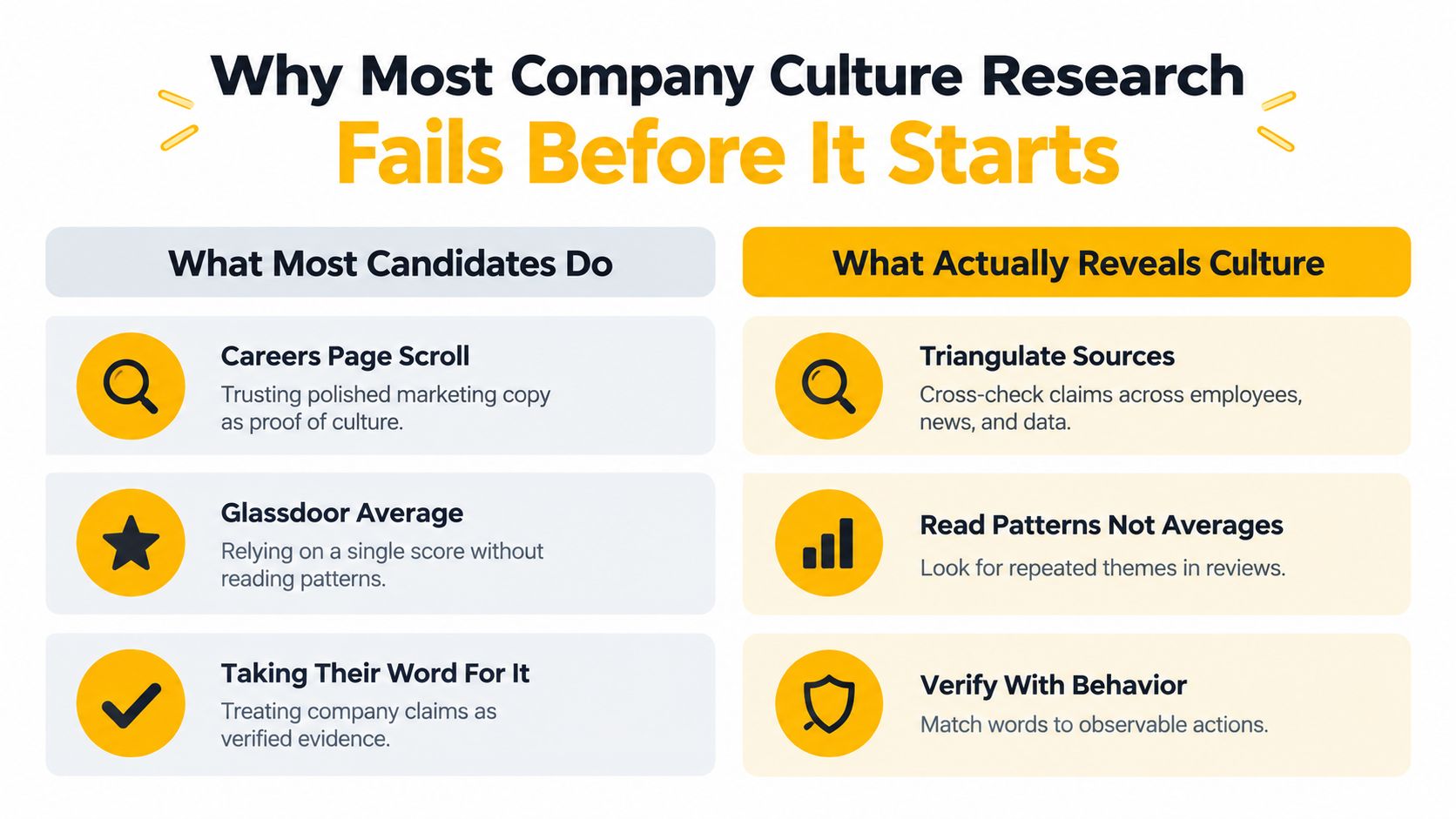
The biggest mistake candidates make is simple. They trust employer-controlled information.
A careers page tells you what leadership wants outsiders to believe. It does not tell you how managers handle conflict, whether interviewers show up prepared, or whether a team goes silent the second hiring gets messy. Mission statements are branding. Culture is behavior.
Stop confusing claims with proof
Most candidates collect culture claims, not culture evidence. They read phrases like “people-first,” “collaborative,” and “transparent,” then treat those words as if they've been verified.
That's backwards.
Real company culture research starts with one rule: if a company says something about itself, assume it's unverified until you see matching behavior. If they claim transparency, look for direct answers in interviews. If they claim respect, look at how they treat applicants. If they claim accountability, check whether leadership publicly owns hard decisions.
Practical rule: The more polished the culture language is, the more aggressively you should look for behavior that confirms it.
There's a reason this matters. A major benchmark summarized by Worldmetrics citing Gallup found that only 20% of U.S. employees strongly agree they feel connected to their organization's culture, which means 8 in 10 do not feel strongly connected. That gap tells you everything you need to know about glossy culture messaging. The statement on the wall and the lived experience on the floor are often two different things.
What to research instead
If you want signals that predict your experience, focus on observable patterns:
- Candidate treatment: Do they acknowledge applications, communicate timelines, and close loops?
- Decision quality: Do job descriptions make sense, or do they read like three roles shoved into one?
- Pressure behavior: How does the company talk during layoffs, backlash, or strategic shifts?
- Meeting norms: A recent Harvard Business Review piece on interruptions and culture argues that interruptions in meetings reveal more than mission statements do. That's right. How people cut each other off tells you more than the “About Us” page.
Research on organizational culture itself backs the need for discipline. A systematic review published by SciELO Brasil found culture research often relies on questionnaires or scales in 50.2% of primary-data studies and interviews in 29.5%, while 12 of 27 papers reported only descriptive analysis. For a job seeker, the takeaway is obvious: shallow inputs produce shallow conclusions.
The right standard
You don't need a perfect picture. You need a defensible one.
That means collecting evidence from places the company doesn't fully control, then checking whether the same pattern appears across sources. If the public story says “supportive and thoughtful” but the hiring process feels chaotic and dismissive, trust the behavior. Behavior is harder to fake.
Sources Worth Checking and What They Actually Reveal
Candidates get this wrong in a predictable way. They read a few Glassdoor reviews, skim the company's values page, maybe check LinkedIn, then decide they have “done the culture research.” They have not. They have sampled the company's marketing and a pile of unmanaged opinions.
Use sources for what they are good at. Then cross-check them against behavior. Culture is not what a company says on a careers page. It is how the company operates when nobody is polishing the story for you.
Research sources compared
| Source | What It Reveals | What It Hides | Reliability |
|---|---|---|---|
| Company careers page | Stated values, recruiting priorities, how the company wants to be seen | Internal friction, bad management, sloppy execution | Low on its own |
| Glassdoor and Indeed reviews | Repeated complaints, praise themes, manager-specific patterns | Verification issues, extreme opinions, context gaps | Moderate if you read patterns |
| Blind | Candid employee sentiment, pay tension, leadership frustration | Industry bias, anonymity noise, selective participation | Moderate |
| LinkedIn posts from employees | Promotion habits, language leaders reward, who gets visibility | Conflict, burnout, exits, anything unflattering | Low to moderate |
| Conference talks and podcasts | How leaders think in public, what they emphasize, whether they dodge specifics | Day-to-day management quality | Moderate |
| News coverage | Layoffs, lawsuits, executive turnover, major public failures | Team-level nuance | High for factual events |
| Peer comparisons | Whether this company looks unusually chaotic or unusually disciplined | Internal causes behind the difference | Moderate to high |
| Public work samples like GitHub or community presence | Engineering habits, documentation quality, collaboration style | Broader non-technical culture | Moderate |
Read patterns, not scores
Review sites still matter. The mistake is treating the average rating like a verdict.
Read for repeated specifics across time. If different reviewers mention the same manager behavior, the same promotion bottleneck, or the same workload problem, pay attention. If one person complains about everything and the next five talk about unrelated issues, that is weak evidence.
Verification limits are real. WebProNews on employer-review verification limits notes that Glassdoor does not require proof of employment for every review. Fine. Treat reviews as leads to investigate, not answers to trust blindly.
If you want a tougher read on the blind spots, this breakdown of why company review sites often mislead candidates is worth your time.
Reviews capture sentiment. Process and public records capture conduct.
Put more weight on behavior-based evidence
The strongest sources show what the company did, not how it described itself.
Start with public records of pressure and accountability. News coverage can show layoff handling, legal trouble, executive exits, and abrupt strategy changes. Reopened roles can hint at churn or confused hiring. Conference talks can reveal whether leaders speak clearly about tradeoffs or hide behind slogans.
Candidate treatment belongs in this section too, because it sits between reputation and direct experience. LiveCareer's Trust Deficit Report coverage reported that 69% of HR professionals said their company often closes job searches and stops responding to candidates. That is not a minor etiquette problem. It is a process signal. Companies that normalize loose ends in hiring often normalize them elsewhere.
One more point matters. A systematic review summarized by SciELO Colombia found 92.8% of analyzed instruments exceeded Cronbach's alpha of 0.70 and 85.7% used construct validity checks, while also noting there is no consensus on how organizational culture should be measured. If researchers cannot reduce culture to one clean measure, you should not let one employer rating or one glowing testimonial make the decision for you.
Your job is simple. Collect signals from sources the company controls, sources it does not control, and sources that record behavior under pressure. When those three line up, you have something you can trust.
Signals That Predict Culture Before You Ever Speak to a Recruiter
You apply on Monday. By Friday, the role has vanished, the job post has changed twice, and nobody can tell what the team needs.
That is culture data.
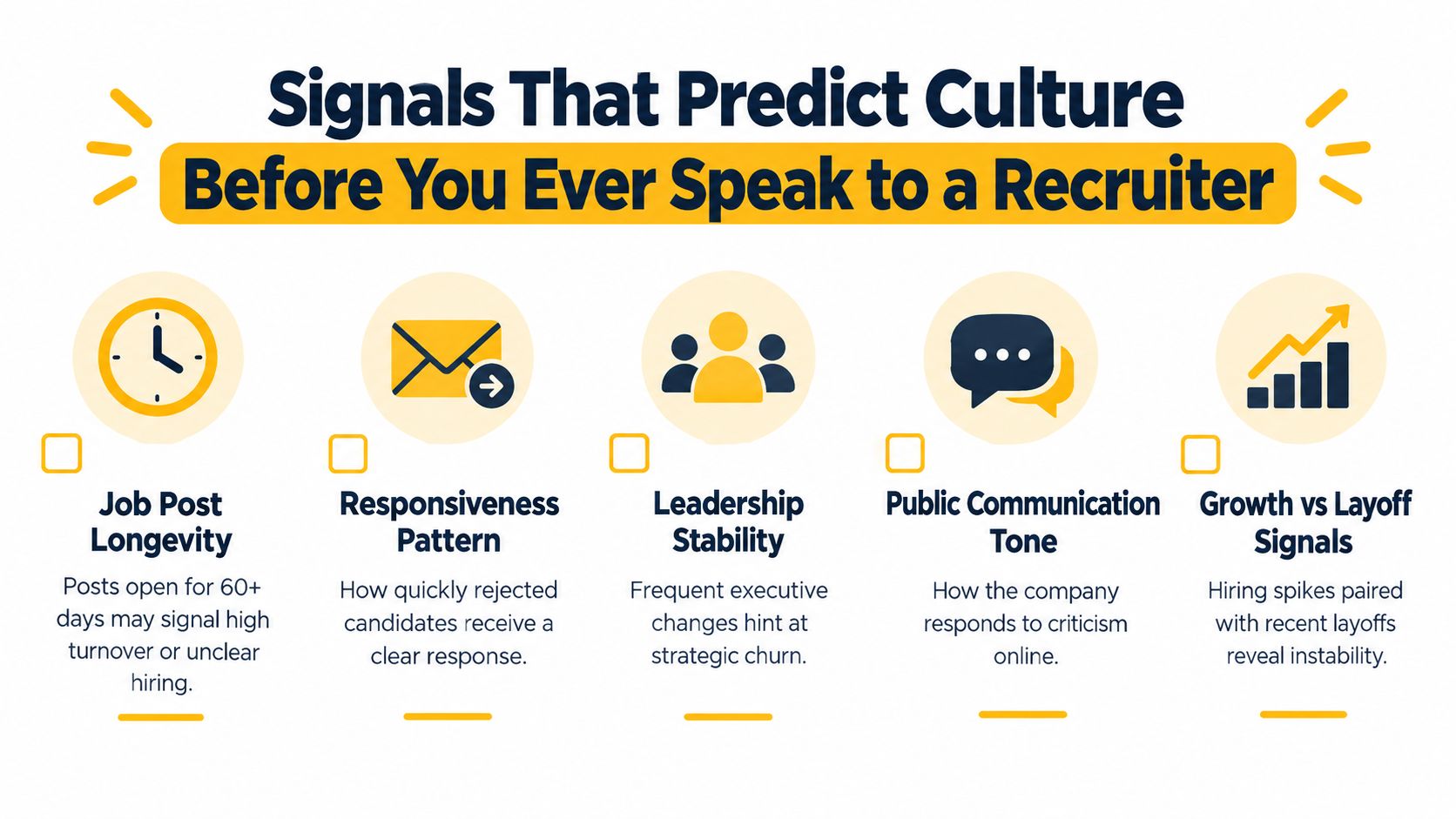
The best pre-interview signals are behavioral, not branded. Mission statements are cheap. So are polished employer pages. What matters is what the company publishes, repeats, leaves unanswered, and tolerates in public before anyone starts selling you on the opportunity.
Start with what the company does when nobody is watching
Before a recruiter calls, you can still see how the company operates under normal conditions.
Job posts are the first clue. A clear company writes clear roles. If the title, level, and responsibilities fight each other, expect confusion inside the team too. A posting that asks one person to set strategy, execute every detail, calm stakeholders, and stay available at all hours is not ambitious. It is badly scoped.
The company's public footprint matters just as much. Look for patterns, not isolated incidents.
- Recurring openings for the same role: churn, failed hiring, or constant reshuffling
- Titles that keep changing: weak org design or political turf wars
- Press statements that dodge specifics: leaders protecting image instead of explaining decisions
- Customer complaints that repeat the same operational failures: internal disorder showing up externally
- Career pages full of values language but thin on role clarity: branding doing work that management should be doing
If you want a practical checklist, review these hiring red flags candidates should take seriously before you spend time on an application.
Use candidate treatment as a proxy for internal standards
A company's treatment of applicants is one of the few culture signals you can observe before you are inside. Use it.
Independent coverage from The Interview Guys on candidate ghosting trends points to rising employer ghosting in recent candidate-experience reporting. The exact percentage matters less than the pattern. Silence, vague updates, and abandoned job searches usually reflect weak ownership and low respect for other people's time.
You already saw the employer-side version of this problem in the earlier section. Companies that normalize loose ends in hiring rarely keep the mess contained to recruiting. The same habits show up in decision-making, feedback, and accountability.
Read inconsistency as a warning
Strong cultures are usually consistent in public long before they are persuasive in interviews.
Check whether the company sounds like the same organization across its job ads, leadership posts, product messaging, and public responses to criticism. If one page promises thoughtful work and another glorifies permanent urgency, believe the contradiction. If leaders talk about transparency while employees and candidates get silence, believe the behavior.
Candidates get burned when they treat each signal in isolation. Don't do that. One sloppy job post can happen. One awkward press quote can happen. Repeated confusion across roles, messaging, and candidate experience is a pattern, and patterns are what predict your day-to-day life after you sign.
Reading the Hiring Process as a Culture Preview
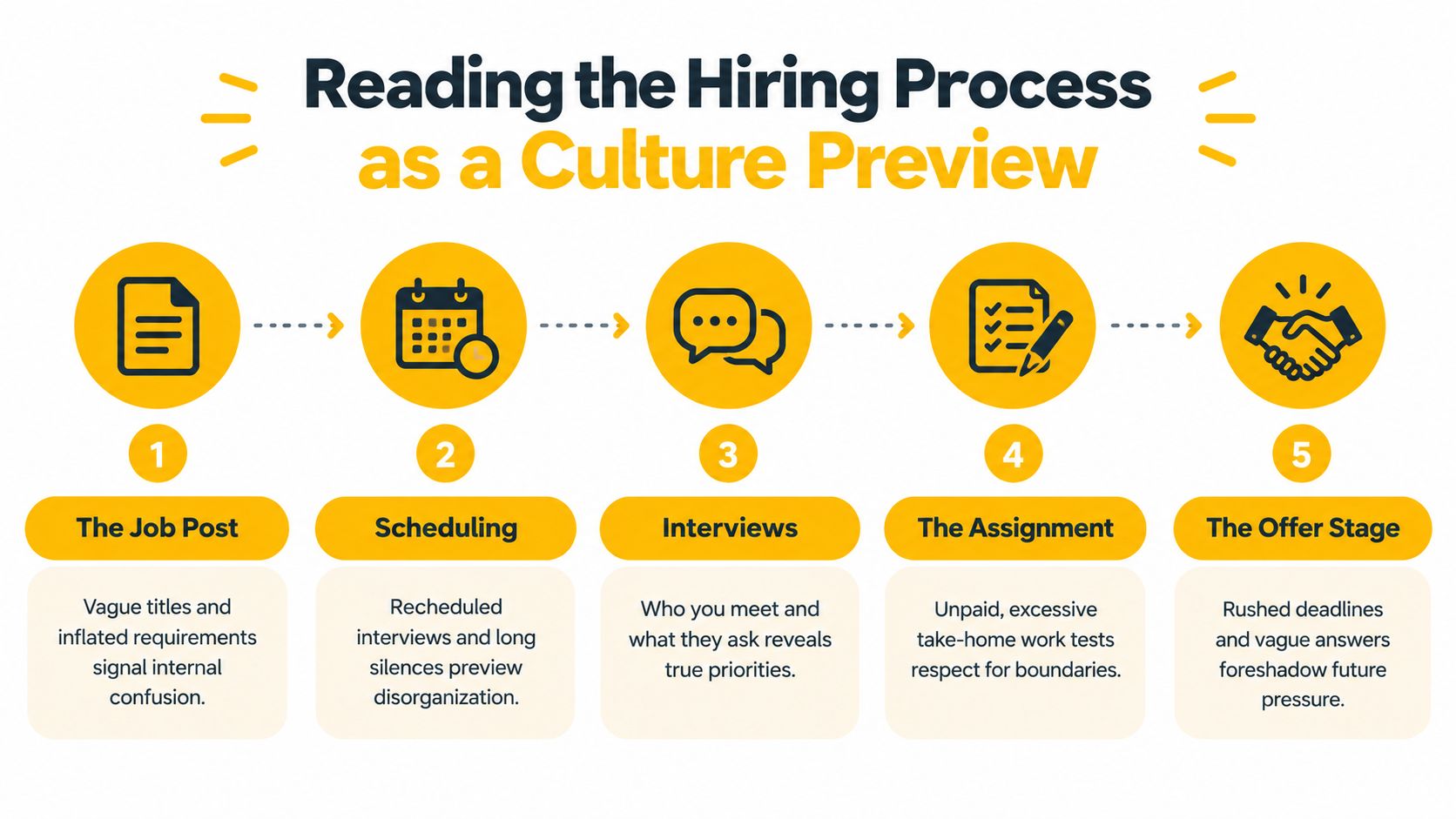
Every hiring stage previews how the company operates once you're inside. Candidates ignore this because they're focused on winning the offer.
That's backwards. You're not just being evaluated. You're auditing the company in real time.
Start with the job post
A bad process usually announces itself early.
If the title is fuzzy, the scope is bloated, and the seniority level doesn't match the responsibilities, assume the team is disorganized. When a posting asks for strategic leadership, deep technical execution, cross-functional diplomacy, nonstop urgency, and “startup scrappiness” in one role, they're not describing excellence. They're describing confusion.
Good job posts usually share three traits:
- Clear ownership: You can tell what the person will own and what they won't.
- Coherent level: The responsibilities match the experience level they're seeking.
- Plain language: The company explains the work without hiding behind clichés.
Treat scheduling and communication as evidence
How a company handles logistics is not separate from culture. It is culture.
Silence after application submission tells you candidates are treated like inventory. Repeated reschedules without explanation suggest internal chaos or low respect for other people's time. Generic templates aren't automatically bad, but a total lack of context often signals a process run for company convenience only.
For a practical benchmark on what healthy and unhealthy hiring behavior looks like, review these company hiring practices that reveal more than interview answers do.
A company that respects people usually shows that respect before the first interview, not after the offer is signed.
Use interviews to spot operating norms
Interviews reveal priorities fast if you know what to watch.
Here are the red flags that matter most:
- Unstructured interviews: People ramble, repeat the same questions, or don't know what they're evaluating.
- Unprepared interviewers: Someone clearly hasn't read your resume or doesn't understand the role.
- Surprise assignments: They drop a major case study on you with unreasonable timing and act like that's normal.
- Contradictory answers: Different interviewers describe different expectations, success metrics, or team structures.
And here are the green flags candidates undervalue:
- Prep materials arrive in advance. You know who you're meeting and why.
- Interviewers acknowledge real tension. They can describe what's hard about the role without pretending everything is perfect.
- The process has visible ownership. One person keeps you informed and closes loops.
The offer stage tells the truth
The final stage exposes how the company handles pressure, power, and ambiguity.
If compensation language gets slippery, if decision deadlines are artificially rushed, or if verbal promises never appear in writing, pay attention. That behavior doesn't magically improve after you join. It usually gets worse, because now you're dependent on them.
A clean offer process looks boring. That's a compliment. Clear terms, documented expectations, and straightforward answers are what adult companies do.
Smart Questions to Ask When Culture Is on the Line
Most candidates ask culture questions that are too easy to answer. “How would you describe the culture here?” is useless. Nobody says, “Disorganized, political, and allergic to feedback.”
Ask questions that force examples.
Ask for recent evidence
Use questions like these in recruiter and hiring manager conversations:
- Ask about disagreement: “Tell me about a recent disagreement on this team and how it got resolved.”
- Ask about attrition: “Why did the last person leave this role?”
- Ask about workload tradeoffs: “What changed in team priorities last quarter, and what got dropped?”
- Ask about feedback style: “How direct is feedback here, and can you give me an example from the last month?”
- Ask about manager quality: “What did the last performance review cycle look like for this manager's direct reports?”
- Ask about onboarding reality: “What usually surprises new hires about this team after they join?”
These questions work because they force specificity. A healthy team can answer them without panic.
Listen for three bad answer types
You're not just listening to the answer. You're evaluating how they answer.
Watch for this:
- Deflection: They answer a different question because the one is uncomfortable.
- Vagueness: You get abstractions, not examples.
- Excessive positivity: Everything is “great,” “collaborative,” and “fast-paced,” but nothing is concrete.
When an interviewer can't name a recent tension, one of two things is true. They're hiding conflict, or they're not paying attention to the team.
Compare answers across people
Don't ask one person and move on. Ask the same question to multiple interviewers.
If the recruiter says the role is stable, the manager says priorities are shifting, and the peer says the team is underwater, you've learned something valuable. Consistency doesn't guarantee a good culture, but inconsistency often exposes one that isn't aligned.
A 2024 global workplace culture survey reported by Gallup's organizational culture indicator page found 56% of workers rated their organization's culture as good or excellent, 26% rated it slightly good, 10% said slightly poor, and 8% said poor or terrible. So yes, many people report positive cultures overall. But nearly 1 in 5 still described culture negatively. That's why you don't settle for polished generalities. You verify what this team is like, not what workplace culture looks like in the abstract.
Turning Research Into a Decision You Can Defend
Company culture research isn't a checklist exercise. It's verification work.
You're trying to answer one question: does the evidence support the story this company is telling me? If the answer is mixed, slow down. If the answer is no, walk.
Use decision rules, not vibes
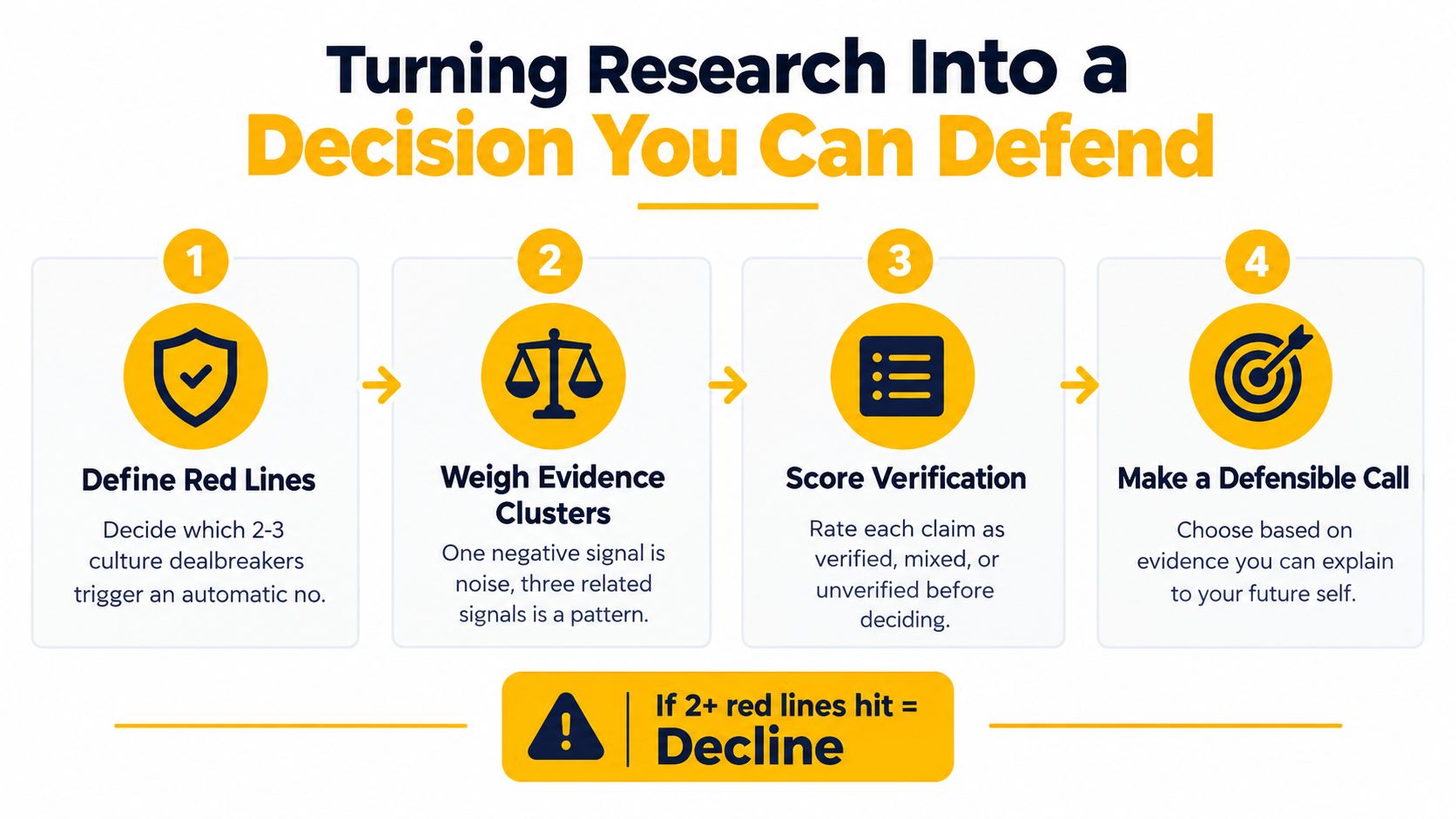
Set your standards before the offer arrives. Otherwise you'll rationalize obvious problems because you're tired, flattered, or desperate to leave your current job.
Use rules like these:
- Walk away if two or more red lines hit. Examples: repeated unexplained reschedules, contradictory role expectations, pressure to decide fast, refusal to clarify reporting lines.
- Allow a slower process only when trust is earned. If communication is clear and interviewers are prepared, a long timeline can be acceptable.
- Treat clustered signals as a pattern. One bad interviewer might be noise. Three related failures usually aren't.
Run a final verification check
Before you accept, answer these plainly:
| Check | What you need to confirm |
|---|---|
| Hiring behavior | Did they communicate clearly and close loops? |
| Role clarity | Do you know what success looks like in the first stretch of the job? |
| Manager evidence | Did the manager answer hard questions directly? |
| Team consistency | Did different interviewers describe the same reality? |
| Pressure handling | Did the company stay transparent when the process got complicated? |
| Written terms | Is every meaningful promise documented? |
If several boxes stay fuzzy, don't invent confidence you haven't earned.
The standard that saves people months
You are not looking for a perfect employer. You're looking for a match you can defend to your future self.
If a company can't produce behavioral evidence for its culture claims during a process built to attract talent, assume those claims won't hold up once you're on payroll. Absence of evidence is evidence of absence when the company had every incentive to show you its best.
GhostedBy helps you check how companies treat candidates after they apply, which is one of the clearest culture signals you can get before accepting an offer. If you want a company-level record of response versus silence instead of another pile of vague employer branding, visit GhostedBy.