
Most job-search advice still treats the process like a checklist: polish your resume, apply widely, prepare for interviews, and wait. That approach misses the part candidates can control most. In a Q1 2026 dataset covering 139,927 applications from 25,635 active job seekers, the median time from search start to first offer was 108 days, up 30% from Q4 2025 and the longest median measured by that study (Huntr's Q1 2026 job-search report). The search is no longer just a writing and interviewing exercise. It's an outcome-tracking discipline.
You need to decide which opportunities deserve your time, identify companies that communicate reliably, measure where your applications stall, and adjust before another month disappears. Applications still matter, but sending more of them isn't automatically progress. The strongest strategy combines targeted applications, warm outreach, careful role screening, and honest records of what happens after you click submit.
Table of Contents
- Rethinking the Job Search Before You Apply
- Setting Up Your Search Foundations
- Researching Companies and Filtering Real Roles
- Running the Application Workflow Day to Day
- Preparing for and Running Real Interviews
- Following Up, Evaluating Offers, and Logging Outcomes
- Building a Weekly Review Loop That Improves the Search
Rethinking the Job Search Before You Apply
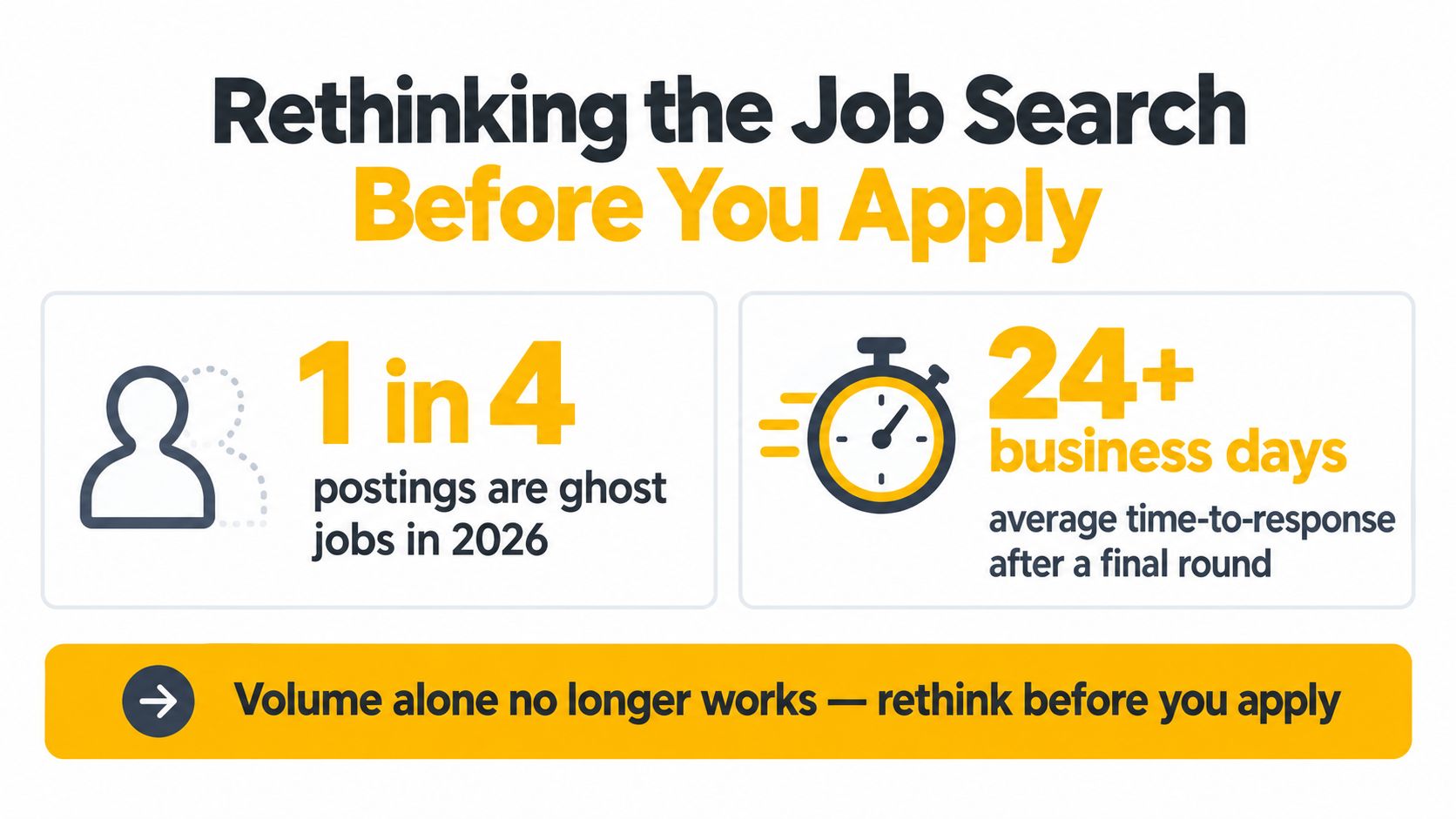
Applying to more jobs is not automatically a better strategy. In the same Q1 2026 dataset, 85% of respondents spent most of their search time on online applications, while only 15% spent most of their time networking (Huntr's Q1 2026 job-search report). Candidates are already devoting most of their effort to applications. The sharper question is whether those applications produce useful responses, conversations, or evidence about where the process breaks down.
A long-run U.S. job-search series shows how the mix of search methods has shifted. In 1995, 65.3% of unemployed jobseekers said they contacted an employer directly, compared with 45.1% who sent a resume or filled out an application. By 2025, resumes and applications had reached 56.1%, while direct employer contact stood at 50.8%. The average number of methods used remained flat at 1.8, so the toolkit changed more in composition than in breadth (the 1995 to 2025 job-search methods series).
Stop confusing activity with progress
An application records activity. Progress produces a response, a conversation, an interview, an offer, or a useful signal about the employer's process. If you track only submissions, you can stay busy without learning which choices improve your results.
Use these three rules:
- Stop equating applications with progress: A carefully selected application supported by a credible referral can be more valuable than a large batch of generic submissions.
- Score opportunities before applying: Look for signs that the role belongs to a real team, reflects a current hiring need, and provides a reasonable path to contact.
- Treat silence as data: Record the company, role, stage, submission date, and last contact. An unanswered application is not a verdict on your ability, but it is evidence about that employer's communication and hiring process.
Ghosting should directly affect how you allocate time. The 2026 report published by PR Newswire found that 57.5% of applicants said applying and hearing nothing back was one of their biggest frustrations, while 53% said an employer had ghosted them during the past year. That figure rose from 48% in 2025 and 38% in 2024 (the 2026 ghosting report published by PR Newswire).
Use the response pattern to judge the opportunity. A company that repeatedly leaves candidates without updates deserves less attention than one that communicates clearly, even if both roles initially look attractive.
Practical rule: Ask two questions before investing more time: “How do I win this role?” and “What evidence says this role deserves another hour of my time?”
Setting Up Your Search Foundations
A disorganized search creates avoidable stress. Before sending an application, decide what you're targeting, prepare reusable materials, confirm your references, and create one place to record every outcome.
Start with a target list of 15 to 25 companies and three to five role families. Role families should describe the work you can credibly perform, not every title you might tolerate. A product operations candidate might target product operations, business operations, program management, and customer operations, but shouldn't treat every operations title as interchangeable.
Build one baseline resume, then create two custom variants for the role families that matter most. The baseline should contain your strongest evidence and clean formatting. Each variant should change the summary, reorder skills, and emphasize the achievements most relevant to that family. Don't build a new resume from scratch for every posting. That slows you down and encourages endless editing.
Line up four to six references before you need them. Confirm their current contact information, ask whether they're comfortable serving as a reference, and remind them what type of role you're pursuing. Give each person a short briefing on the projects or results you'd like them to discuss. A reference who understands your target role can be much more useful than a prestigious contact who barely remembers your work.
Build a tracker you'll actually use
A spreadsheet is enough. The tool matters less than the discipline of updating it after every meaningful event.
| Column | What to record | Why it matters |
|---|---|---|
| Company | Legal or public company name and careers-page URL | Prevents duplicate research and clarifies the employer |
| Role | Exact title, location, and requisition identifier | Keeps similar openings separate |
| Source | Referral, company site, recruiter, job board, or outreach | Shows which channels produce useful responses |
| Date applied | The day you submitted | Gives every follow-up a clear reference point |
| Contact | Recruiter, hiring manager, referrer, or blank | Makes the next action specific |
| Stage | Applied, screen, interview, exercise, final, offer, closed | Shows where the pipeline is breaking |
| Next action | Follow-up, preparation, question, or archive decision | Turns the tracker into a working system |
| Last update | Most recent email, call, or status change | Prevents forgotten applications |
| Outcome | Response, rejection, ghosting, withdrawal, or offer | Creates evidence for your weekly review |
Use a simple rule: if a row hasn't been updated in seven days, either follow up or record a reason for closing it. Unresolved rows create mental clutter and make the search feel larger than it is. Your tracker should reduce decision fatigue, not become another inbox.
Researching Companies and Filtering Real Roles
A job posting is not proof that a company is actively hiring. Candidates need to inspect the listing, the team, and the employer's communication pattern before investing serious application time.
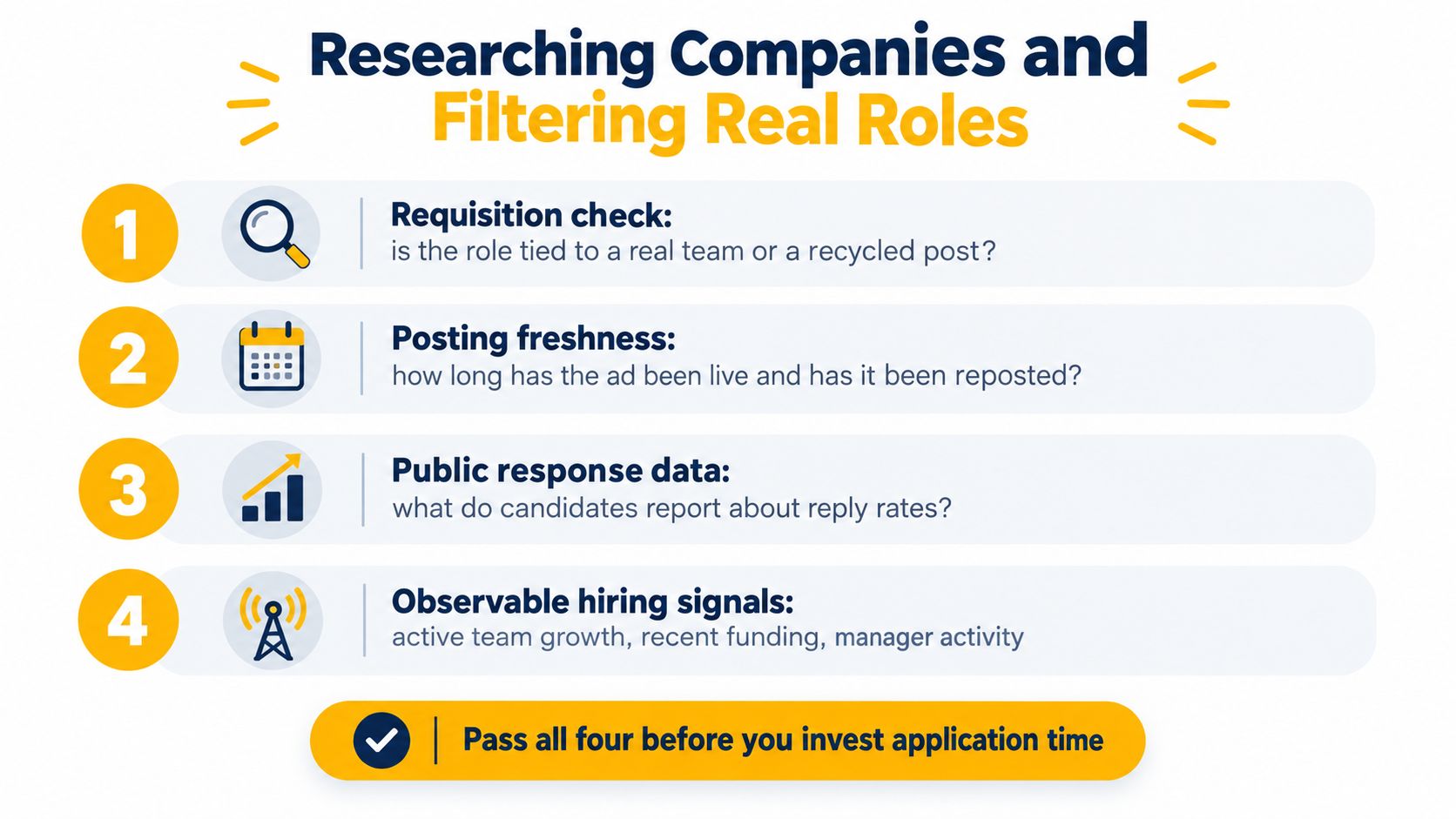
The problem is widespread. In a 2025 Checkr survey, 66% of adults who had actively searched for a job in the previous six months said they had applied for jobs that appeared open but later turned out to be inactive (Checkr's 2025 hiring disconnect report). In 2026, iHire reported that 41.2% of job seekers had encountered a fake or scam job in the previous year, while 39.3% said fake, fraudulent, or ghost jobs were a chief challenge (iHire's 2026 State of Online Recruiting report).
Use a four-signal filter
Check these signals before tailoring your resume:
- Requisition age: Is the role unusually old, repeatedly reposted, or still active without visible movement?
- Team specificity: Does the description identify a real function, reporting line, location, or hiring manager?
- Hiring history: Has the company posted and closed similar roles recently, or does the same listing keep resurfacing?
- Employee confirmation: Do current employees on LinkedIn indicate that the team is expanding or recruiting?
A posting doesn't need to pass every test to be worth considering. But if it fails two or more signals, archive it with a reason rather than applying automatically. A weak listing can still be legitimate, but it should require stronger evidence before you spend time tailoring materials.
Run a focused company check
Review the company's latest 10-Q if it's publicly traded, recent Glassdoor reviews dated within the last several months, two current employee LinkedIn profiles, and a recent press release. Look for consistent clues about team growth, leadership changes, layoffs, product direction, and the actual scope of the role.
Don't treat one negative review as decisive. Look for patterns in communication, management, workload, and interview coordination. You can also use this company culture research guide to structure the questions you ask before applying.
The purpose isn't to eliminate every uncertain opportunity. It's to reserve your best effort for roles with credible hiring signals and to recognize when a company is asking candidates to provide free pipeline data.
Running the Application Workflow Day to Day
Treat applications as a daily operating rhythm, not a weekend sprint. A focused morning block is enough to scan new listings, run them through your filter, and sort them into three groups: apply now, apply later, and skip.
The apply-now group should receive the most attention. Rework the top three resume bullets so they reflect the posting's language without copying it mechanically. If the role emphasizes launch coordination, stakeholder management, and process design, make those themes visible near the top. Reorder your skills so the most relevant capabilities appear first.
Don't attach a cover note by reflex. Write one when the employer asks for it or when you have a specific angle, such as a referral, a portfolio link, a relevant domain insight, or a clear explanation for an unusual career move. A short, specific note is useful. A generic paragraph about being passionate is not.
Keep quality visible in the workflow
For the apply-later group, record the reason and a follow-up date. The role may need more research, a referral, a portfolio update, or a conversation with someone on the team. If you don't set the next action, apply later usually becomes never.
Reserve a second work block for warm outreach. Send two to three personalized messages to potential referrers, former colleagues, recruiters, or hiring managers. Mention something concrete from the role or company. “I saw your team is working on enterprise onboarding, and I've led a similar process redesign” gives the recipient a reason to respond. “Can you refer me?” gives them administrative work without context.
Cap daily applications at a number you can defend with quality, usually five to eight. That isn't a universal quota. It's a guardrail against turning fatigue into a strategy. Ultimately, log responses, referrals requested, roles archived, and follow-ups scheduled, not just the number of submissions. A practical job application tracking method can help keep those records connected to your daily decisions.
Preparing for and Running Real Interviews
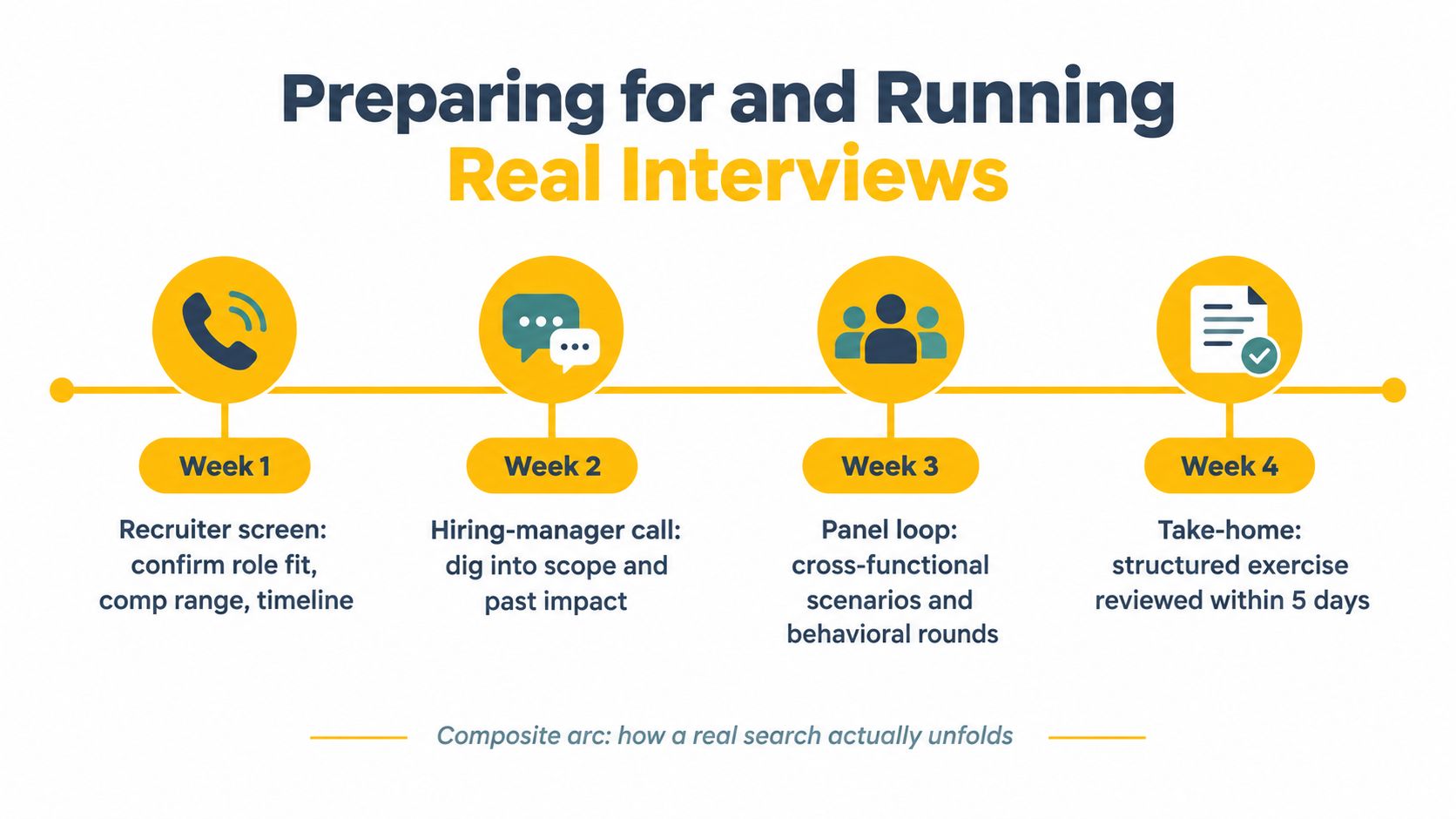
Consider a composite candidate, Maya, a mid-level product operations professional moving through a recruiter screen, a hiring-manager call, a panel loop, and a take-home exercise. Maya doesn't prepare the night before. Forty-eight hours before the first conversation, she rereads the job description and writes down the three problems the team is probably hiring her to solve.
She prepares two stories for each likely competency. Every story includes the situation, her decision, the action she took, and a measurable result. She doesn't memorize a speech. She creates enough structure to answer clearly without sounding rehearsed.
Give each interview a different job
During the recruiter screen, Maya focuses on logistics, compensation range, reporting structure, and role clarity. She wants to know whether the opportunity is real and whether the basic conditions fit before spending time on preparation.
For the hiring-manager call, she opens with a 90-second summary of her relevant work. Then she asks what the team needs to accomplish, which problems have resisted previous attempts, and what success would look like in the first 90 days. Those questions shift the conversation from biography to business need.
In the panel loop, Maya treats each interviewer as a separate stakeholder. A peer may care about collaboration, a technical partner may care about operational judgment, and an executive may care about prioritization. She takes notes between rounds and adjusts examples without changing the underlying facts.
Treat take-homes as mutual evaluation
Before starting an exercise, Maya confirms the expected scope, deliverable, evaluation criteria, and deadline. If the prompt is ambiguous, she asks clarifying questions. She submits work she can defend in a live discussion, not an elaborate presentation designed to hide uncertain thinking.
Close every interview by asking about next steps and timing. Candidates often avoid the question because they fear appearing demanding. Clear process questions help you manage preparation, identify delays, and decide how much time to keep investing.
Following Up, Evaluating Offers, and Logging Outcomes
The post-interview window is where candidates often give away power. Send a same-day thank-you note that refers to one specific topic from the conversation. Mention the product problem, operating challenge, or team priority you discussed. A generic message that could have gone to any company adds little.
If the stated timeline passes, follow up at day five and again at day ten. Keep the message short and ask whether the process is still active. If there is no response after that, move the role to a cold-parked state in your tracker. Don't keep checking your inbox indefinitely. The documented silence is an outcome.
Research reinforces why this matters. A 2025 Greenhouse survey of 2,200 candidates across the U.S., U.K., and Ireland found that 63% felt left in the dark after interviews, with Gen Z reporting the issue at 78% (Greenhouse candidate experience findings).
Evaluate the whole offer
When an offer arrives, don't judge it by the headline salary alone. Score the base, bonus, equity, benefits, growth trajectory, manager quality, role scope, and working conditions. Use the same criteria for every offer so excitement doesn't distort the comparison.
| Criterion | Weight | Offer A Score (1-5) | Offer B Score (1-5) |
|---|---|---|---|
| Base compensation | |||
| Bonus or variable pay | |||
| Equity or long-term value | |||
| Benefits and flexibility | |||
| Role scope | |||
| Manager and team | |||
| Growth trajectory | |||
| Company stability |
Use a 48-hour decision window when possible. Speak with two people currently inside the company and one person who has left. Ask what the role owns, how decisions get made, and what caused the former employee to move on. You're not collecting reassurance. You're testing whether the offer matches the story told during interviews.
If the search ends without a hire, log the outcome anyway: ghosted, rejected after finals, rescinded, or withdrew. Record the response time, stage reached, and one lesson. This job application follow-up framework can help you keep follow-ups consistent without sending emotional or repetitive messages.
Building a Weekly Review Loop That Improves the Search
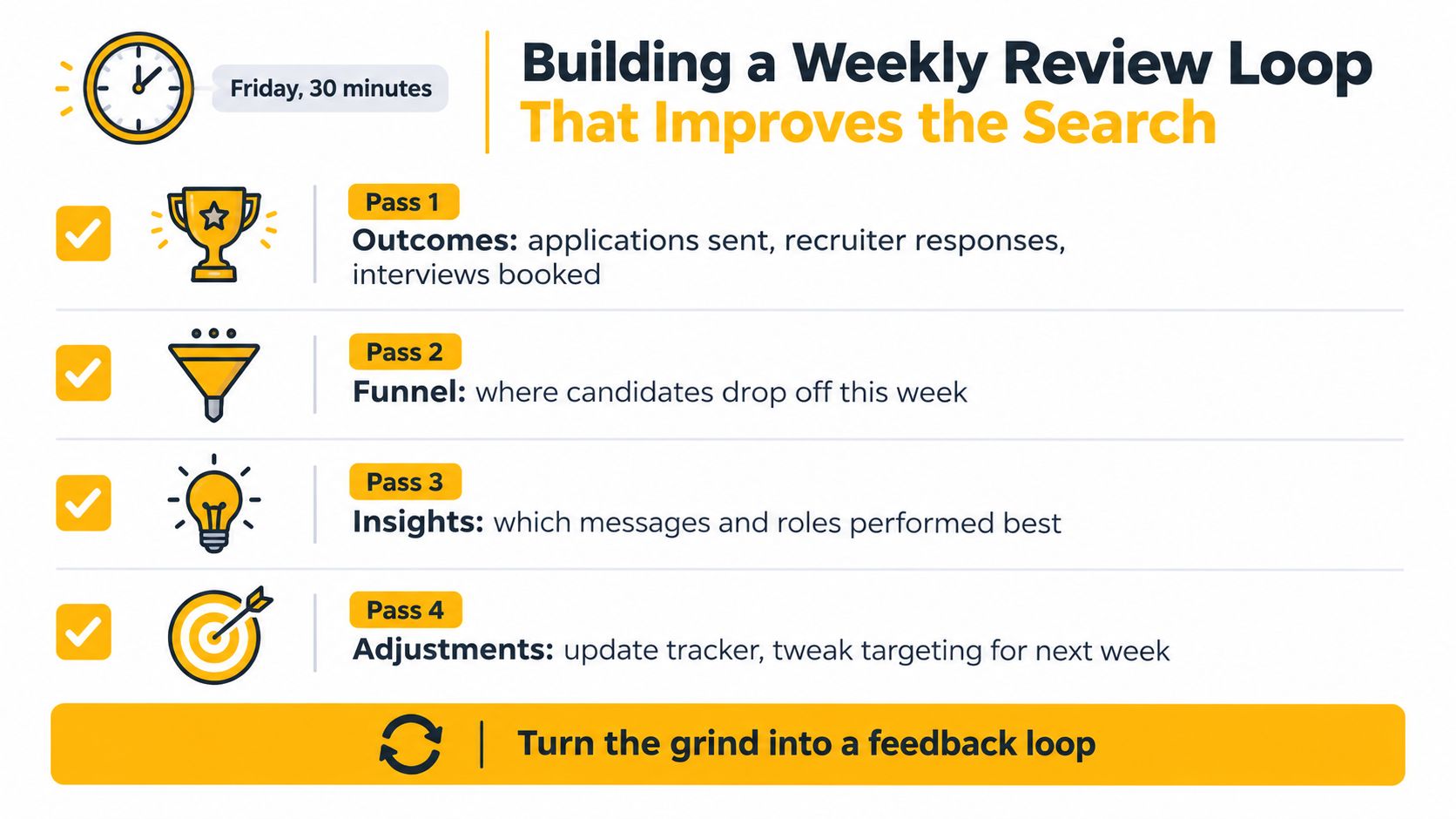
Reserve 30 minutes on Friday for a review. Open the tracker and examine the search like an operating system, not a personal referendum. Your job is to find bottlenecks and make the next cycle more deliberate.
Run four passes:
- Outcomes: Count applications sent, recruiter responses, interviews, offers, and rejections. Mark which roles went silent and at what stage.
- Channel performance: Compare referrals, cold outreach, inbound applications, and job boards. Identify which sources produced replies and which consumed time without movement.
- Message quality: Compare resume variants, cover notes, outreach wording, and portfolio links. Keep the versions connected to conversations. Retire those that repeatedly produce no response.
- Targeting health: Review the companies on your list. If a team has gone dark, a posting keeps recycling, or the role no longer fits, remove it.
Your review should end with three decisions: next week's target list, your application volume cap, and one experiment. The experiment might be a shorter application, a different outreach hook, a referral request sent earlier, or a more selective role filter. Change one variable at a time so you can tell what affected the outcome.
The search gets easier to manage when every closed loop teaches you something. A rejection after a recruiter screen may point to role fit or positioning. No response after many targeted applications may point to channel choice or resume framing. Repeated silence after final interviews may tell you to examine the employers entering your pipeline, not just your interview performance.
The goal isn't to make job searching feel productive. The goal is to make each week produce better decisions than the week before.
Stop treating silence as empty space. Record it, compare it, and use it to decide which companies deserve another application. That habit turns a frustrating search into a measurable process with clearer trade-offs and fewer wasted hours.
Use GhostedBy to check company response patterns before applying, keep roles and stages in a private application board, and report outcomes when employers respond, close the process, or go silent. Start tracking your next applications as evidence, not guesses, so your weekly review reflects how companies treat candidates.