
You've sent the thank-you email, answered every follow-up question, completed the final interview, and heard the same sentence that candidates hear every day: “We'll be in touch.” The interviewer promised an update by Friday. It's now Wednesday, and you're checking your inbox between meetings, refreshing a screen that still contains no decision, no explanation, and no useful next step.
That silence creates a specific problem. A rejection without detail tells you the outcome, but it doesn't tell you whether your examples lacked depth, your technical experience missed a requirement, or another candidate fit the role more closely. Hiring feedback only becomes useful when it connects an observable answer, skill, or behavior to the criteria used for the decision. This guide shows you when to ask, what to write, how to interpret vague replies, and how to turn whatever you receive into a better search.
Table of Contents
- The Silence After the Final Round
- How Rare Hiring Feedback Actually Is
- When to Ask for Feedback Without Sounding Desperate
- Templates That Get Real Answers
- Reading Between the Lines of Vague Replies
- What to Do With the Feedback You Receive
- Turning One Response Into a Better Job Search
The Silence After the Final Round
The first email usually arrives from the candidate, not the employer. You thank the panel for its time, mention one detail from the conversation, and confirm your interest. Then you wait.
On Friday afternoon, you tell yourself the hiring manager is busy. On Monday, you assume the team is finishing its debrief. By Wednesday, the silence has become information, even if it isn't a formal decision. A company that says it will follow up and then doesn't has shown you something about its process, though you still need to distinguish a delayed decision from a closed one.
Candidates generally encounter three outcomes after a serious interview process:
- The polite rejection: You receive a courteous message, but it contains no explanation beyond “we've decided to move forward with another candidate.”
- The complete ghost: No decision arrives, and no one answers your follow-up.
- The useful response: The employer identifies a specific requirement, compares it with evidence from your interview, and explains the gap without turning the message into a judgment about your personality.
The first outcome gives closure. The second gives neither closure nor learning. The third is rare because it requires interviewers to compare notes, agree on job-related evidence, and communicate carefully.
Practical rule: “We'll be in touch” is a process promise, not feedback. Treat it as incomplete until the company gives you a decision or a revised timeline.
Before sending another message, ask what you need. Are you trying to confirm whether the role remains open? Do you want to know why your answer on stakeholder management fell short? Or are you hoping the recruiter will reverse the decision? Those are different requests, and only the first two can produce a productive exchange. If you're dealing specifically with the aftermath of a final round, this guide to being ghosted after a final-round interview can help you separate a delayed response from a pattern of silence.
How Rare Hiring Feedback Actually Is
The gap between a response and useful feedback is wider than most candidates realize. In 2022, 34% of candidates worldwide said they still hadn't heard back from an employer two months after applying, while 58% received an automated acknowledgment or thank-you message and only 7% were told they hadn't received the job, according to SHRM's report on rising candidate resentment. An automated receipt confirms that an application entered a system. It says nothing about the quality of the evaluation.
Feedback collection is also uncommon. Only about one-quarter of nearly 200,000 candidates surveyed globally had been asked for feedback about their recruiting experience at any stage. Among employers that asked, 40% did so only after candidates were hired, while 20% asked throughout every stage. Rejected candidates, who make up most applicants, therefore often disappear from the measurement process entirely.
The problem persists after interviews. In an October 2025 survey of 1,024 candidates, 53% said a potential employer had ghosted them. The most common point was after submitting an application, at 28%, followed by after one interview at 20% and after an initial phone screen at 16%, as reported in iHire's survey of employer ghosting. Silence still appeared after multiple interview rounds, skills assessments, and salary or benefits negotiations.
That unevenness isn't a verdict on your candidacy. Large pipelines create more handoffs, legal concerns make recruiters cautious, and interviewers often treat feedback as an internal score rather than a candidate service. Smaller teams or government hiring processes may use more visible rubrics, while high-volume retail, hospitality, and corporate recruiting can leave candidates with a template or nothing at all.
The practical conclusion is blunt: don't approach feedback as a favor you need to beg for. Treat it as a targeted request for evidence tied to the role. Before investing more time, check whether other candidates report consistent communication from the company. An aggregated view of candidate outcomes, rather than a collection of emotional reviews, is the kind of context available through candidate-experience data on GhostedBy.
When to Ask for Feedback Without Sounding Desperate
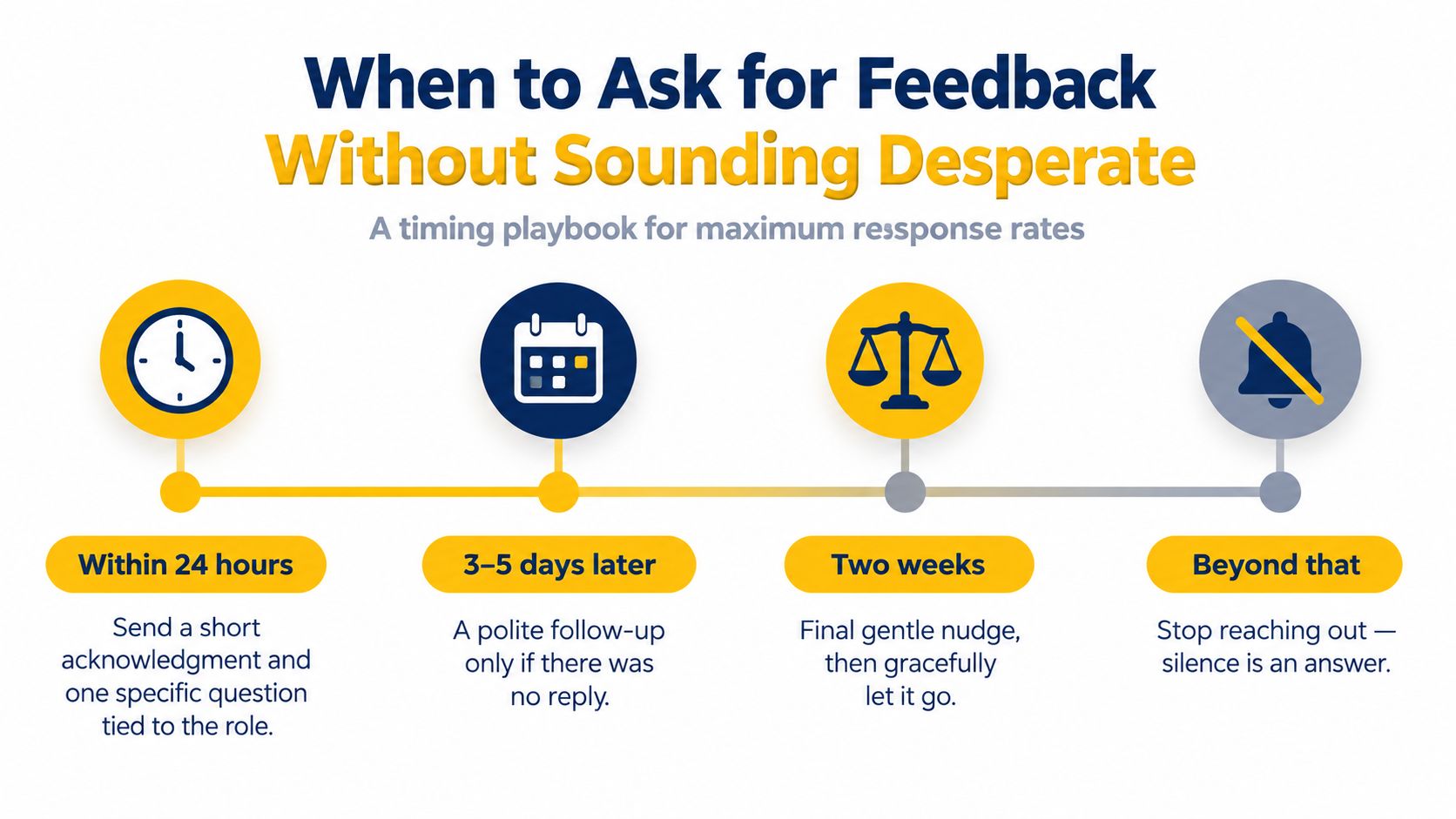
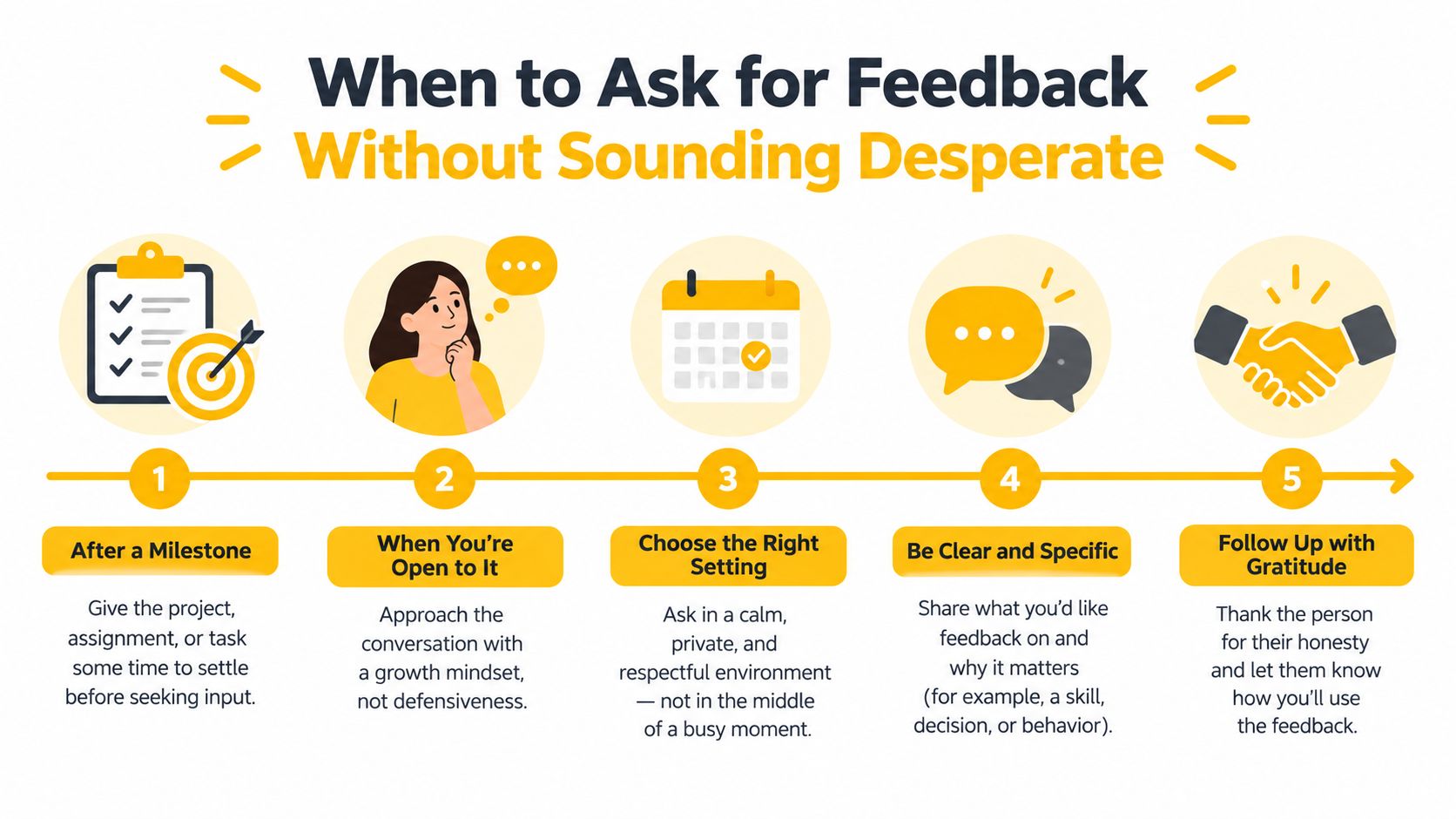
Timing determines whether your request feels professional or like an attempt to reopen a closed decision. The best message is short, specific, and easy for the recipient to answer without reconstructing the entire interview process.
Within 24 hours
If you've received a rejection, acknowledge it promptly and ask one focused question. Tie the question to a stated responsibility, assessment criterion, or skill from the job description. Don't ask, “Why didn't I get the job?” Ask, “Was the deciding gap in my experience with cross-functional delivery, or was it the depth of my examples during the interview?”
This gratitude-led tone recognizes the decision without pretending you're happy about it. The recipient can answer one question, and you avoid sounding as if you expect a full panel report.
At one week
If the employer promised an update and missed it, send one follow-up that references the original date. Keep the message closure-oriented rather than accusatory:
“I'm checking whether there's an updated timeline for the role. If the team has closed the process, I'd appreciate any brief feedback on the requirements where my experience was less aligned.”
That wording does two jobs. It asks for the status, and it gives the recruiter a safe way to provide useful information without promising confidential detail.
After a second silence
Use a different channel once, if you have a legitimate contact. A LinkedIn note to the hiring manager, a reply to the recruiter, or a post-interview survey can work better than sending the same email repeatedly. Change the purpose of the message from pursuit to closure, and don't contact several employees at once to force a response.
Two asks, then move on. Repeated messages won't create a feedback culture inside a company that doesn't have one. Beyond that point, log the silence, protect your reputation, and redirect your energy toward employers that communicate clearly. For broader guidance on following up without over-contacting a hiring team, use this job application follow-up guide.
Templates That Get Real Answers
A good feedback request doesn't require polished corporate language. It needs a clear moment, one relevant criterion, and a question that the recipient can answer without exposing confidential comparisons with other candidates.
After the interview
Subject: Thank you, and one question about the role
Hi [Name],
Thank you for taking the time to speak with me about the [Role] position. I enjoyed discussing [specific project, responsibility, or challenge].
I'm especially interested in how the team evaluates [specific criterion]. If you have a moment, I'd value any quick observation about whether my example of [brief example] demonstrated the level of experience the role requires.
Thanks again,
[Your Name]
This plants the feedback request before a rejection exists. It asks about evidence, not whether the interviewer personally liked you. Keep it to one question. Don't apologize for taking up time, and don't attach a long explanation of why you deserve the role.
After a rejection
Subject: Follow-up on the [Role] interview
Hi [Name],
Thank you for letting me know about the decision. I appreciated the opportunity to meet the team and learn more about [specific responsibility].
If you're able to share one brief piece of feedback, I'd be grateful to understand how my experience compared with the role's needs in [specific criterion]. In particular, I'd like to know whether I needed stronger examples of [skill or behavior], or whether another requirement carried more weight in the decision.
I understand you may not be able to discuss confidential details. Any job-related observation would help me prepare more effectively for similar roles.
Best,
[Your Name]
The sentence about confidential details lowers pressure without weakening the request. You're showing judgment, not surrendering your right to ask. Avoid demanding the panel's notes, asking who beat you, or writing an emotional account of how much time you invested.
After no response
Subject: Closing the loop on the [Role] process
Hi [Name],
I'm following up on my message about the [Role] position. If the team has made a final decision, please let me know when convenient.
If you're able to share one observation tied to the role's criteria, I'd also appreciate feedback on [specific skill, example, or assessment]. If there's no further information available, a confirmation that the process is closed is helpful too.
Thank you,
[Your Name]
This is the final professional nudge. It gives the employer two easy responses, a decision update or a short criteria-linked observation. Use short paragraphs, a neutral subject line, and a normal signature. Never send one massive block of text, apologize repeatedly, or imply that the company owes you a detailed legal explanation.
Reading Between the Lines of Vague Replies
A response is not automatically feedback. Some messages exist only to close the inbox.
“Not the right culture fit” usually tells you almost nothing. It may refer to collaboration expectations, communication style, work environment, or an undefined personal impression. “We went with someone closer to the requirements” is slightly more informative, but it still leaves you without the requirement. “Strong candidate, tough decision” is often a courtesy phrase designed to soften the rejection, not a diagnosis of your performance.
Apply two tests to every reply:
- Does it name a specific skill, experience, behavior, or assessment outcome?
- Does it connect that observation to a requirement for the role?
If the answer to both questions is no, label the message a courtesy response, not useful hiring feedback. Save it for your records, but don't build your next career move around it.
Subjective personality language deserves extra scrutiny. A 2025 interview-feedback report found that 84% of rejected candidates received no interview feedback. Among the feedback that candidates did receive, descriptions were often subjective and differed by gender, with men more often described as confident or level-headed and women as bubbly or pleasant, according to Textio's 2025 interview feedback report.
That distinction matters because “you weren't confident enough” is not a development plan. A useful version would identify an observable behavior, such as answers that didn't explain the decision-making process, and connect it to a requirement, such as leading senior stakeholders through ambiguity.
You can ask one clarifying question:
“When you mention alignment with the requirements, which capability would you recommend I strengthen first?”
If the answer remains vague, stop. Chasing a second layer of interpretation from an employer that has already offered no evidence usually wastes time and can make a closed process feel adversarial.
What to Do With the Feedback You Receive
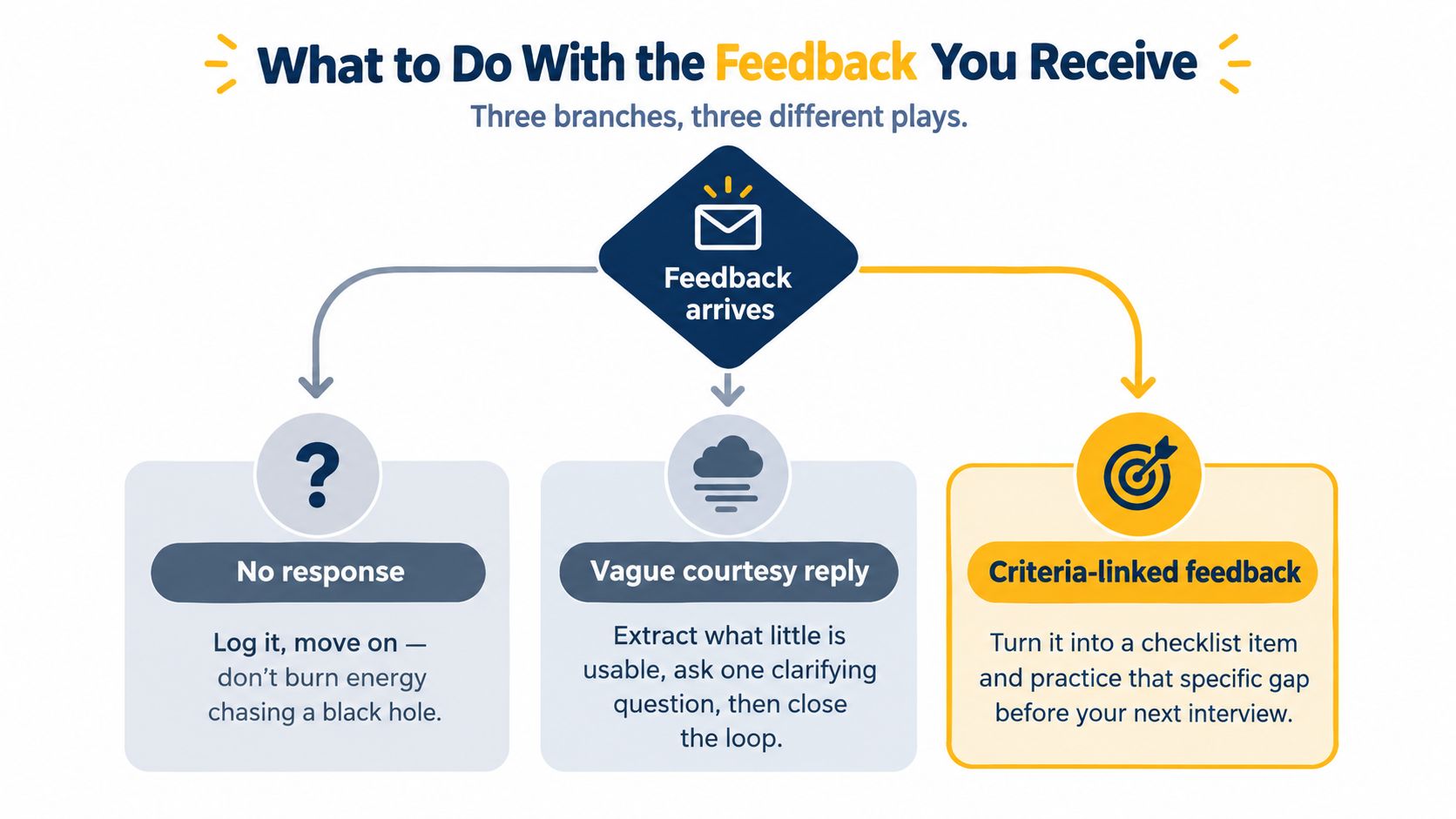
Treat the outcome as a decision tree, not a referendum on your worth. Your next move depends on whether the company gave you information, not on how disappointed you feel.
No response
Record the dates, stage, promised timeline, and last contact. Mark the company as a weak communication signal, then decide whether the role is important enough to revisit later. Don't spend days composing increasingly careful messages for an inbox that has already answered through silence.
Vague courtesy reply
Extract the small amount that may be usable. If the company says another candidate had more experience, compare the job description with your resume and identify the missing evidence. Ask one clarifying question only if the reply names a criterion. Otherwise, close the loop and move on.
You might update the opening of your resume, request a portfolio review from a trusted professional, or practice a clearer example for the next interview. Don't treat “culture fit” as proof that you need to change your personality. Treat it as a signal that the employer failed to describe its evaluation clearly.
Criteria-linked feedback
Turn the message into a concrete practice item. If the panel says your technical answer didn't address trade-offs, write a stronger answer, rehearse it aloud, and add a similar example to your interview preparation notes. If the gap is portfolio evidence, revise the relevant project and ask someone qualified to review it.
Reapplying can make sense when the company invites it or when you can demonstrate meaningful improvement. It doesn't make sense to reapply immediately with the same resume and the same examples. You can also withdraw from the company's pipeline if the process was disrespectful, the role changed materially, or the feedback exposed a mismatch you don't want to solve.
A personal tracker prevents one rejection from becoming a story about your entire career. Log the company, role, stage, date, outcome, exact wording, and tag: skills, experience, communication, salary, culture, or process. A single data point isn't a verdict. Compare it with other interviews, reference checks, and the company's pattern of treating candidates consistently.
Turning One Response Into a Better Job Search
Hiring feedback becomes a skill when you turn it into a repeatable loop. Don't save only the emotional summary, such as “they didn't like my answer.” Save the exact wording, the question that prompted it, the criterion involved, and the behavior you can change.
Use a simple record after every interview:
- Capture the evidence: Write the question, your answer, and the employer's exact observation while the conversation is fresh.
- Tag the gap: Classify it as a skill, experience, communication, salary, culture, or process issue.
- Test the pattern: Compare it with feedback from other interviews before treating it as a stable weakness.
- Create practice: Draft two improved answers, complete a relevant project, or ask for a portfolio review.
- Update the search: Adjust your resume, cover letter, target roles, or company list based on repeated evidence.
Suppose three employers say your examples show execution but not stakeholder management. Rewrite the resume lead-in to make cross-functional ownership more visible. Change the opening paragraph of your cover letter so it addresses that requirement directly. Then prepare two interview answers that explain how you handled disagreement, secured approval, and measured the result.
Company behavior belongs in the same record. Tag each application as responsive, delayed, generic, or silent, and note the stage where communication changed. A company that responds quickly to applications but disappears after assessments has a different candidate experience from one that sends regular updates but provides no meaningful feedback. That distinction helps you decide where to invest your preparation time.
A dedicated application tracker can keep roles, dates, stages, messages, and outcomes together. GhostedBy uses aggregated company-level outcomes, private application tracking, and a defined 21-day ghosting window after the last relevant contact, while individual applications and identities remain private. Its record is designed to show reported response and ghosting patterns rather than subjective written reviews, and percentages are withheld until a company has at least five eligible outcomes.
The useful question isn't “Did they reject me?” It's “What evidence should change how I approach the next role?”
Run the routine after every interview, including the ones that end in an offer. Record what worked, what confused the interviewer, what the company communicated, and whether the role still fits your priorities. Over time, that record turns rejection into selective information and helps you stop spending effort on processes that repeatedly provide none.
Use GhostedBy to check a company's reported response patterns before you invest in an application, then keep your applications, stages, and outcomes organized privately. Start logging your next interview today, request criteria-linked feedback once, and use the record to direct your time toward employers that communicate consistently.