
Approximately 80% of surveyed hiring managers have ghosted candidates, while 53% of surveyed job seekers say an employer has ghosted them. Candidate ghosting is therefore a mainstream hiring problem, not an isolated frustration or a simple story about unreliable applicants.
The important question is where communication stops, what happened immediately beforehand, and whether the process made silence predictable. A candidate who receives no acknowledgment after applying is in a different situation from someone ignored after several interviews, a skills assessment, salary negotiations, or an accepted offer. Treating every disappearance as the same event hides the process failures that recruiting teams can fix.
Table of Contents
- Understanding Candidate Ghosting in Modern Hiring
- Why Ghosting Happens at Every Stage of Recruitment
- Rethinking Who Is Responsible for Hiring Silence
- Strategies Employers Can Use to Prevent Candidate Ghosting
- How Job Seekers Can Track Applications and Avoid Being Ghosted
- Using Shared Hiring Data to Build Better Candidate Experience
Understanding Candidate Ghosting in Modern Hiring
Candidate ghosting means that communication stops during recruitment without a clear explanation or formal closure. The behavior can come from either side. An employer may stop replying after an application or interview, while a candidate may disappear before an interview, after receiving an offer, or shortly before the start date.
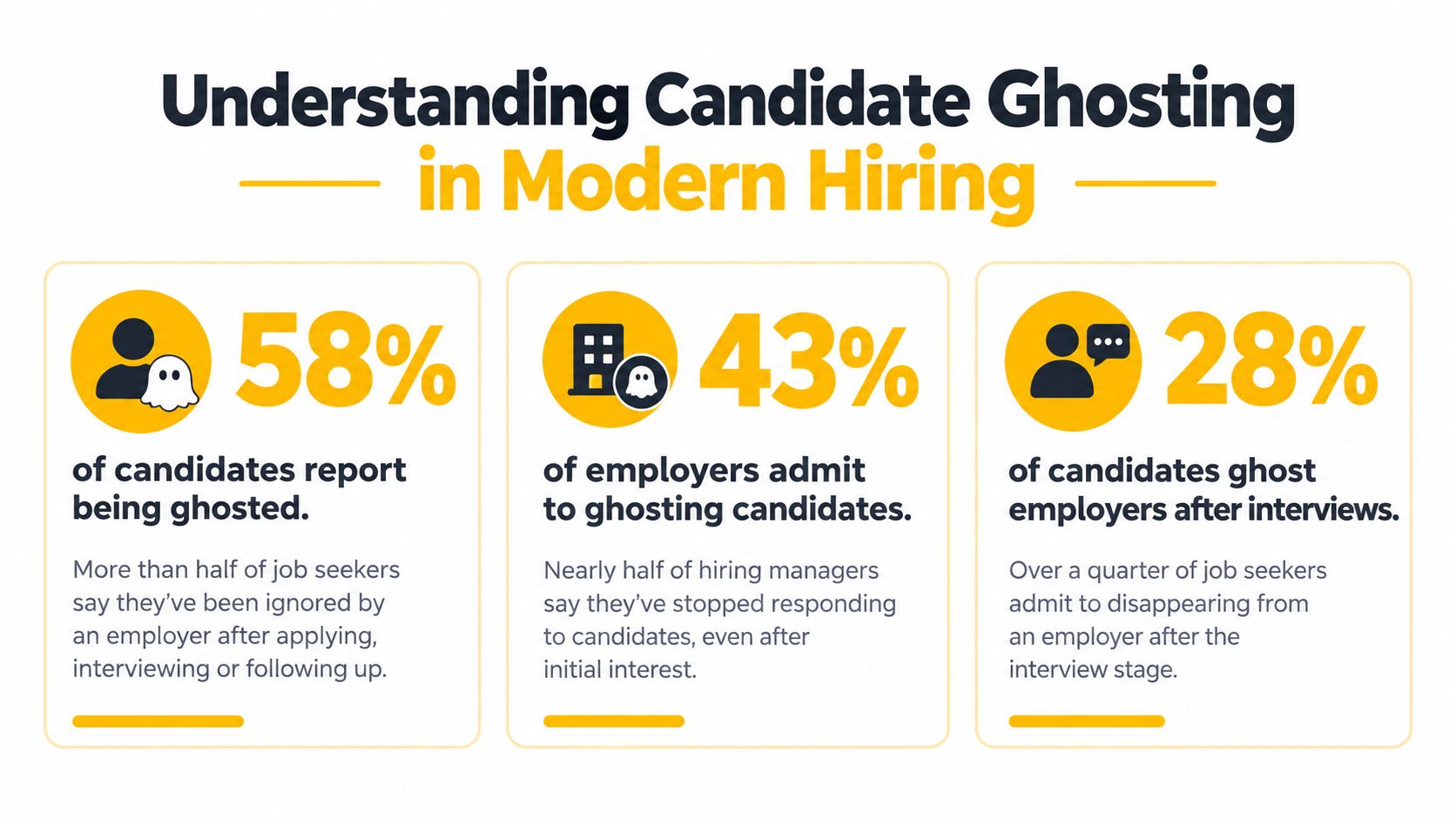
The employer-side pattern is already measurable. A Resume Genius survey of 625 hiring managers reported by HR Dive found that approximately 80% had ghosted job candidates. The breakdown matters: 11% always ghosted, 22% frequently did so, and 47% occasionally did so. Only 20% said they never ghosted candidates.
That distribution tells us more than the headline. Systematic employer silence was less common than occasional silence, which suggests that many failures emerge from overloaded workflows, delayed decisions, unclear ownership, or roles that remain open after hiring priorities change. The candidate still experiences the same outcome, but the intervention differs. A team that occasionally loses communication needs process controls, not a warning about professionalism.
Why stage changes the meaning
Recent candidate evidence confirms that silence can occur well beyond the initial application. An iHire survey of 1,024 candidates found that 53% had been ghosted by an employer during their job search. Among respondents, 11% experienced silence after multiple interview rounds, 9% after completing a skills assessment, and 4% after negotiating salary or benefits.
Those stages represent different levels of investment. An unanswered application wastes attention. Silence after an assessment discards completed work. Silence during compensation discussions can disrupt a candidate's decisions about other opportunities, resignation timing, and financial planning.
A useful candidate-experience record should therefore capture the stage reached, the last employer contact, the expected next step, and whether the company formally closed the process. Candidates looking for a practical definition can also review this guide to candidate experience, because ghosting is best understood as a measurable failure inside that broader journey.
Why Ghosting Happens at Every Stage of Recruitment
Ghosting follows the hiring funnel, but it doesn't look identical at each point. At the application stage, the candidate may never receive confirmation that a human reviewed the submission. After a screening call, silence can indicate that scheduling or feedback ownership broke down. After an offer, the risk shifts toward uncertainty between acceptance and the start date.
The iHire survey provides a clear stage-based view. Alongside the 53% who reported employer ghosting, candidates described silence after substantial interaction, including interviews, assessments, and compensation discussions. The later the disappearance occurs, the more evidence it provides about the process's ability to maintain relationships, not merely process volume.
Candidate behavior also appears in employer-side data. A 2026 peer-reviewed study of 9,040 U.S. respondents found that 3.9% reported experiencing new-hire ghosting within the previous year. This narrower measure concerns people who had accepted an offer and then disappeared, so it shouldn't be combined with applicant ghosting. It does, however, identify a distinct late-funnel risk.
Communication is a measurable control
The same study found that better employer communication was negatively associated with new-hire ghosting, with an odds ratio of 0.56 and a reported interpretation of approximately 44% lower odds of a new hire disappearing. The finding doesn't prove that every communication improvement prevents ghosting, but it supports a practical conclusion: contact quality and cadence should be tracked before a missed start date occurs.
Longer delays between offer acceptance and the start date also increased risk. A candidate who accepts an offer may still face competing offers, counteroffers, administrative uncertainty, and doubts about whether the employer is prepared for their arrival. A signed document doesn't automatically create engagement.
| Recruitment stage | What silence may indicate | Useful measurement |
|---|---|---|
| Application | No acknowledgment, unclear status, or inactive requisition | Date applied and date of first response |
| Interview process | Delayed feedback or missing decision ownership | Last interview, promised update, and actual reply |
| Assessment | Candidate effort not connected to a clear review process | Assessment completion and closure status |
| Offer to start | Weak preboarding or unresolved uncertainty | Acceptance date, next contact, and start confirmation |
This mapping reveals why one overall ghosting rate is insufficient. A recruiting team can have acceptable application acknowledgment while losing accepted hires during preboarding. Conversely, a team may retain finalists but leave early applicants without closure. The denominator and stage determine the diagnosis.
Rethinking Who Is Responsible for Hiring Silence
The common narrative treats candidate ghosting as a reliability problem caused by applicants, often with demographic explanations attached. The evidence supports a more reciprocal interpretation. A recent U.S. survey reported by LiveCareer found that 25% of job seekers had ghosted an employer, while 39% said they would consider doing so after an unfair or poorly handled hiring experience. Accepting another offer was the most common reason.
That doesn't make every disappearance reasonable. Candidates still create avoidable disruption when they stop responding after accepting an offer or scheduling an interview. The data does show, however, that employer behavior can shape the decision environment in which candidates disengage.
Consider two similar outcomes. In the first, a candidate receives a clear timeline, learns that the hiring manager needs more time, and gets a revised decision date. In the second, the candidate hears nothing for weeks after an interview, can't determine whether the role remains active, and receives no response to a follow-up. Both processes may end with a candidate leaving. Only one gives the candidate a usable path to make that decision professionally.
Process failure can make silence rational
A slow or opaque process increases the practical cost of staying engaged. Candidates may be interviewing elsewhere, managing work commitments, or deciding whether to share sensitive information such as resignation plans. If an employer doesn't provide a dependable next step, the candidate has little evidence that continued effort will produce a decision.
This is why demographic generalizations are weak diagnostics. A separate 2025 survey reported that 54% of hiring managers had experienced a Gen Z candidate ghosting after an offer, but that result is self-reported, U.S.-specific, and doesn't establish that age causes ghosting. A stronger analysis asks which stage failed, how long the candidate waited, whether expectations were set, and whether another opportunity changed the candidate's options.
Diagnostic rule: Before labeling a candidate unreliable, record the employer's last contact, promised response date, actual delay, and any unresolved change in the role.
The reciprocal pattern also changes how employers should read their own data. A rise in candidate silence may reflect stronger competition, but it may also reveal delayed feedback, inconsistent messaging, unclear compensation, or a gap between the advertised role and the actual job. Candidate ghosting can be an output metric for employer process quality.
Strategies Employers Can Use to Prevent Candidate Ghosting
Candidate ghosting usually starts as a process gap, not a mystery. Employers lower the risk when every stage has a named owner, a promised response window, and a fallback update if the decision slips. Candidates are far more likely to stay engaged when the process stays legible.
Build communication into the workflow
A useful operating rule is simple: every active candidate record should contain a next-contact date. That field forces a real decision about who replies, when they reply, and what they will say if the hiring team is still waiting on feedback. Without that discipline, internal delay is easy for candidates to read as disinterest, disorganization, or a silent rejection.
The same logic applies after the offer is accepted. Pre-start ghosting often follows long periods with no practical contact, unclear logistics, or no obvious person to ask for help. Employers can reduce that risk by shortening idle time where possible, scheduling check-ins before day one, and treating unusual gaps in pre-start communication as an early warning rather than waiting for a missed start date.
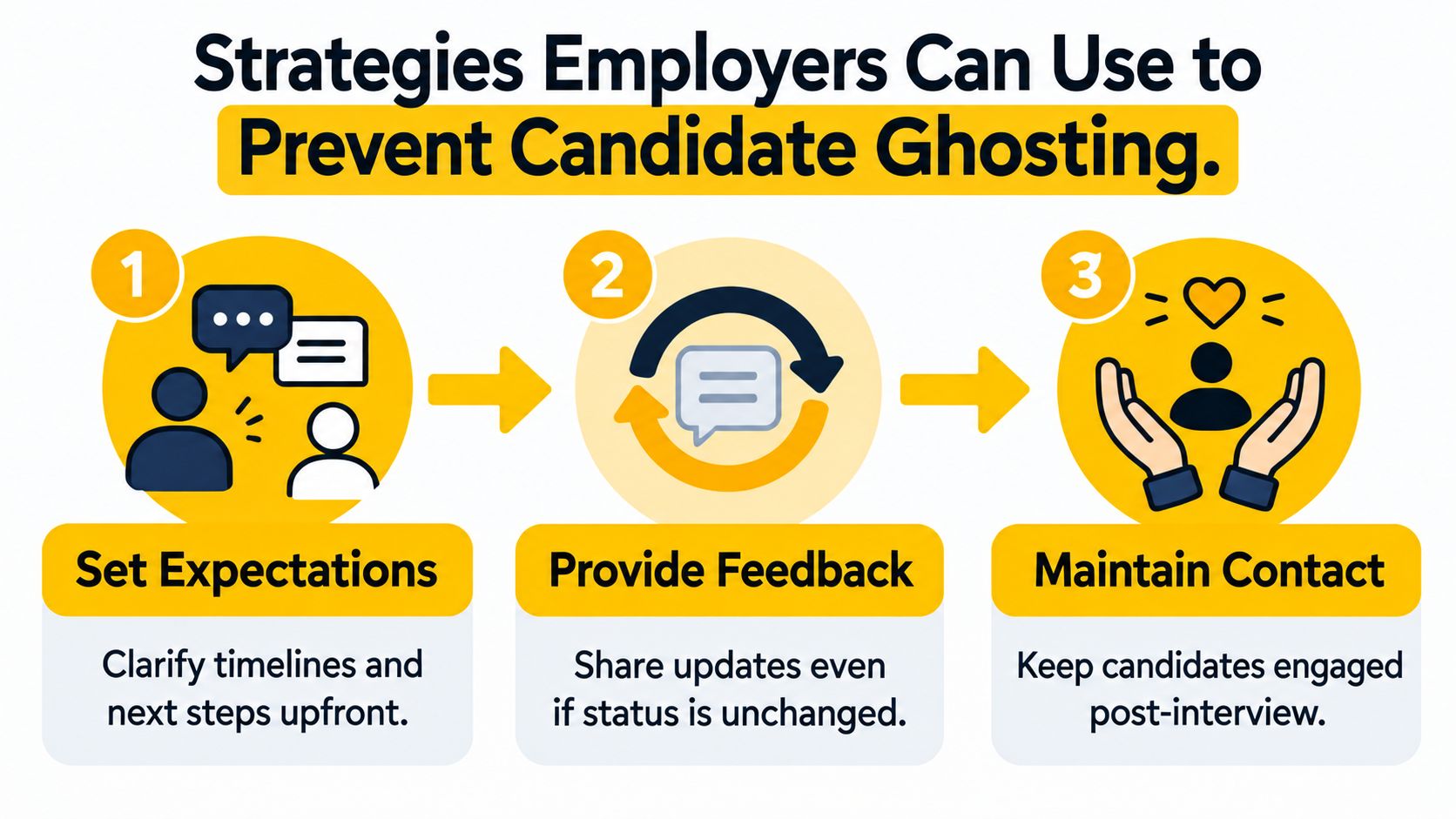
A practical operating model includes:
- Set expectations: Tell candidates when the next update should arrive, who will send it, and which factors could delay the decision.
- Provide interim feedback: If nothing has changed, say that directly instead of letting the promised date pass in silence.
- Maintain pre-start contact: After acceptance, share onboarding steps, confirm logistics, and give the new hire one clear contact for questions.
- Measure response latency: Track the time between a candidate action and an employer reply, then review delays by recruiter, hiring manager, role, and stage.
- Close every process: Use a formal outcome such as rejection, withdrawal, offer withdrawal, or accepted start. “No response” should not function as the default close code.
Use thresholds that expose bottlenecks
Ghosting is easier to prevent when employers separate failure types instead of collapsing them into one rate. Application-stage silence, post-interview silence, and offer-to-start drop-off point to different operational problems. A single dashboard can show all three, but each needs its own threshold and owner.
Counts matter as much as percentages. If one manager has one eligible case, any percentage attached to that case is unstable and easy to overread. A better internal rule is to review patterns only when there are enough comparable outcomes to distinguish a one-off delay from a repeat process problem.
Operational rule: Treat an unusual communication gap as an alert while the candidate can still be re-engaged.
This changes what teams investigate. Instead of labeling a candidate unreliable, look for measurable friction: delayed interview feedback, compensation questions left hanging, conflicting messages from recruiter and manager, or a role that changed after posting. Those are fixable.
Honest uncertainty also performs better than unexplained silence. If the role is paused, say so. If approvals are late, give the revised decision point. Candidates can handle ambiguity when it is named clearly. They are more likely to disappear when they have to infer what the employer will not state.
How Job Seekers Can Track Applications and Avoid Being Ghosted
Candidates can't control whether an employer replies, but they can control the quality of their records and the point at which they stop investing attention. A centralized application log should include the company, role, application date, current stage, last relevant contact, promised next step, and outcome.
The last-contact field is especially important. “Applied three weeks ago” and “completed a final interview three weeks ago” describe very different situations. Recording the event that created the expectation makes follow-up more precise and helps candidates compare companies without relying on memory.
A useful tracking routine includes:
- Record the commitment: Write down when the recruiter or hiring manager said you'd hear back.
- Separate stages: Keep applications, screens, interviews, assessments, offers, and starts as distinct statuses.
- Log every meaningful contact: Note the date and substance of emails, calls, assessments, and compensation discussions.
- Schedule one follow-up: Send a concise message that refers to the last conversation and asks whether the process remains active.
- Protect your options: Continue other applications until the offer is documented and the start process is clearly underway.
Decide when waiting has become inefficient
Candidate expectations vary, but waiting periods can still be measured. A 2026 survey of 962 candidates found that 51.8% considered three days or less an acceptable application-response period, while 20.1% expected an answer within 24 hours. Those expectations don't mean every employer that misses a short window has ghosted. They do explain why long unexplained delays quickly reduce trust.
GhostedBy uses a 21-day inactivity window after the last relevant contact before silence can count as ghosting. That cutoff is conservative compared with the shorter response expectations reported in the survey, and it provides a consistent operational rule rather than asking each candidate to make an emotional judgment.

Candidates can use a dedicated job-search inbox to separate recruiting conversations from daily work and personal messages. A tool such as this application tracking guide can help turn scattered messages into a pipeline with dates and outcomes.
After the relevant cutoff, send a final professional note, mark the process as inactive, and move on unless the employer reopens communication. That approach preserves the relationship while preventing one silent application from consuming attention that belongs elsewhere.
Using Shared Hiring Data to Build Better Candidate Experience
Candidate experience becomes difficult to improve when every silence remains private. A recruiter may see one unanswered message, a candidate may remember one abandoned interview, and neither side can determine whether the event reflects an isolated mistake or a repeated company pattern.
Shared outcome data changes the unit of analysis. Instead of publishing subjective reviews, a system can record whether a company responded, formally closed the process, or went silent after a defined stage. Candidates can then evaluate response patterns before committing time, while employers can identify where communication failures become visible outside their internal systems.
The measurement design matters as much as the interface. A trustworthy record should:
- Use stage-specific outcomes: Application silence shouldn't be combined with post-offer failure.
- Show counts with percentages: Readers need the denominator and the number of eligible outcomes.
- Require a minimum sample: The 2025 Ghosting Index analysis recommends at least five eligible outcomes before displaying a company-level percentage.
- Verify contributors: Email verification can reduce anonymous manipulation while preserving individual privacy.
- Publish rules: Candidates should understand when silence qualifies as ghosting and how the aggregate record is calculated.
Transparency creates a different incentive
Traditional employer reviews often compress many experiences into a narrative about culture or reputation. Structured response outcomes ask a narrower question: did the company communicate at the relevant stage? That narrower question is more actionable for a candidate deciding whether to apply, follow up, or keep interviewing elsewhere.
GhostedBy provides company-level records of reported responses and ghosting, a private application board, stage tracking, outcome reporting, and a 21-day ghosting window after the last relevant contact. It also keeps individual applications private and requires at least five eligible outcomes before showing a percentage, so early records remain counts rather than false precision. Candidates and employers can learn more about the model through its candidate experience data approach.
The broader insight is that candidate ghosting is partly a visibility problem. When employers can't see their communication gaps by stage, they fix them late or not at all. When candidates can't compare reported response patterns, they discover process risk only after investing time. Aggregated, rule-based data gives both sides an earlier signal and makes communication quality part of the hiring decision.
GhostedBy helps candidates check reported company response patterns, privately track applications, and report whether a process received a response, formal closure, or silence. Visit GhostedBy to turn your job search into a measurable pipeline and make employer communication part of your next application decision.