
48% of U.S. job seekers had at least one negative hiring interaction, and 45% were ghosted. That makes a candidate experience survey a measurement problem, not a branding exercise.
Most hiring teams still treat candidate feedback like a sentiment check, then wonder why the process doesn't change. The underlying issue is that silence, delays, and vague closure are process failures that need to be tracked as outcomes, not just feelings.
Table of Contents
- Why Candidate Experience Surveys Matter Now
- Designing a Survey That Measures Experience
- Outcome Tracking Versus Satisfaction Scores
- How Aggregated Outcome Data Complements Surveys
- Sample Questions for Each Hiring Stage
- Timing, Response Rates, and Data Quality
- Turning Survey Findings Into Hiring Improvements
- Building a Continuous Candidate Experience Loop
Why Candidate Experience Surveys Matter Now
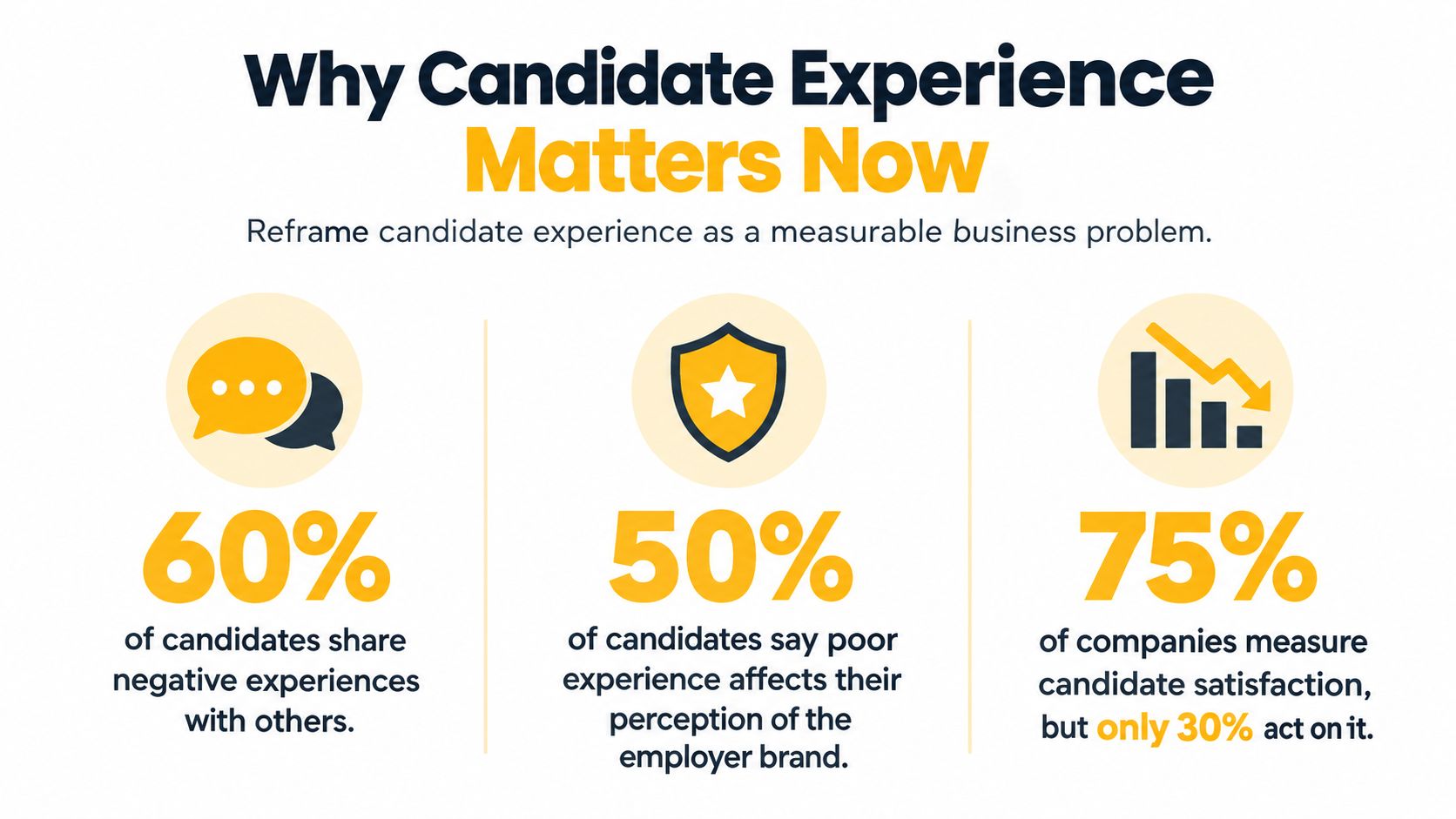
Candidate experience has become an operational signal because hiring silence is common enough to distort employer reputation. In CareerPlug's 2023 survey of 500 people who had applied for jobs in the previous 12 months, 48% experienced at least one negative hiring interaction, 45% said a potential employer had ghosted them, 34% said they never heard anything after submitting an application, and 49% declined a job offer because of a poor experience (CareerPlug's 2023 Candidate Experience Report). Those are not edge cases. They are recurring failure patterns.
The earlier benchmark was similar. In CareerBuilder's 2016 survey of 3,900 American workers, 75% said they had never heard back from an employer after applying, and 82% expected a response regardless of interest (CareerBuilder survey coverage). A response, even a rejection, gives the process closure. Silence signals that no closure logic exists.
Practical rule: a satisfaction score without a process record is usually a vanity metric. If you cannot tell when the candidate last heard from the employer, you do not have a diagnosis.
The main mistake is collapsing the hiring journey into one post-process question. A candidate who received a prompt rejection, a candidate who waited three weeks after interview, and a candidate who never heard back all had different experiences. One end-of-funnel score hides those differences, which is why continuous measurement beats one-time surveying.
A candidate experience survey becomes useful when it separates perception from operational behavior. Ask what happened at each stage, then compare those answers with real process timing. That is how a recruiting team stops collecting noise and starts seeing where the funnel breaks.
what candidate experience means in practice explains the measurement framework in more detail.
Designing a Survey That Measures Experience
A candidate experience survey only becomes useful when it follows the hiring journey as a sequence, not as a memory dump. Application, screening, interview, rejection, withdrawal, and offer decisions each create different failure points. Compressing all of that into one score hides whether the problem was communication, fairness, speed, or closure.
Measure the journey in stages
The strongest design is event-based. Trigger short surveys immediately after the relevant moment, then link the response to process data such as days to disposition, number of interactions, and stage reached. That pairing shows what candidates felt alongside what happened.
Stage-based collection also helps with bias. A longitudinal academic study found response rates falling from 52% after an emailed post-group-interview survey to 42% after a video interview and 36% after the selection phase (candidate-experience cycle study). Late-funnel feedback still matters, but it needs careful interpretation because the people who answer are not a clean proxy for everyone who applied.
Practical rule: ask close to the event, but do not force a response at the emotional peak. A 48 to 96 hour delay after the final decision preserves recall without capturing only raw reaction.
Keep the instrument short and diagnostic
One overall item is not enough. A strong survey includes one broad experience question plus diagnostic items on clarity of expectations, timeliness, respect, fairness, and outcome communication. Use the same anchored scale for each item so you can compare stages and markets without rebuilding the analysis every time.
The survey should also include a binary operational outcome. Did the candidate receive a response, did the process close, did they withdraw, or did they get no response at all? That distinction matters because sentiment alone cannot verify whether the employer communicated.
A practical design looks like this:
- Application stage: short, focused questions on clarity and ease.
- Interview stage: questions on preparation, communication, and respect.
- Rejection or offer stage: questions on closure, transparency, and timing.
That structure turns a candidate experience survey into a diagnostic tool. It can explain where the process failed instead of merely describing discomfort.
Outcome Tracking Versus Satisfaction Scores
Satisfaction scores and outcome tracking answer different questions. A satisfaction score shows how a candidate felt. It does not confirm whether the employer replied, closed the process, or disappeared after the last touchpoint. Outcome tracking records what happened, which is what you need to diagnose process failure.
The gap is visible in applicant behavior. As noted earlier, CareerBuilder's 2016 survey found that 75% of applicants said they never heard back after applying. That is a documented process result rather than a mood. A star rating can still look acceptable while the candidate was ghosted, rejected, or left without closure.
What satisfaction captures and what it misses
A satisfaction survey can measure sentiment, tone, and perceived fairness. That information has value, but it leaves a blind spot when the employer's behavior cannot be checked against the response. Two candidates can give the same score for very different experiences, and the score alone will not show who received clear closure and who waited in silence.
Outcome tracking is more direct. It records whether there was a response, whether the process ended, whether the candidate withdrew, and whether silence followed the last meaningful contact. That makes it possible to compare companies on observable behavior, not just subjective impressions.
Why both should exist together
The strongest measurement stack combines both layers. Outcome data exposes the process, while survey items explain the experience behind it. Together, they separate poor communication from an unfavorable decision, which are different problems and need different fixes.
Candidate-experience reporting should also publish counts before percentages. Counts show how much evidence sits behind a result. Percentages only become useful once the sample is large enough to interpret with care. When companies skip that step, they often make thin feedback look stronger than it is.
Satisfaction measures sentiment. Outcome tracking measures behavior. Hiring teams need both to see where the candidate journey broke down.
How Aggregated Outcome Data Complements Surveys
Surveys are retrospective. Aggregated outcome data is comparative. Put those together and you get a candidate experience system that can show not only what candidates felt, but how a company behaves across time.

GhostedBy publishes aggregated company-level outcomes rather than written reviews or subjective scores, and it requires at least five eligible outcomes before a Ghosted Rating percentage appears, while keeping individual identities, applications, roles, and dates private by default. That matters because it turns isolated complaints into a record you can compare without exposing personal data. The result is less performative than review sites and more auditable than anecdotal feedback. candidate experience data and outcomes
Why aggregation changes the signal
When a system only shows personal stories, the loudest voices dominate. Aggregation smooths out one-off frustration and focuses attention on repeated patterns of response, silence, and closure. That makes the record more useful for candidates who want to assess a company before applying.
A company's public record becomes more meaningful when it's tied to consistent rules. GhostedBy's 21-day ghosting window and threshold for public percentages are examples of that logic. Candidates can see how often a company responds versus goes silent, and they can check that record before deciding where to spend their time.
Why privacy and thresholds matter
Minimum thresholds are not a cosmetic choice. They reduce the chance that a tiny sample creates a false impression, and they keep the emphasis on company-level behavior rather than individual cases. Privacy-by-default design also lowers the risk that feedback becomes a personal grievance log instead of a measurement system.
A good outcome record doesn't reward companies for being loud. It rewards them for being consistent.
Surveys and outcome data complement each other. Surveys explain the quality of the experience. Aggregated outcomes reveal whether the experience was closed, acknowledged, or ignored. Together, they give candidates and hiring teams a clearer view of the same process.
Sample Questions for Each Hiring Stage
A candidate experience survey works best when each stage gets a different question set. Application feedback should be about clarity and friction, interview feedback should test preparation and communication, and rejection or offer feedback should focus on closure and honesty. One survey question can't do all three jobs well.
Stage-based question examples
| Hiring stage | Timing | Sample question | What it measures |
|---|---|---|---|
| Application | Right after submission | How clear was the application process? | Friction and clarity |
| Screening | After the recruiter call | How clearly did the recruiter explain next steps? | Communication quality |
| Interview | After the final interview | How respectful of your time did the process feel? | Process burden |
| Rejection | 48 to 96 hours after notice | How timely and clear was the rejection communication? | Closure and respect |
| Offer decision | After acceptance or decline | Was the role described accurately during hiring? | Alignment and trust |
A compact set of questions is better than a long one. The more time you ask candidates to spend, the more likely they are to abandon the survey or rush through it. Keep the core instrument focused on the moments that shape perception.
Questions that separate communication from fairness
Two candidates can both leave unhappy, but for different reasons. One may feel ignored, while the other may feel the process was fair but the role wasn't right. Your question design needs to distinguish those cases.
Use wording that isolates the issue. Ask whether expectations were clear, whether updates were timely, whether the process felt respectful, and whether the outcome was explained. Then pair each answer with a binary outcome field, such as received response, process closed, withdrew, or no response.
A few strong examples:
- Application clarity: “How easy was it to understand the next step after applying?”
- Interview communication: “Did you receive a definite next step after the interview?”
- Rejection closure: “Was the decision communicated clearly and promptly?”
That gives you data you can act on instead of vague sentiment. It also makes the survey more useful to recruiters, because the answers point toward a specific fix rather than a generic complaint.
Read more question patterns in hiring feedback prompts by stage.
Timing, Response Rates, and Data Quality
Survey timing affects data quality more than many hiring teams admit. Wait too long, and memory gets vague, so answers drift into general opinion. Ask too quickly, especially after rejection, and you capture emotion without enough context to act on it.
The useful window is after the decision has settled but before recall fades. That is why stage-specific timing matters. The decline across stages documented in the academic cycle study cited earlier makes the broader point clear, later responses can be shaped by who stayed engaged, not by the full candidate population.
Read the denominator, not just the percentage
Response rates need context. If a survey shows high satisfaction but only a narrow slice answered, the result may describe the most motivated candidates, not the experience overall.
Publish the denominator, invitation volume, and completion rate with every aggregate result. Without those fields, the number is easy to misread. The same caution applies to segmented reporting, because applicants and interviewed candidates do not behave the same way.
Practical rule: treat respondents as a defined segment, then check whether that segment changed by stage.
Controls that keep the data usable
The send should be triggered automatically when the hiring workflow closes an application or records a final decision. Withdrawn candidates need to be suppressed at the system level, or they will receive irrelevant invites and distort the sample. One response per verified email or application keeps duplicates out of the dataset, and a single reminder is enough to recover missed completions without turning the survey into follow-up spam.
A clean quality checklist looks like this:
- Verified identity: one response tied to one application or email.
- Limited reminders: no repeated chasing that distorts completion.
- Anonymous reporting: candidates are more likely to give candid answers when they do not fear retaliation.
- Stage separation: application, interview, rejection, and offer data should stay separate.
These controls matter because most survey noise comes from process, not from sentiment. Without them, the results look precise but tell you very little. With them, the survey becomes data a recruiting team can use to spot where the process breaks down.
Turning Survey Findings Into Hiring Improvements
Data only matters when it changes behavior. If low fairness scores don't trigger a review, or if application silence doesn't change the process, then the survey is just documentation of the problem. Operational intelligence starts when the hiring team uses the feedback to alter a workflow.
Use the data to find the failure point
Low fairness scores often correlate with long unexplained delays. Communication scores often improve when candidates get a definite next step instead of a vague “we'll be in touch.” Those are not abstract observations, they're the kinds of comparisons that turn survey results into process fixes.
Stage-segmented dashboards help because they show where the company is strong and where it isn't. A team may communicate well after interviews but remain silent after applications. Without stage-level data, that pattern stays hidden behind an average score.
Set decision triggers for action
A recruiting team needs thresholds for intervention, even if those thresholds are internal rather than public. If application acknowledgment drops, review the auto-response and recruiter routing. If interview feedback turns negative, audit scheduling, interviewer prep, and next-step clarity. If rejection scores fall, rewrite the message and tighten the turnaround time.
That logic matters because candidate experience problems usually sit in operations, not in branding. A polished careers page won't fix a broken disposition process. A better survey can show you exactly where the process is leaking trust.
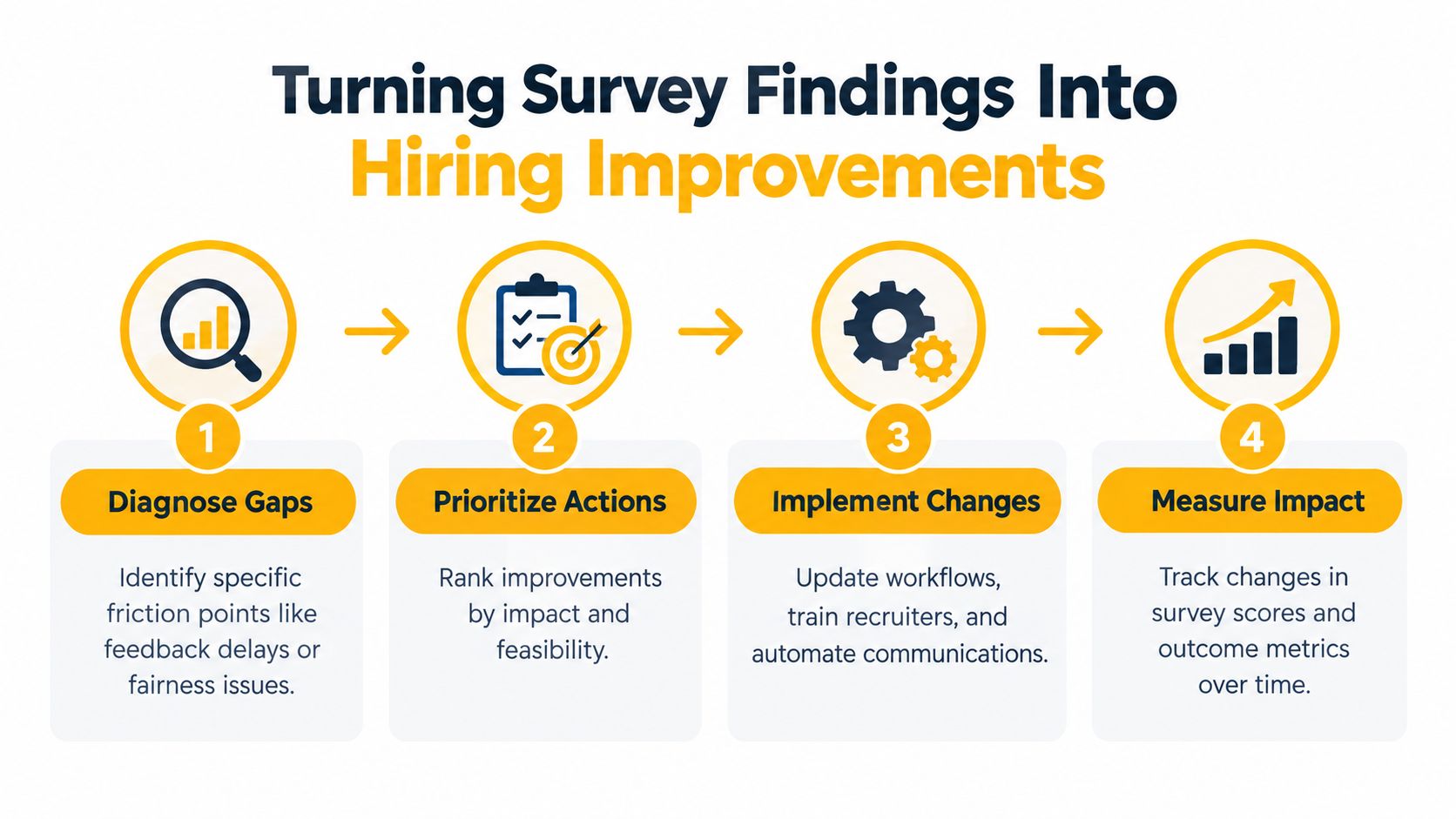
The point is to close the loop visibly. If you change the process based on candidate feedback, tell future candidates what changed. That turns feedback into a management discipline, not a reputation repair tactic.
Building a Continuous Candidate Experience Loop
A strong candidate experience program is a loop, not a report. You collect feedback at multiple stages, pair perception with outcome data, protect the quality of the sample, and then change the hiring process based on what the data shows. That's how the survey becomes an operating system instead of a postmortem.
The loop also forces harder thinking about automation. Candidates may accept AI in hiring, but they still want human accountability and clear explanations. Separate automated acknowledgment, status updates, human review, rejection explanations, and contact channels if you want to know which forms of automation build trust and which ones just make silence feel colder.
The same applies to the metric itself. A higher satisfaction score doesn't automatically mean a better hiring process, especially if the survey misses stage-level ghosting or closure failures. The better question is whether the company can show who heard back, who didn't, and how the process changed after the feedback came in.
GhostedBy publishes company-level response and ghosting outcomes so candidates can see how employers behave before they apply. If you want a clearer record than a star rating or a one-off complaint, visit GhostedBy and use the data to compare companies before you invest your time.