You're about to apply for a job, and you do what people do now. You open the company profile, scan the stars, read a few comments, and try to answer a bigger question than the page can really answer. Not just “Do employees like it there?” but “If I spend an hour tailoring this application, will anyone reply?”
That's why employer reviews feel so important. They give you something concrete when the rest of the hiring process feels opaque. A few paragraphs from current or former employees can seem more useful than a polished careers page because they sound lived-in. They can warn you about chaotic management, unrealistic workloads, or a healthy team culture.
But they can also leave out the one thing many candidates care about most: response behavior.
A company can have warm reviews about culture and still run a slow, silent hiring process. Another company can have mixed sentiment from employees but a disciplined recruiting team that closes the loop with applicants. If you only read reviews, you may confuse workplace sentiment with hiring reliability.
That's the shift worth making. Treat employer reviews as one signal, not the whole answer. They tell you how people describe an employer. Outcome-based records tell you what happened after candidates applied. Put together, those signals are much more useful than either one alone.
Table of Contents
- Introduction Why Employer Reviews Feel Essential Before You Apply
- What Employer Reviews Are and How They Work
- Why Written Employer Reviews Can Mislead
- How Outcome Based Records Differ From Subjective Reviews
- How to Use Both Signals When Evaluating Companies
- Reading Patterns Without Overreacting to Single Data Points
- Making Smarter Application Decisions With Better Information
Introduction Why Employer Reviews Feel Essential Before You Apply
You spot a job that looks promising, open the company profile in another tab, scan the star rating, and read a handful of comments. One review praises a supportive manager. Another describes confusion and delays. By the time you finish, you are trying to answer a bigger question than the page was built to answer: if you put real time into this application, is this company likely to respond?
That is why employer reviews carry so much weight before you apply. They feel like a window into the company before you spend an hour rewriting your resume or drafting a cover letter. Reviews give you something the careers page usually does not. Friction, praise, complaints, and small details that sound lived rather than polished.
The habit is common enough that reviews now shape first impressions before a candidate ever clicks Apply. A 2025 Glassdoor employer branding statistic reported that 86% of candidates check employer reviews before applying, according to this Glassdoor statistics roundup.
Why reviews became a default filter
Reviews help because they fill a trust gap. A company describes itself the way a restaurant writes its own menu. Reviews sound more like diners comparing what arrived at the table. They are incomplete, sometimes emotional, and still useful because they add texture that official messaging leaves out.
They also help you sort limited time. If you are choosing between several openings, you need a quick way to decide where to focus. Reviews can surface patterns around manager quality, workload, advancement, and whether employees sound energized or worn down.
Read reviews as sentiment signals, not final answers.
That framing matters. Written reviews are good at capturing how people felt. They are much less reliable at answering an outcome question such as whether recruiters acknowledge applications, schedule interviews promptly, or close the loop after a final round.
If you have ever tried to decode scattered comments about culture, broader company culture research can help clarify what candidates and employees often mean by terms like “healthy culture” or “toxic culture.” Even then, one important gap remains. Sentiment tells you how the company is described. It does not tell you what usually happens to applicants.
That is the missing layer job seekers often need. Employer reviews can point to workplace sentiment. Outcome-based records such as Ghosted Ratings answer the question reviews rarely answer: will this company reply?
What Employer Reviews Are and How They Work
Say you open a company review page before applying. In a few seconds, you see stars, short quotes, and category scores for pay, leadership, or work-life balance. It feels like a shortcut, but it helps to know what that page is made of.
At a basic level, employer reviews are public submissions from people who say they worked at a company, interviewed there, or went through some other direct experience with it. Review platforms collect those submissions and sort them into a company profile. That profile usually combines ratings, written comments, and labels tied to topics such as management, compensation, or hiring.
The restaurant comparison still fits here. A review page works like a stack of diner feedback pinned to the wall. One person comments on service, another on price, another on whether they would come back. Over time, those separate reactions start to act like a reputation summary, even though each person only saw one slice of the full experience.
What gets submitted
Review platforms usually collect two kinds of input.
Structured input is the sortable part. It includes star ratings, yes or no recommendations, and category scores. This is what lets you scan ten employers quickly and spot rough differences.
Written input is the explanation. People describe what happened, how they interpreted it, and how the experience felt from their seat.
Those two layers do different jobs:
- Ratings help you compare quickly. They compress a lot of reactions into a fast first read.
- Written comments explain the rating. They show what someone meant by “supportive manager” or “chaotic culture.”
- Repeated themes shape the company's public image. One review may be an outlier. A theme that shows up again and again deserves more attention.
This is why employer reviews are best read as sentiment signals. They tell you how people describe the company and how strongly they felt about it.
How platforms turn comments into a company profile
A review site is not just a comment box. It is an organizer.
Once submissions come in, the platform groups them by employer, often adds averages, and may break results into categories like career growth, leadership, benefits, or interview experience. That design makes scattered stories feel more stable than they really are. Averages look settled. Written comments remain messy.
That combination is useful, but it can also blur an important distinction. A company can earn decent sentiment from employees while still handling applicants poorly. Someone reading only the review page may come away with a clear answer to “How do people feel about working there?” and no real answer to “Will they reply if I apply?”
How job seekers usually read them
Job seekers rarely study every post. They use review pages the way travelers use weather apps. First, they check the headline condition. Then they look closer to see whether the forecast matches their plans.
A practical reading pattern often looks like this:
- Scan the overall score and categories. This gives you the broad mood.
- Read a handful of recent comments. Recent submissions can reflect changes in management or hiring pace.
- Look for specifics that repeat. “No feedback after final interviews” means more when several candidates report it.
- Separate workplace sentiment from hiring outcomes. Reviews may tell you the office feels supportive, but outcome-based records such as Ghosted Ratings address the question reviews often miss: will this company respond?
That last step matters more than many applicants realize.
A review page can tell you whether people sound proud, frustrated, overworked, or supported. It usually cannot tell you, with much precision, what happens after you hit apply. That is why reviews are helpful, but incomplete. They describe sentiment well. They answer response behavior less well.
Why Written Employer Reviews Can Mislead
You open a review page before applying and see a familiar mix. One person says the company is supportive. Another says the interview process was chaotic. A third gives five stars with almost no detail. By the time you finish scrolling, you have plenty of feeling and very little clarity about one practical question: if you apply, will anyone reply?
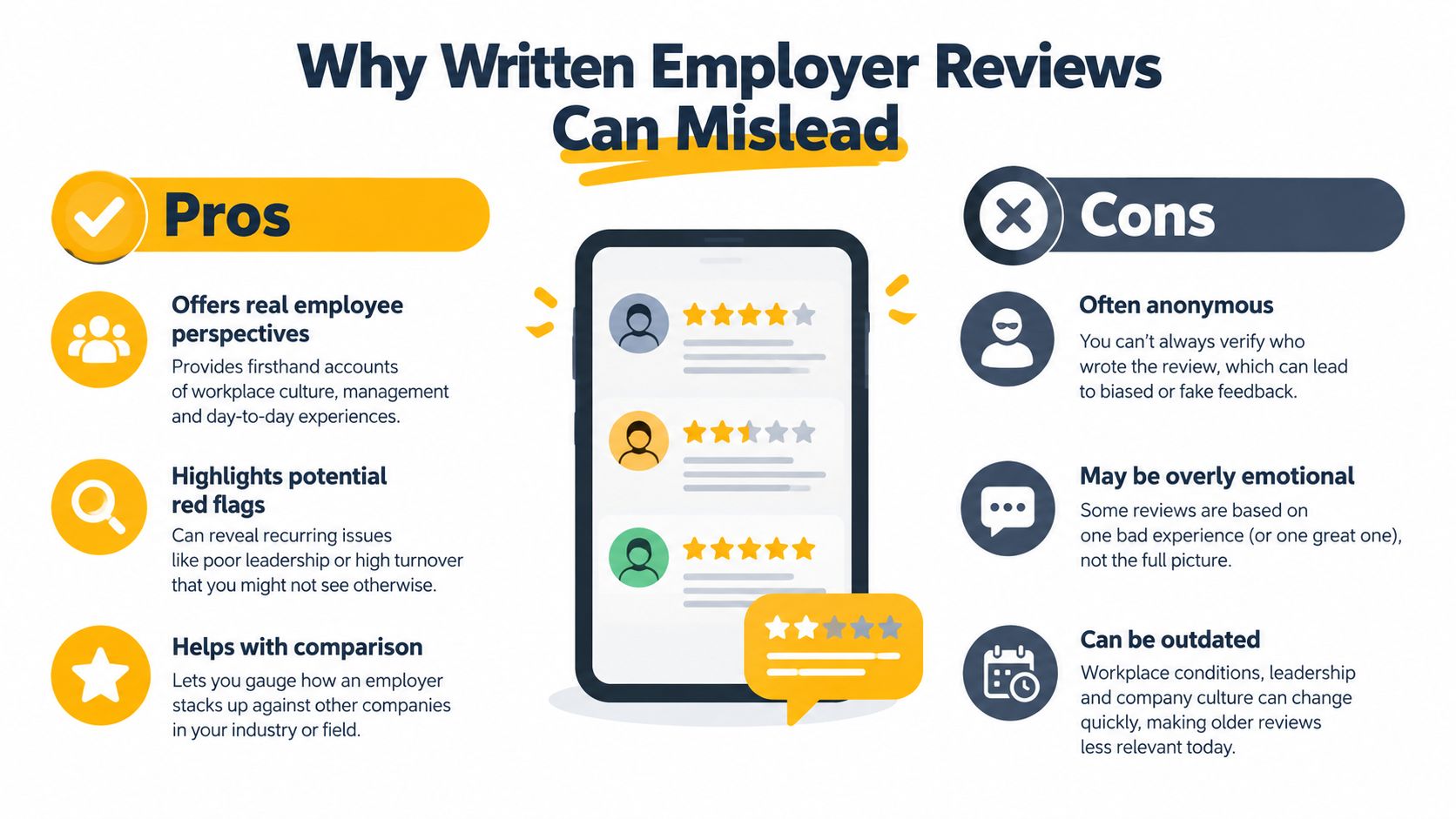
Written reviews often create that problem because they are built from reactions, not from matched records of what happened. They capture sentiment well. They capture hiring follow-through less precisely.
Strong experiences speak louder than ordinary ones
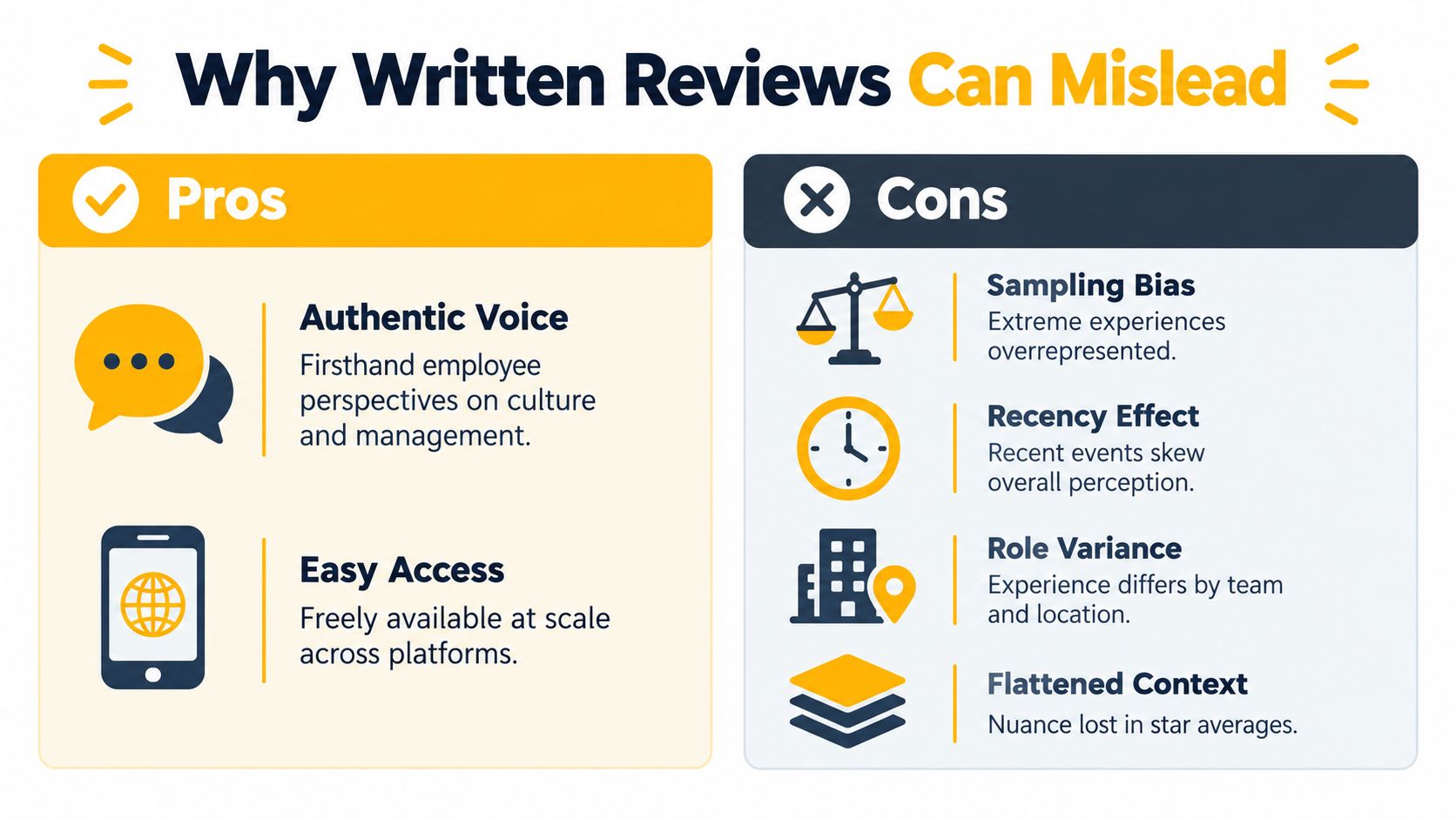
Review pages work a lot like comment cards at a hotel. Guests with a smooth, average stay often say nothing. Guests who had an excellent or awful experience are far more likely to leave a detailed note. Employer reviews follow the same pattern.
That creates sampling bias. The written record can tilt toward emotional extremes, even if the typical experience sits somewhere in the middle.
Timing can skew the picture too. A reorganization, layoffs, a new manager, or a hiring freeze can change review tone quickly. If you read only a small cluster of recent posts, you may treat a temporary shift as if it describes the company at all times.
Role and location matter just as much. A designer in one office, a warehouse associate in another city, and a finance manager at headquarters may all be reviewing the same employer while describing very different systems, leaders, and expectations.
A star rating compresses too much
A single score looks tidy, but job searching is not tidy.
One average can combine current employees and former employees, corporate offices and field locations, senior professionals and entry-level hires, hiring booms and slower periods. That compression makes a review page easy to scan, but harder to trust for a specific decision.
Here is the practical problem:
| What a review suggests | What you still need to know |
|---|---|
| “Great culture” | Do applicants hear back after applying or interviewing? |
| “Management is disorganized” | Is that one department or a broader company pattern? |
| “The interview process was frustrating” | Which stage broke down, screening, interviews, or final decision? |
| “People are friendly” | Are rejected candidates given closure or left waiting? |
That gap matters because a warm workplace and a responsive hiring process are not the same thing.
Hiring friction gets mixed into emotion
A written review often bundles several problems into one conclusion. “Disrespectful process” might mean long gaps between interviews. It might mean a rejection that arrived weeks late. It might mean no response after a final round. Those are different failures, but they can end up sounding identical on a review page.
Research summarized in the Global Journal of Management and Business Research review found that ghosting frequently appears around later hiring stages and is tied to weak communication and slow processes. That matters because it shows why employer sentiment and employer response behavior should be separated. One describes how the experience felt. The other describes whether the process moved.
A candidate cannot use that distinction if the review stays vague.
Practical rule: Treat hiring complaints as more useful when they include stage, timing, and outcome. “No reply after final interview for three weeks” gives you something to evaluate. “Bad process” does not.
Reviews answer mood better than response odds
This is the limit many job seekers run into. Reviews are good at showing broad sentiment signals. They can tell you whether people sound proud, frustrated, burned out, or supported. They rarely answer the narrower question that affects your application strategy: what are the chances this employer will close the loop?
That is why reviews can mislead without being wrong. They point to atmosphere. They do not consistently measure follow-through.
If you treat them as sentiment signals, they become much easier to use. Then you can pair that sentiment with outcome-based response data, such as Ghosted Ratings, to answer the question review pages often leave unresolved: will this company reply?
How Outcome Based Records Differ From Subjective Reviews
You read ten employer reviews. Seven sound angry, two sound glowing, and one is too vague to use. You still have the question that matters before you spend two hours on an application. Will this company respond?
Outcome-based records address that gap. Written reviews capture sentiment signals. They show whether people felt respected, ignored, supported, or burned out. Outcome records track a narrower result. Did the employer reply, close the loop, or go silent long enough to count as ghosting under a stated rule?
That difference changes the job of each signal. Reviews describe the weather. Outcome records check whether the train showed up.
What outcome-based data is measuring
A review usually starts with a story, then asks readers to interpret it. Outcome-based tracking starts with a shared event and applies the same rules across reports.
That structure helps candidates compare employers on one practical point: response behavior during hiring.
One example appears in this guide to company review sites and outcome-focused alternatives. In GhostedBy's model, contributors verify their email address, ghosting can count after a 21-day silence window following the last relevant contact, and a public Ghosted Rating appears only after five eligible outcomes. Those rules matter because they define what counts before a company-level pattern becomes visible.
Subjective Reviews Versus Outcome Based Records
| Dimension | Written Employer Reviews | Outcome Based Records |
|---|---|---|
| Primary unit of information | Opinion, rating, narrative | Reported hiring result |
| Main question answered | What was the experience like | What happened after applying |
| Best for | Culture, management, workplace themes | Response reliability, process follow-through |
| Comparability | Lower, because stories vary in scope | Higher, because outcomes use shared rules |
| Privacy model | Public written commentary | Aggregated company-level reporting |
| Common blind spot | Timing and stage can be vague | Emotional nuance is limited |
| Use in decision-making | Good for spotting sentiment patterns | Good for checking operational consistency |
Why the structure changes the conclusion
A harsh review can come from one bad interaction. A calm review can still hide a stalled process. Outcome-based records reduce that ambiguity because they sort reports by what happened, not only by how strongly someone felt about it.
That is especially useful with ghosting. Silence is easy to describe loosely and harder to compare fairly. A rule-based record creates a shared yardstick, the way a thermostat gives you a number instead of asking whether the room feels cold. For a job seeker, that means less guesswork about whether a complaint points to a pattern or a one-off experience.
Why reviews still matter
Outcome data will not tell you whether a manager gives clear feedback or whether a team has realistic workloads. Reviews still carry that context. They explain the human side of the process.
Used together, the two signals answer different questions:
- Written reviews show sentiment patterns and workplace themes.
- Outcome records show whether candidates report follow-through.
- Your own application notes help you compare what happened to you with the broader pattern.
That combination is the useful shift. Instead of asking reviews to answer every question, you let reviews describe sentiment and let outcome data answer the question reviews often leave open: will this company reply?
How to Use Both Signals When Evaluating Companies
You find a role that looks strong. The reviews sound positive. The job description fits. Then one practical question cuts through all of it: if you apply, will anyone respond?
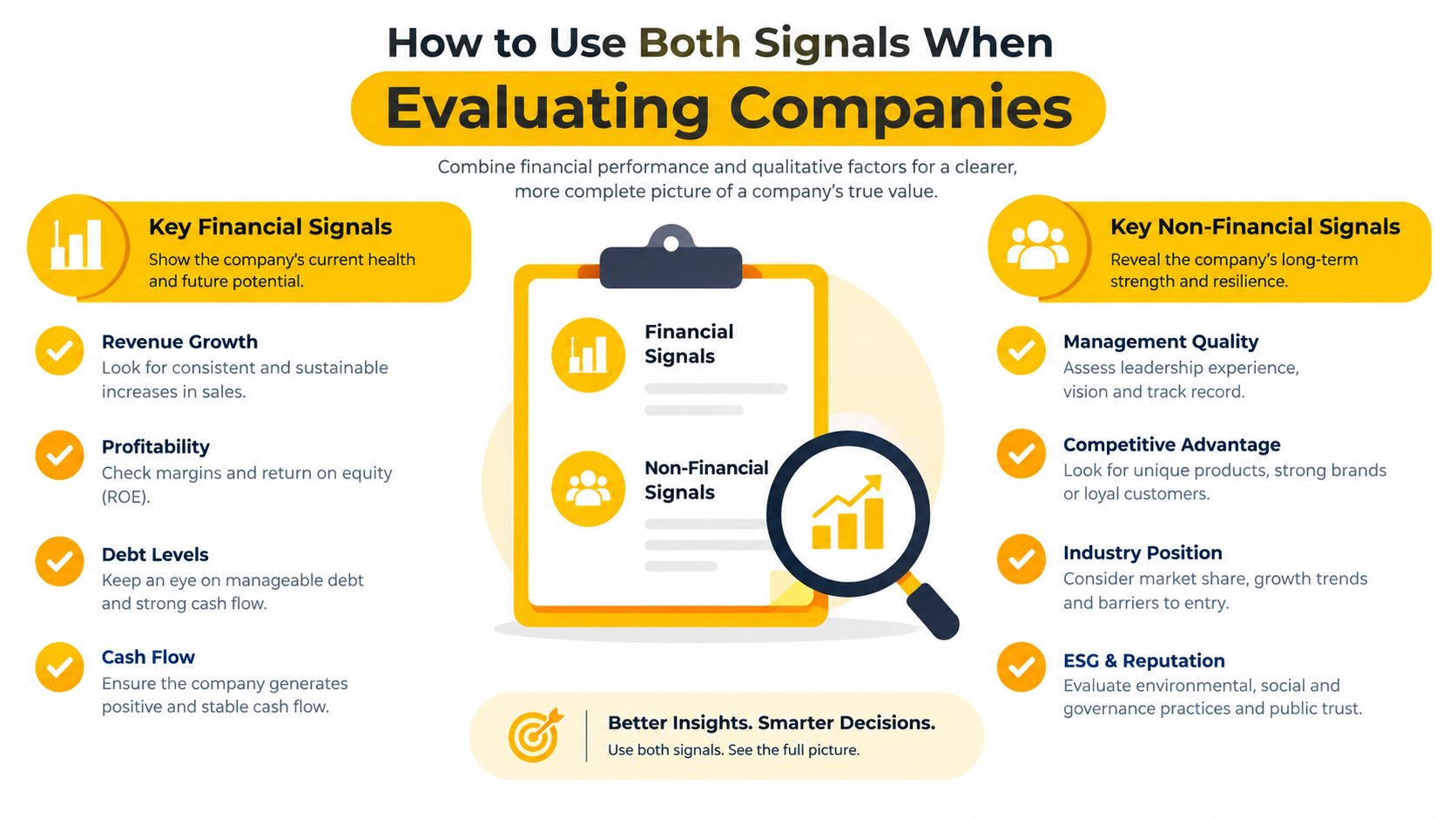
That is where using two signals together becomes useful. Reviews help you judge sentiment. Outcome records help you judge follow-through. One tells you how people felt. The other tells you what happened.
Step one read reviews like a theme map
Treat employer reviews like comments after a restaurant meal. They can tell you whether people liked the experience, but they do not always tell you whether service was consistently on time. Read them for repeated themes, not for a final verdict.
A few questions help:
- Which topics show up again and again? Repeated mentions of disorganized hiring, unclear priorities, or supportive managers matter more than one intense review.
- Does the praise include details? “My manager gave clear feedback” carries more weight than “great company.”
- Does the complaint match your role or team? Feedback from a retail location may not predict an experience in finance or engineering.
Your goal here is simple. Separate mood from pattern.
Step two check outcome data for response behavior
Reviews often blur together very different problems. A candidate may dislike leadership but still get timely updates. Another candidate may say little about culture because the process stopped without a reply.
Outcome-based records help answer the narrower question reviews often miss: will this company respond?
One useful way to compare those signals is to review a Glassdoor alternative that focuses on employer response patterns across the hiring process. That kind of comparison helps you sort two very different risks. One is “employees seem unhappy.” The other is “candidates report silence.”
Those are not the same problem, and they should not lead to the same decision.
Step three keep your own notes while you apply
This part is easy to skip. It is also the part that makes your judgment sharper over time.
A simple tracking system works like keeping receipts after a big purchase. Without it, you rely on memory. With it, you can see what happened and compare your experience with the broader pattern.
Keep a private record of:
- Company and role
- Date applied
- Last message received
- Current stage
- Whether the process still looks active or has gone quiet
A factual tool can help with that. GhostedBy lets candidates check a company's Ghosted Rating, track applications by stage, and report outcomes using set rules such as a 21-day ghosting window and a five-outcome threshold before a percentage appears. Used that way, it adds response data to the sentiment you already get from reviews.
Step four match your effort to the signal mix
Once you have both signals, decide how much time and energy the company deserves.
- Apply with confidence if reviews show healthy team patterns and response data looks steady.
- Apply, but set expectations carefully if the role looks strong and response behavior looks mixed.
- Follow up on a schedule if communication starts well but becomes inconsistent after screening or interviews.
- Reduce your investment sooner if silence appears to be a recurring part of the process.
The point is not to predict every outcome. It is to make a cleaner bet. Reviews show the tone around the company. Outcome data shows whether the hiring process tends to close the loop. Together, they give you a more realistic picture of what applying is likely to feel like.
Reading Patterns Without Overreacting to Single Data Points
A single harsh review can spook you. A single ghosting report can do the same. Neither should control your decision on its own.
What matters is pattern reading. Think less like a detective solving one dramatic case and more like someone checking whether the same issue keeps appearing under similar conditions.

Stage matters more than many candidates realize
Ghosting doesn't happen evenly across the funnel. A Greenhouse report found 61% of job seekers had been ghosted after a job interview, and the share was 66% for historically underrepresented candidates compared with 59% for white candidates, according to the Greenhouse State of Job Hunting report. That tells you something important. “This company ghosts people” is too vague. You want to know where in the process things tend to break.
A separate 2026 study found ghosting occurs most often after interviews and after offer acceptance, with silent offer rejection at 45% and offer acceptance without joining at 42%, while poor recruiter communication at 48.6% and slow hiring processes at 50% were major causes. The same source noted 41% of organizations reported candidates ghosting them during interviews, 51% reported too few applicants, and 48% of employers ranked improving candidate experience as a priority in 2026, according to the International Journal of Research in Digital Marketing and Resource Management study. In other words, context matters. Some messy experiences reflect company behavior. Some reflect a strained market.
What to look for instead of perfection
Use a simple interpretation filter:
- Volume first: A tiny sample can hint at a problem, but it can't define a company.
- Stage specificity: “No response after final interview” tells you more than “terrible process.”
- Consistency: Repeated silence reports matter more than one vivid complaint.
- Recency: Fresh patterns are more actionable than old ones.
- Fit: A problem in one geography or function may not apply to your path.
If a signal changes your mind, ask what exactly changed it. A pattern, or one memorable story?
Business impact helps explain why this matters
Candidate silence isn't just annoying. It changes future behavior. A LiveCareer survey reported 48% of respondents would not apply to a company again after being ghosted, 42% said it would make them trust the company less, and 37% said they would share the experience with others, according to HR Reporter's summary of the survey. That's why response records are worth checking. They don't just describe a company. They shape whether candidates stay in the funnel at all.
Making Smarter Application Decisions With Better Information
Employer reviews are useful when you treat them for what they are. They are sentiment signals. They help you understand how people describe a company's culture, management, workload, and internal reality.
They are not, by themselves, a reliable answer to the question many candidates care about most. Will this company reply?
Outcome-based records fill that gap. They don't tell you everything. They do tell you whether candidates report hearing back, whether silence becomes a pattern, and whether hiring reliability looks different from the company's general reputation.
If you put both together, your decision process gets much stronger. Before you apply, check the tone of the reviews. Look for repeated specifics, not dramatic one-offs. Then check whether there's any structured response record that shows what happened to candidates after they entered the funnel. During your own search, keep dates, stages, and follow-ups organized so silence becomes visible instead of vague.
A short checklist helps:
- Read for themes: Focus on repeated review patterns tied to your likely role.
- Check response behavior: Look for company-level evidence of replies versus silence.
- Note the stage: Application, interview, and final-round experiences can differ.
- Track your own timeline: Don't rely on memory once multiple processes overlap.
- Decide effort deliberately: Strong role, weak response pattern means proceed carefully, not blindly.
Better job search decisions usually don't come from more opinions. They come from better categories of information.
GhostedBy gives candidates a way to check company-level response patterns, privately track applications, and report outcomes instead of posting subjective reviews. If you already use employer reviews to judge culture, it's worth pairing that with a tool that shows whether companies tend to respond or go silent before you spend more time applying.