
More applications don't automatically create better results. They can create more opportunities, but they can also consume time on employers that rarely communicate, channels that produce little response, and roles that receive a generic submission.
Treat your search as a measurable pipeline instead. Choose targets with reasonable evidence of responsiveness, adapt each application to the role, record dates and contacts, follow up within a defined boundary, and use every outcome to improve the next decision. Cold online applications typically produce recruiter contact only about 2% to 3% of the time, while applications submitted within 24 hours can perform 2 to 4 times better than late submissions, according to response-rate and application-timing data from LoopCV. That makes targeting and timing more important than raw volume.
The problem is that silence is now common. Greenhouse reported that 61% of job seekers had been ghosted after an interview in late 2024, while 38% were mass-applying to roles and 18% to 22% of posted jobs on its platform were classified as ghost jobs in a typical quarter, as reported in its 2024 State of Job Hunting report.
The job application tips below turn that uncertainty into decisions you can track. GhostedBy can support company research, private application tracking, and outcome reporting, but the larger advantage comes from building a disciplined process that still works when no platform can predict an employer's next move.
Table of Contents
- 1. Research Company Responsiveness Before Applying
- 2. Organize Applications in a Private Tracking System
- 3. Report Application Outcomes to Build a Collective Record
- 4. Customize Your Application to the Specific Role
- 5. Follow Up Strategically and Know When to Move On
- 6. Use a Dedicated Job-Search Email to Stay Organized
- 7. Optimize Your Resume and LinkedIn for Applicant Tracking Systems
- 8. Leverage Your Network for Referrals and Insider Information
- 9. Prepare for Behavioral and Technical Questions with Specific Examples
- 10. Maintain Persistence Without Desperation in Your Job Search
- 10-Point Job Application Tips Comparison
- Turn Every Application Into Better Evidence
1. Research Company Responsiveness Before Applying
Before you spend an evening tailoring a resume, investigate how the employer communicates with candidates. A company's public reputation matters, but candidate response patterns can reveal a different risk: whether your application is likely to disappear without a clear outcome.
GhostedBy's company records can help you check reported response and ghosting patterns before applying. You can also compare several employers in the same industry to establish a practical baseline for what “normal” communication looks like in your target market. A weak record doesn't prove that your application will fail. It tells you to invest cautiously and keep other opportunities active.
Practical rule: Treat responsiveness as a prioritization signal, not as a prediction of your individual result.
Compare patterns before committing effort
A company with a poor communication record may still offer an excellent role. The useful response is not automatic rejection. Apply if the opportunity justifies the uncertainty, but lower the amount of unpaid research you do before receiving evidence of genuine interest.
Review the company's record alongside its size, hiring volume, role seniority, and application channel. A high-volume employer may have a different process from a small specialist firm, so avoid treating one rating as a complete explanation. Use the information to decide how much time to invest, when to follow up, and how many parallel applications you need.
For more context on evaluating employer communication before applying, read this guide to company hiring practices. Record the reason for prioritizing or deprioritizing each company. That note will help you assess later whether the signal was useful.
2. Organize Applications in a Private Tracking System
An application that lives only in your sent folder is difficult to manage. You may remember the company but forget the exact posting, the recruiter's name, the date of your last contact, or which version of your resume you submitted.
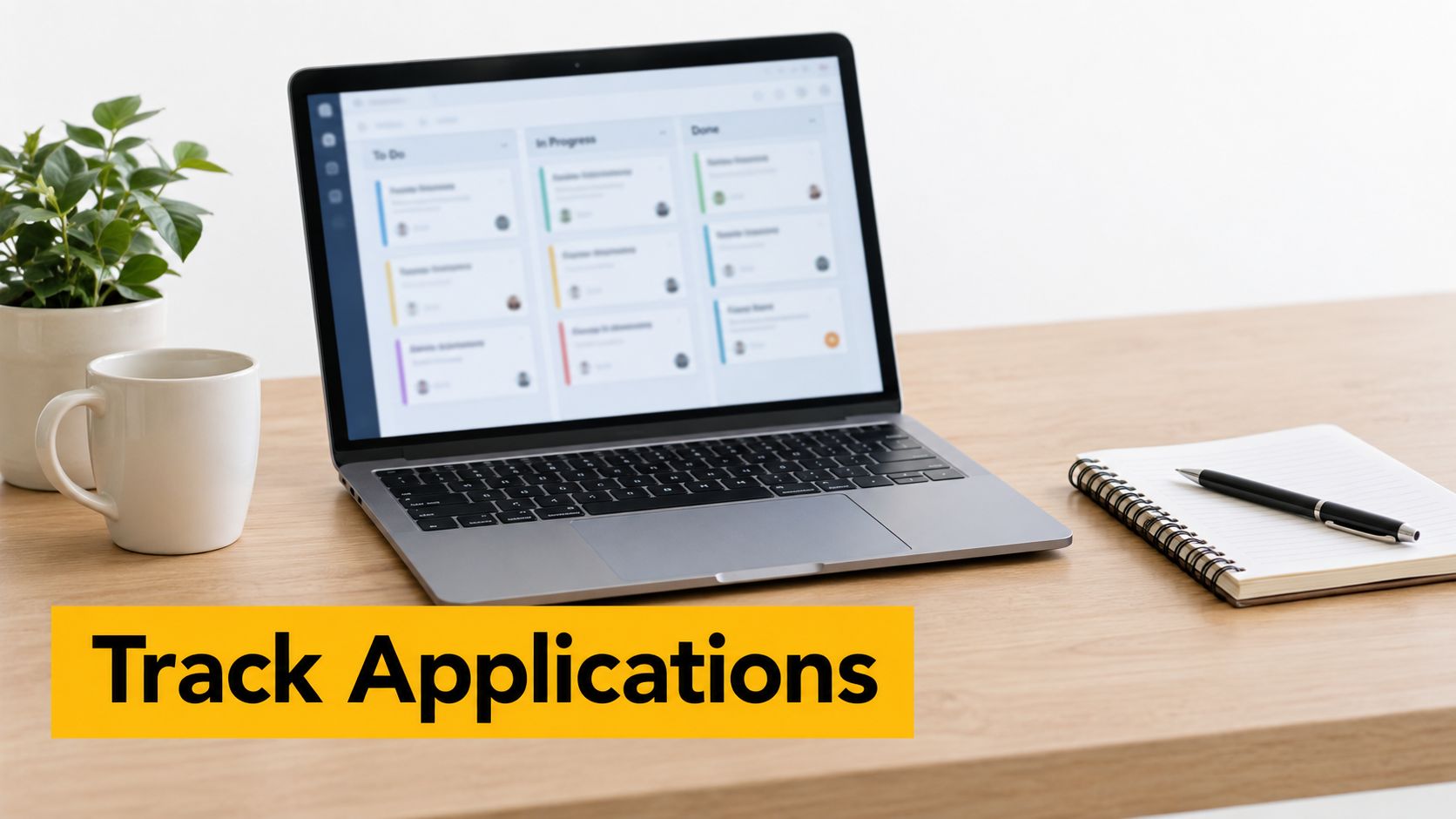
A private tracking system turns memory into evidence. Record the company, role, posting link, application date, source, recruiter contact, materials used, current stage, follow-up dates, and final outcome. Update the record on the same day you apply or receive a message, while the details are still accurate.
Track decisions, not just activity
A board should answer practical questions quickly. Which applications are waiting for a response? Which require a follow-up? Which roles moved forward after a resume written for the role, a referral, or a particular channel? Which companies repeatedly consume time without producing useful communication?
Use stages such as saved, applied, screening, interview, final stage, closed, and ghosted. Add a reminder based on the date of your last relevant contact, not merely the date you submitted the form. This distinction matters because a recruiter reply resets the communication context.
A weekly review can expose patterns that a daily inbox cannot. If several applications stall after the same stage, refine your interview preparation or targeting. If one channel generates more conversations, allocate more effort there rather than assuming every application route deserves equal attention.
A private job application tracking approach can help keep roles, stages, dates, and outcomes together. The tool matters less than the habit of recording each decision while it happens.
3. Report Application Outcomes to Build a Collective Record
Silence is easy to dismiss as an individual inconvenience, but repeated silence becomes useful information when candidates record it consistently. Reporting a response, rejection, closure, or lack of communication helps turn an isolated experience into an aggregated company-level signal.
The record becomes more useful when candidates report positive outcomes as well as negative ones. An employer that rejects applicants promptly may still be disappointing, but it provides a very different candidate experience from an employer that never confirms what happened. Reporting only bad experiences would distort that distinction.

Report with a clear boundary
GhostedBy defines ghosting as no response after 21 days following the last relevant contact. That boundary prevents a candidate from labeling a normal short delay as a definitive communication failure. It also gives you a consistent point at which to stop waiting indefinitely and document what happened.
Your individual application details remain private while aggregated company-level information can become visible. According to GhostedBy's published rules, contributors verify their email address, companies need at least five eligible outcomes before a percentage appears, and companies can't pay to improve a rating or remove valid outcomes.
Use the same discipline in your own record. Report promptly after receiving a clear response or after the applicable silence window passes. If an old application still has a missing outcome, documenting it can help fill gaps, but preserve the exact dates and avoid guessing what happened.
For a broader explanation of structured candidate-experience data, see these candidate experience tools. Collective reporting doesn't guarantee a better individual result. It improves the information available for the next candidate's decision.
4. Customize Your Application to the Specific Role
A generic application makes the reviewer infer the match. A specific one makes the connection visible through relevant experience, role-specific language, and a clear reason this employer fits your target criteria.
Read the job description before editing your materials. Mark the main requirements, repeated skills, operating context, and outcomes the employer appears to value. Then select evidence from your background that addresses those points directly. Use the role's terminology where it accurately describes your experience, and pair each important term with a concrete example of how you applied the skill.
The Providence recruiter guidance on applications and interviews recommends researching the organization, matching strengths to the role, and customizing application materials. These actions give you controllable variables to record and compare, rather than relying on application volume to compensate for weak relevance.
Make the evidence traceable
Save the resume and cover letter version submitted for each role. Record which requirements you addressed, which examples you used, and what company research influenced your wording. If the process continues, these notes identify the claims an interviewer may ask you to explain and show which tailoring choices were tested.
Use the company's name only for a specific, genuine reason. Connect its product, operating model, customers, or stated priorities to your experience. Address the hiring manager by name only when you can verify it, then proofread the final files. A typo does not prove poor performance, but it can weaken the impression that the application was prepared deliberately.
Huntr's Q3 2025 trends report found customized resumes converted at 5.95%, compared with 2.9% for non-customized resumes, and reported a median time to first offer of 55 to 71 days during that period, as reported in a peer-reviewed study of job search outcomes and ghosting. These figures do not establish that customization guarantees an offer. They identify a measurable variable: compare customized and less-customized applications alongside role type, evidence used, and outcome.
5. Follow Up Strategically and Know When to Move On
Silence after an application doesn't automatically mean rejection, but waiting without a deadline turns uncertainty into lost time. Your follow-up plan should state when you'll send a message, how many times you'll try, and when you'll redirect your effort.
Send an initial follow-up after 5 to 7 business days when the posting or recruiter hasn't provided another timeline. Keep it short, identify the role, confirm your continued interest, and ask whether the process has moved forward. If there's still no response, space any additional message by at least two weeks rather than sending repeated reminders.
Use the last contact date
The relevant clock begins with the last meaningful communication. If a recruiter replies with a new timeline, record that date and adjust your reminder. If the employer gives no timeline, use your own boundary instead of treating every day of silence as a reason to check again.
After 21 days without a response following the last relevant contact, GhostedBy's framework allows the outcome to count as ghosting. That's a useful documentation point, not a universal law of hiring. Some processes move slowly, so archive the application as low priority while continuing to apply elsewhere.
Independent guidance differs on the precise waiting period. One 2026 Yale career article recommends archiving a process after 7 to 10 business days without movement, while another framework uses 21 days before counting ghosting. The shared decision is more important than the exact threshold: set a limit, record it, and don't let one employer control your search.
6. Use a Dedicated Job-Search Email to Stay Organized
Recruiter messages compete with personal correspondence, newsletters, receipts, and old work conversations when they all arrive in one inbox. A dedicated address gives job-search communication a clear home and reduces the chance that an interview request or scheduling change gets buried.
Use a professional address built around your name, then place it consistently on your resume, LinkedIn profile, and cover letters. Check it daily during an active search. Create labels for companies or stages if you're managing the process manually, and archive messages only after recording the important details in your application board.
Connect messages to applications
The useful connection isn't having another inbox. It's linking each message to the correct role. Record the sender, date, requested action, interview details, and any change in timeline. That context prevents you from replying as though every recruiter message concerns the same application.
An optional agentic inbox can automatically connect job-related emails and updates to the relevant application record. If you don't use an integrated system, apply a consistent subject-line label or folder structure instead. The objective is reliable retrieval, not a particular software setup.
Keep the address after you find a job. Former recruiters, colleagues, and future opportunities may need to reach you later, and a stable professional contact point preserves the history of your search. Separate job communication from personal mail, but don't create an address so complicated that you'll mistype it on every form.
7. Optimize Your Resume and LinkedIn for Applicant Tracking Systems
A resume has to work for two readers. A screening system may need to parse its text, while a recruiter needs to understand your contribution quickly. Dense graphics, decorative columns, images, tables, and unusual headings can make that first task harder without adding evidence of ability.
Use standard headings such as Professional Experience, Education, Skills, and Certifications. Mirror relevant terminology from the job description in your experience bullets and skills section, but use each term in context. If the posting asks for Python, AWS, or microservices, describe where and how you used those skills rather than placing them in an isolated keyword block.
A keyword is useful only when the rest of the application can support it.
Preserve human readability
Choose a simple layout and a conventional file type requested by the employer. Save the file with your name and a clear description, such as FirstName_LastName_Resume, so the recipient can identify it easily. Check the extracted text by copying it into a plain document or using an ATS scanning tool, but treat any score as a diagnostic rather than a hiring forecast.
The DCAA guidance on the USAJobs application process emphasizes concise summaries, bullet points, relevant achievements, simple formatting, and careful reading of the full posting. Those principles apply broadly, although federal applications can have their own requirements.
Keep LinkedIn consistent with the resume's factual record. Expand relevant experience in a readable way, use natural search terms, and remove outdated claims that could create confusion. Keyword stuffing may improve neither parsing nor trust. Every term should help a human understand your fit.
8. Leverage Your Network for Referrals and Insider Information
A network can help in two different ways. Someone inside a company may refer you, or they may give you information about the role, team, communication habits, and hiring timeline before you invest substantial effort.
Start with former colleagues, managers, classmates, alumni, professional communities, and credible LinkedIn connections. Ask a specific question instead of sending a vague request for help. You might ask whether the role is still active, how the team handles interviews, or whether the contact feels comfortable referring someone with your background.
Validate, don't outsource, your decision
A referral is not proof that the role is a good fit. Insider information can also be incomplete or shaped by one person's experience. Compare what you hear with the job description, the company's public record, and your own priorities.
Ask directly about communication. Does the team explain next steps? Do candidates receive closure? Has the hiring timeline changed? These questions address an opportunity cost that ordinary networking advice often ignores. A role with strong internal enthusiasm but poor candidate communication may still deserve a cautious application rather than full commitment.
Provide a concise resume and a short explanation of the role you're targeting when requesting a referral. Thank the person regardless of the outcome, keep them updated, and offer help when you can. Use company-level records such as GhostedBy's Ghosted Rating to validate what you hear, not to dismiss a personal account.
Network before you need a job. Relationships built only at the moment of application can feel transactional, while genuine professional contact gives both sides more context when an opportunity appears.
9. Prepare for Behavioral and Technical Questions with Specific Examples
Interview preparation should produce usable evidence, not memorized speeches. Select the competencies the role requires, then prepare examples that show what happened, what you were responsible for, what you did, and what changed afterward.
The STAR structure, Situation, Task, Action, Result, keeps answers from drifting into general claims. For a project management role, prepare stories involving conflict, deadlines, leadership, and scope changes. For an engineering role, practice technical problems while explaining your reasoning, trade-offs, and decision process. For sales or customer success, prepare examples involving objections, customer problems, retention, or process improvement.
Build a reusable evidence library
Create more examples than you expect to use, then map each one to several competencies. Use real measures when they exist, such as time saved, revenue influenced, quality improvement, customer feedback, or delivery progress. Don't invent a metric to make a story sound stronger. A clear qualitative result is better than a false number.
Practice aloud until the structure feels natural rather than rehearsed. Ask a friend or mentor to interrupt with follow-up questions, because interviewers often test the detail behind the first answer. Prepare questions about the team, role expectations, success measures, and the hiring process.
The Providence interview guidance recommends specific examples, preparation around problem-solving, teamwork, and communication, and thoughtful questions that help the candidate evaluate the organization as well. That last point matters. An interview supplies evidence about the employer too, so record what you learn in your application board.
After each interview, write down which examples worked, where you were vague, and what the interviewer asked twice. That record turns one conversation into preparation for the next one.
10. Maintain Persistence Without Desperation in Your Job Search
Persistence is more useful when it serves a pipeline rather than one employer. A silent application may reflect a frozen requisition, a crowded channel, an internal candidate, or a weak hiring process. You cannot control those causes. You can control how much effort each opportunity receives and whether one unanswered submission distorts your entire search.
Ghosting should be treated as a process risk, not immediate evidence that your application failed. Reports from recent hiring markets show that candidate silence has affected people at substantial levels, so record an employer's responsiveness instead of interpreting every delay personally. The PeopleScout study on candidate ghosting surveyed more than 1,000 job seekers across 10 global markets and reported that 64% had been ghosted in more than half of their applications. It also found that 43% were less inclined to apply to the organization again after being ghosted. That pattern makes employer communication useful evidence for future targeting decisions.
Review the pipeline weekly
Separate activity from progress. Record applications sent, conversations started, interviews completed, follow-ups due, processes closed, and opportunities still active. Compare the transitions between stages. If specific applications produce more screens, preserve the elements that distinguish them. If one channel generates little communication, reduce its share. If interviews repeatedly stall after a particular question type, revise the related examples.
Use recorded dates to set follow-ups, then define a stopping point before frustration takes over. A follow-up can clarify whether a process remains active. Repeated messages cannot create a hiring decision when the employer has stopped responding.
Avoid promising yourself that a certain application volume will produce an offer. Evidence can support better prioritization, faster follow-up, and more precise materials, but it cannot guarantee a result. Take a break when concentration drops, stay connected with supportive peers, and treat rejection or silence as information about the process rather than a complete judgment of your worth.
Close each inactive record with a short note: channel, dates, response pattern, effort invested, and outcome. Over time, that record shows which employers, role types, and application tactics deserve more attention.
10-Point Job Application Tips Comparison
| Title | 🔄 Implementation Complexity | ⚡ Resource Requirements | 📊 Expected Outcomes | 💡 Ideal Use Cases | ⭐ Key Advantages |
|---|---|---|---|---|---|
| Research Company Responsiveness Before Applying | Low, quick lookup of company response data | Minimal, web access and a few minutes per company | Better application prioritization, fewer wasted efforts | Early-stage screening to avoid poor communicators | Saves time, sets realistic expectations |
| Organize Applications in a Private Tracking System | Medium, initial setup and ongoing discipline | Moderate, time to maintain; optional integrations | Fewer missed deadlines, clearer pipeline visibility | Managing many concurrent applications | Centralized view, privacy by default |
| Report Application Outcomes to Build a Collective Record | Low–Medium, simple reports with verification | Minimal, time to submit outcomes and verify email | More transparent, aggregated company metrics over time | Community-driven accountability and crowd-sourced data | Verified, anonymized insight into employer behavior |
| Customize Your Application to the Specific Role | Medium–High, tailor resume and cover letter per role | High, significant time per application | Higher callback and interview rates when well-targeted | Competitive roles where fit and nuance matter | Improves ATS pass rates and recruiter impression |
| Follow Up Strategically and Know When to Move On | Low–Medium, schedule and timing discipline | Low, brief follow-up messages and tracking | Increased visibility; clearer decision point to stop waiting | Roles with uncertain timelines or mixed response patterns | Keeps application active without over-contacting |
| Use a Dedicated Job-Search Email to Stay Organized | Low, create account and route messages | Low, one extra inbox to check and maintain | Fewer missed recruiter messages, cleaner history | Active job searches with many recruiter contacts | Professional appearance and easier message management |
| Optimize Your Resume and LinkedIn for ATS | Medium, reformatting and keyword optimization | Moderate, time to revise and test with tools | Higher ATS pass rates and recruiter search visibility | Large organizations using automated screening | Improves automated screening and human readability |
| Leverage Your Network for Referrals and Insider Information | Medium, outreach and relationship maintenance | Moderate, time to build/maintain contacts | Higher callback rates, earlier role visibility | Roles reachable via personal or alumni networks | Bypasses screening and adds credibility |
| Prepare for Behavioral and Technical Questions with Specific Examples | Medium, craft STAR stories and practice | Moderate, rehearsal, mock interviews, study | Better interview performance and higher offer rates | Final-stage interviews and technical assessments | Clear, memorable responses; reduced anxiety |
| Maintain Persistence Without Desperation in Your Job Search | Low–Medium, ongoing habits and mindset work | Moderate, emotional energy, tracking, community support | Sustained momentum, resilience, improved long-term outcomes | Long or highly competitive job searches | Prevents burnout and maintains steady progress |
Turn Every Application Into Better Evidence
A job application becomes more valuable when it produces a clear learning record, whether or not the employer responds. Start by researching the company's candidate communication pattern and the role's actual requirements. That first step helps you decide whether the opportunity deserves a fast, highly customized submission or a lower place in your pipeline.
Next, adapt the resume, cover letter, and profile to the role. Keep the connection traceable by recording the requirements you addressed, the examples you selected, and the version of each document you submitted. A custom application isn't only a persuasion tool. It's also an experiment. If several applications using the same positioning reach interviews, you've gained evidence about which part of your background resonates with that market.
Record exact dates and contacts as soon as you apply. Save the posting, recruiter details, communication history, current stage, and last relevant contact. Without those details, follow-up becomes a guess and silence becomes emotionally louder than it needs to be.
Set a boundary before waiting begins. Send a concise follow-up within your chosen window, respond promptly when the employer engages, and decide in advance how many attempts justify further attention. A 2025 experiment on response timing found that managers rated silent candidates less favorably, with the likelihood of recommending an applicant falling from 57% to 19% in the silence condition, according to the study on online pauses and silence. That result concerns hiring judgments in an experiment, not a promise that your follow-up will change an employer's decision. It does support treating communication as a meaningful part of the process rather than an administrative detail.
Review outcomes every week. Look for patterns in target selection, application timing, keywords, referrals, interview answers, and employer communication. Don't judge your entire search from one rejection or one unanswered form. Compare groups of applications and change one controllable variable at a time.
GhostedBy is one optional way to check company records, privately track applications, and report outcomes. Its aggregated approach can help you see candidate communication at the company level while keeping individual application details private. The broader system remains yours: research, tailor, record, follow up, document, and refine.
Use GhostedBy to check a company's reported communication record before investing time in an application, keep roles and follow-up dates organized privately, and report what happens after you apply. Visit GhostedBy to make your job-search pipeline more measurable and your next application decision better informed.