
Popular advice says candidate experience lives in one number, usually a survey score. That's too blunt to be useful. The core problem is split across different moments in the journey, and the best candidate experience tools don't all solve the same failure. Some make outcomes visible before someone applies, some keep applications organized, some remove scheduling friction, some collect structured feedback, and some personalize the enterprise journey at scale. No single platform closes every gap, so the right comparison starts with what part of the process you want to change or measure, how much data the tool captures, how much setup it takes, who will end up using it, and where it still leaves blind spots.
Table of Contents
- 1. GhostedBy
- 2. Starred
- 3. Survale
- 4. candidate.fyi
- 5. GoodTime Hire
- 6. ModernLoop
- 7. Paradox Olivia
- 8. Great Recruiters
- 9. Greenhouse
- 10. Phenom
- Top 10 Candidate Experience Tools Comparison
- Build the Candidate Experience Stack Around the Gap
1. GhostedBy
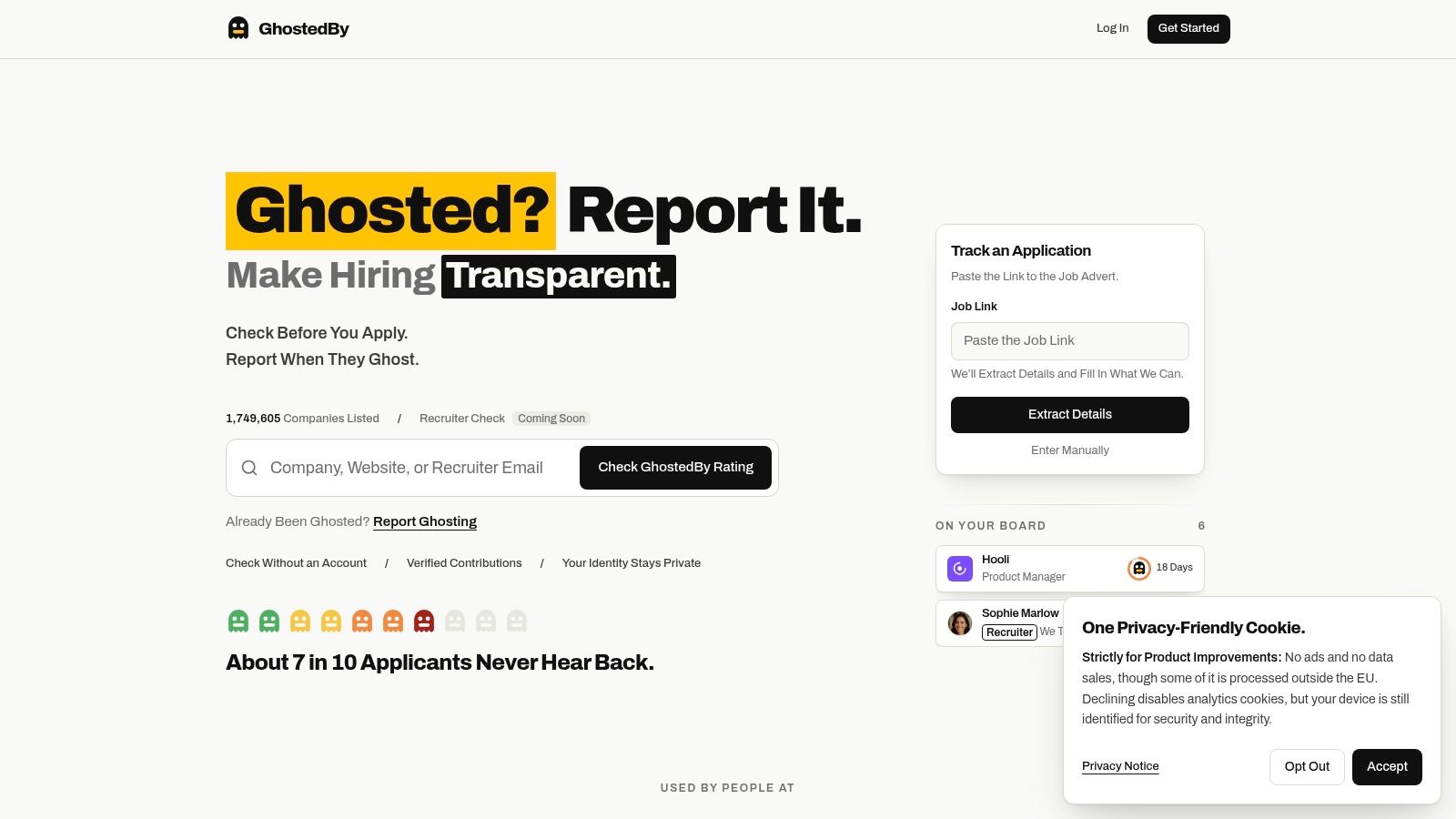
GhostedBy measures a part of candidate experience that ATS reports usually miss: whether employers respond at all. It turns hiring silence into a public, company-level record, letting job seekers review reported responses and ghosting before investing time in an application. Employer silence remains a recurring pain point in hiring research, including findings on candidate response expectations and ghosting (iHire 2025 and 2026 ghosting data).
The product works before the application, rather than after a survey request. Users can search companies, review a Ghosted Rating or outcome counts, maintain a private application board, and report what happened during each process. GhostedBy applies a 21-day ghosting rule, requires at least five eligible outcomes before displaying a public percentage, and says contributors verify their email before outcomes affect the record. Those rules make the public methodology easier to inspect than an anonymous review feed, although the resulting coverage depends on candidate participation.
Practical rule: use GhostedBy when you need hiring-response visibility before applying, not a retrospective satisfaction score.
Fit, effort, and limits
GhostedBy suits job seekers, career coaches, and researchers who want evidence about employer responsiveness. Its optional Agentic Inbox, priced at $4 per month, attaches job-related email to the relevant application, reducing manual sorting for users managing several processes. It is a workflow aid for individual candidates, not a recruiting operations platform.
The main limitation is coverage. Smaller or niche employers may have too few reported outcomes to support a useful comparison. GhostedBy records what happened, but it does not explain whether delays came from approvals, recruiter capacity, or hiring-manager decisions. Teams should therefore treat it as a transparency layer and candidate-side signal, not a diagnostic system for fixing internal workflow.
Its public methodology, privacy model, and stated position that companies cannot pay to alter ratings make the product relevant to the pre-application stage of a broader stack. The candidate experience explainer provides further context on the problem it measures. For a product overview, visit GhostedBy.
2. Starred
Starred is built for teams that want to measure candidate experience as a process, not an afterthought. Its core strength is stage-specific survey automation, which means you can compare experience at apply, interview, offer, and reject rather than flattening everything into one post-hire opinion. That aligns well with the broader evidence that hiring silence and frustration happen at different points in the funnel, not just at the end (candidate ghosting stages and response pain points).
The platform is a better fit for TA teams that already have enough hiring volume to need segmentation. Its value is in branded surveys, ATS integrations, and benchmarking, which give recruiting leaders a way to separate a bad interview loop from a weak application process or a broken offer stage. That's a more useful operating model than generic satisfaction scoring, because it tells you where the funnel is failing.
Where Starred fits best
- Structured measurement: Stage-triggered surveys help teams compare experience by funnel point.
- Workflow reduction: Native ATS integration cuts down on manual survey management.
- Benchmark-driven improvement: The platform is most useful when you have enough responses to compare trends over time.
The main limitation is that Starred is less valuable for very low-volume teams. If you don't have enough data coming through each stage, benchmarking becomes noisy and the platform's structure can outpace your hiring volume. Pricing is quote-based, so it also requires a buying process that's more formal than plug-and-play software.
Website: Starred
3. Survale
Survale changes the measurement layer of the candidate journey by tying feedback to the job, location, recruiter, and hiring manager. That context helps TA leaders move from “candidates were unhappy” to identifying where dissatisfaction appears and which operating conditions may be contributing to it. The result is a diagnostic view of the process, rather than a general sentiment score.
The IJMSM transparency study found that only 2.73% of applications received feedback and 97.27% received no feedback at all among the LinkedIn postings reviewed (IJMSM transparency study). Survale helps teams examine whether communication gaps relate to a specific stage, recruiter, location, or hiring manager, giving outcome feedback more operational meaning.
Its strongest fit is an organization that already manages recruiting through defined processes and can act on segmented findings. Event-triggered surveys, CandE benchmarking, and executive dashboards connect candidate perception with workflow context. Teams can assess whether frustration follows delayed communication, interview design, or another part of the hiring process, rather than treating every low score as the same problem.
Survale's value is not feedback collection alone. It connects feedback to the people and processes that shaped the experience.
Trade-offs to weigh
Survale suits larger TA teams and enterprises with enough hiring activity to compare results across groups. Implementation requires clear survey triggers, ownership of follow-up, and agreement on which outcomes matter. Teams that only need a lightweight feedback layer may find that operating model heavier than necessary.
Pricing and packaging are modular and quote-based, which makes forecasting harder and adds buying complexity. The flexibility can support larger programs, but it also requires more planning before rollout. For a practical framework on organizing this information, see our guide to candidate experience data.
Website: Survale
4. candidate.fyi
candidate.fyi focuses on the active middle of the journey, where candidates are waiting for logistics, timelines, and prep material. Its branded portals centralize interview schedules, panels, timelines, and updates in one place, which matters because candidate uncertainty often starts when the process goes quiet rather than when a decision is final. The platform also collects pulse feedback during the journey, so it's not only a communication tool, it's also a monitoring layer.
This is a strong fit for teams that want to reduce status-chasing without building a custom candidate portal from scratch. The portal gives candidates a clearer view of what's next, while templates and ATS workflow integration reduce repetitive coordinator work. That combination is especially useful for teams that run many interviews and need consistency more than they need deep analytics.
The product's biggest strength is candidate visibility. If candidates can see the schedule, prep expectations, and next steps in one branded space, your recruiting inbox gets fewer “what happens now?” messages. That said, the portal model does create overhead if you open many requisitions at once, because each job can require its own setup and upkeep.
Best fit and limitation
candidate.fyi works best for teams that want a clean, candidate-facing layer during live recruiting. SMB-friendly pricing is published online, which makes it easier to buy without a drawn-out procurement cycle. The downside is that per-job portals can become cumbersome if your hiring volume is very high or highly fragmented.
For teams comparing candidate experience tools by journey stage, candidate.fyi sits squarely in the active-process layer. It doesn't replace a measurement platform, but it does make the live experience clearer and less fragmented for candidates who are already in the funnel.
Website: candidate.fyi
5. GoodTime Hire
GoodTime Hire is strongest where scheduling and candidate visibility overlap. Its self-scheduling, candidate portal, messaging, and Candidate Pulse surveys help reduce the back-and-forth that often turns a promising process into a slow one. For enterprise teams, that matters because the scheduling layer is where many hiring workflows get stuck, and the candidate experience degrades while calendars are negotiated.
The product is a good fit for hiring teams running panel interviews, superdays, or other multi-part scheduling problems. Its portal keeps candidates informed, while the scheduling engine helps recruiters coordinate around multiple stakeholders without handholding every step. The Experience+ add-on adds interviewer prep and AI-assisted candidate workflows, which pushes it beyond a pure booking tool.
What to compare before buying
- Scheduling depth: GoodTime is built for complex coordination, not just single-interview booking.
- Candidate visibility: The portal gives candidates a better sense of timing and status.
- Survey layer: Candidate Pulse helps you capture reactions after rounds, not just after the process ends.
The trade-off is cost and packaging. Full candidate experience functionality sits inside an add-on, and pricing is quote-based, so smaller teams may struggle to justify the implementation if they only need one or two scheduling features. GoodTime is most sensible when scheduling friction is a recurring operational burden and not just a one-off annoyance.
Website: GoodTime Hire
6. ModernLoop
ModernLoop is a scheduling-first platform with a candidate experience layer built into the coordination workflow. Its Candidate Portal comes in Standard and Premium forms, with the Premium tier adding branding and deeper personalization. That distinction matters, because a portal that merely exists is not the same as one that reduces uncertainty for the candidate.
The platform's strength is that it connects calendars, availability, timelines, and candidate communication in a way that aims to remove repeated manual touchpoints. For recruiting operations teams, that can mean less coordinator overload. For candidates, it means fewer gaps between “we'd like to move forward” and “here's exactly what happens next.”
Good scheduling software doesn't just book a slot, it reduces the amount of invisible work a candidate has to guess at.
ModernLoop is best for teams that care about execution speed and consistency more than post-process analytics. The candidate portal and pulse surveys give it some feedback capability, but its real value is in making interview coordination feel less like a black box. That's especially helpful when candidates are moving across multiple interviewers or time zones.
The main limitation is that some of the more useful candidate-facing features sit behind the Premium tier, so the base product may not deliver the experience you expect if you only buy the standard plan. Pricing details are not public, so you'll need a sales conversation to understand fit.
Website: ModernLoop
7. Paradox Olivia
Paradox, through Olivia, is the most conversation-driven tool in the group. It handles candidate engagement through text, web, and chat, answering FAQs, screening applicants, and scheduling interviews around the clock. That makes it especially relevant for high-volume hiring environments where candidates expect immediate responses and mobile-native interactions.
Its best use cases are frontline and distributed hiring models, including retail, QSR, hospitality, and healthcare. In those environments, a 24/7 conversational layer can reduce the latency between interest and interview, which is often where candidates drop out. The tool is less about deep feedback analytics and more about keeping the application moving without waiting for business hours.
The trade-off is that Paradox is optimized for engagement and logistics rather than post-process measurement. If your goal is to collect stage-by-stage experience data and diagnose root causes, you'll likely need a separate analytics layer. If your goal is to answer questions, screen faster, and book interviews outside the recruiter's workday, it's one of the strongest options.
Good fit when volume matters
Paradox is a strong match for teams that hire at scale and need a consistent, always-on candidate interface. It also helps recruiters reclaim time from repetitive questions and scheduling tasks, which can be a real operational win. The platform is enterprise-oriented, so smaller teams may find the cost and implementation effort hard to justify unless they have a real volume problem.
Website: Paradox
8. Great Recruiters
Great Recruiters serves a different buyer entirely, staffing and recruiting agencies that need reputation management, not just workflow efficiency. It automates review requests, aggregates candidate and hiring manager feedback, and surfaces recruiter scorecards and public profiles. In agency work, that visibility matters because trust is part of the product.
The platform's value is that it turns service quality into something candidates can see. Agencies can use public profiles and reviews as proof points, while leaders get trend reporting and coaching insights. That makes it more of a market-positioning tool than an internal analytics suite, although the operational feedback still helps recruiters improve.
This category is especially relevant when the agency's brand is part of the deal. If clients or candidates are choosing between firms, transparent proof of service quality can influence who gets the call. The limitation is that some of the most visible features are agency-specific, so corporate TA teams may not find the public reputation layer as useful.
Why agencies should pay attention
Great Recruiters is strongest when reputation and responsiveness affect business development. It can help firms create a more visible service record and give leaders a structured way to coach recruiters using real feedback. Pricing is typically quote-based, which is standard for tools in this part of the market.
Website: Great Recruiters
9. Greenhouse
Greenhouse is the most practical baseline option if you want candidate experience measurement without adding another vendor. Its built-in post-process survey includes nine default questions and free-text comments, which makes it easy to collect a consistent feedback layer from inside the ATS. For teams already operating structured hiring, that native measurement is often enough to expose obvious friction.
The advantage here is simplicity. You don't need a separate contract, another integration project, or a new dashboard just to start measuring candidate sentiment. That makes Greenhouse useful for organizations that want a basic, ATS-native read on experience and are willing to keep the analytics layer simple.
Because the survey is built into the ATS, it's best for baseline visibility rather than deep diagnosis. Dedicated candidate experience platforms will usually outperform it on segmentation, benchmarking, and workflow-specific analysis. Greenhouse is the lower-friction answer when the main goal is to start tracking something consistently.
Native baseline, not full analytics
If you already run hiring through Greenhouse, the survey gives you a credible place to begin. The marketplace also gives you room to expand later if you outgrow the built-in feature set. That said, pricing is tiered and quote-based, so the full buying picture still depends on your package.
For teams comparing candidate experience tools by implementation effort, Greenhouse is one of the lightest starts. It's not the deepest system in the category, but it's a useful benchmark if your current problem is that you aren't measuring candidate experience at all (Greenhouse overview).
Website: Greenhouse
10. Phenom
Phenom sits at the enterprise end of the candidate experience stack. Its Talent Experience platform focuses on AI-personalized career sites, content, analytics, and a 24/7 chatbot that can screen and schedule. That makes it less of a point solution and more of a broad candidate layer for large organizations with multiple geographies and audience segments.
The main advantage is personalization at scale. If you need multi-language support, customized job recommendations, and a consistent experience across a large employer brand footprint, Phenom is built for that problem. It also centralizes a lot of candidate touchpoints, which can help enterprise TA teams standardize how candidates move from discovery to application to interview.
The downside is implementation burden. Enterprise scope usually means more setup, more internal coordination, and more governance before you see value. That's not a flaw if you need the scale, but it does make Phenom a poor fit for teams looking for a quick improvement to one narrow stage.
Where enterprise value shows up
Phenom makes the most sense when candidate experience is part of a broader digital talent strategy. It's not trying to solve only scheduling or only feedback, it's trying to shape the whole front door of hiring. For global teams, that can be a real advantage if the site experience, chatbot, and analytics all need to line up.
Website: Phenom
Top 10 Candidate Experience Tools Comparison
| Product | Core features | UX & trust (★) | Unique selling point (✨) | Target audience (👥) | Pricing (💰) |
|---|---|---|---|---|---|
| GhostedBy 🏆 | Aggregated outcome reporting, private application board, Agentic Inbox | ★★★★★, verified contributors, 21‑day ghosting rule, 5‑outcome threshold | ✨ Public, evidence-based Ghosted Ratings (no written reviews) | 👥 Job seekers, career coaches, researchers | 💰 Free core; Agentic Inbox $4/mo |
| Starred | Stage-triggered branded surveys, ATS automations, dashboards | ★★★★☆, automated surveys + benchmarking | ✨ Stage-specific CX intelligence tied to ATS | 👥 TA teams, mid→large orgs | 💰 Quote-based |
| Survale | Event-triggered surveys, CandE benchmarking, exec dashboards | ★★★★☆, ties feedback to job/location/recruiter | ✨ Root-cause diagnostics linking sentiment to ops | 👥 Enterprise TA leaders, people analytics | 💰 Modular / quote-based |
| candidate.fyi | Branded per-role portals, templates, pulse feedback | ★★★☆☆, candidate-facing clarity, per-job visibility | ✨ Role-specific candidate portals & prep resources | 👥 SMBs, hiring teams wanting candidate portals | 💰 SMB-friendly, published pricing |
| GoodTime Hire | Self-scheduling, candidate portal, Pulse surveys, Experience+ add-on | ★★★★☆, measurable scheduling improvements | ✨ Enterprise scheduling + AI-enabled Experience+ | 👥 Enterprise recruiting ops, interview teams | 💰 Quote-based |
| ModernLoop | Fast scheduling, Candidate Portal (Std/Premium), pulse surveys | ★★★★☆, visible timelines reduce no-shows | ✨ Lightweight portal + coordinator time-savings | 👥 Recruiting ops, mid-size teams | 💰 Contact sales |
| Paradox (Olivia) | Conversational apply, automated screening, 24/7 scheduling | ★★★★☆, mobile-first conversational UX for volume | ✨ AI assistant for high-volume, after-hours hiring | 👥 Retail, QSR, hospitality, healthcare (high-volume) | 💰 Custom / enterprise |
| Great Recruiters | Automated feedback, recruiter scorecards, public profiles | ★★★☆☆, public recruiter social proof & trends | ✨ Agency-focused profiles & awards to win clients | 👥 Staffing & recruiting agencies | 💰 Quote-based |
| Greenhouse | Built-in post-process surveys, survey triggers, marketplace | ★★★☆☆, easy baseline CX inside ATS | ✨ Native CX without adding a vendor | 👥 Companies using Greenhouse ATS | 💰 Tiered / quote-based |
| Phenom | AI-personalized career sites, chatbot, globalization tools | ★★★★☆, personalized candidate journeys at scale | ✨ Deep AI personalization + multi-language support | 👥 Large enterprises with global hiring | 💰 Enterprise / custom |
Build the Candidate Experience Stack Around the Gap
The best buying approach is to start with the failure point that's most visible in your process. If candidates can't see whether employers respond, start with GhostedBy for pre-application visibility and personal tracking. If you need structured measurement inside the hiring process, use Starred or Survale. If the problem is confusion during the active process, candidate.fyi gives candidates a clearer place to look. If scheduling is the bottleneck, GoodTime Hire or ModernLoop should be on the shortlist. If your hiring motion depends on instant engagement and high-volume responsiveness, Paradox is the right comparison. If you're staffing or recruiting as a service, Great Recruiters is the reputation layer to study. If you just need a baseline inside your ATS, Greenhouse is the easiest start. If you're an enterprise team trying to personalize at scale, Phenom belongs in the conversation.
Don't confuse activity metrics with actual candidate outcomes. A tool can show more messages sent, more interviews scheduled, or more survey responses collected without improving the experience itself. The useful question is whether the tool reduces silence, increases clarity, or makes the hiring process more accountable to the candidate.
Before implementation, define the outcome you want to move, not just the feature you want to buy. Confirm ATS integration, survey coverage, and privacy rules. Check whether public reporting is aggregated, how thresholds are handled, and whether the tool lets you separate response speed from decision quality. For quote-based platforms, compare the implementation effort against your hiring volume, because a powerful platform can still be the wrong fit if you won't generate enough signal to use it well.
The strongest candidate experience stacks usually combine tools rather than relying on one vendor to do everything. A visibility layer, a measurement layer, and a workflow layer can work together if each one owns a distinct part of the journey. The mistake is buying overlap, then assuming the extra activity means the candidate experience improved.
GhostedBy makes candidate experience visible by turning hiring silence into a shared company-level record. If you're comparing candidate experience tools and want the pre-application layer that shows how often companies respond, visit GhostedBy and check the record before you apply.