
35% of U.S. job seekers said an employer never acknowledged their application in 2023, up from 32% in 2022. That gap makes hiring transparency a measurable candidate-experience problem, not a vague promise about openness.
Hiring transparency matters because silence changes how candidates interpret every other signal. A salary range can be helpful, but a role can still feel opaque if no one confirms receipt, no one shares timing, and no one explains when the process ends. The data show that candidates don't just want information about the vacancy, they want evidence that the employer is actually running a process they can trust.
Table of Contents
- Why Hiring Transparency Matters Now
- What Hiring Transparency Actually Includes
- From Pay Disclosure to Process Accountability
- How Aggregated Outcome Data Improves Clarity
- Tools Candidates Can Use to Assess Employers
- How Employers Can Build Verifiable Transparency
- Common Misconceptions About Hiring Transparency
Why Hiring Transparency Matters Now
The strongest signal in hiring isn't always what a company publishes. It's whether candidates hear back at all. In 2023, 40% of U.S. job seekers said they were ghosted after a second- or third-round interview, up from 30% in 2022, and 25% said poor recruiter communication drove them to stop communicating, compared with 18% in 2022 and 5% in 2020. The pattern is simple. The further candidates move into the funnel, the more silence starts to function like a hidden rejection letter rather than a neutral delay. Indeed's 2023 U.S. research also found that 45% of candidates had been ghosted by a potential employer, while 34% said they never heard anything after submitting an application.
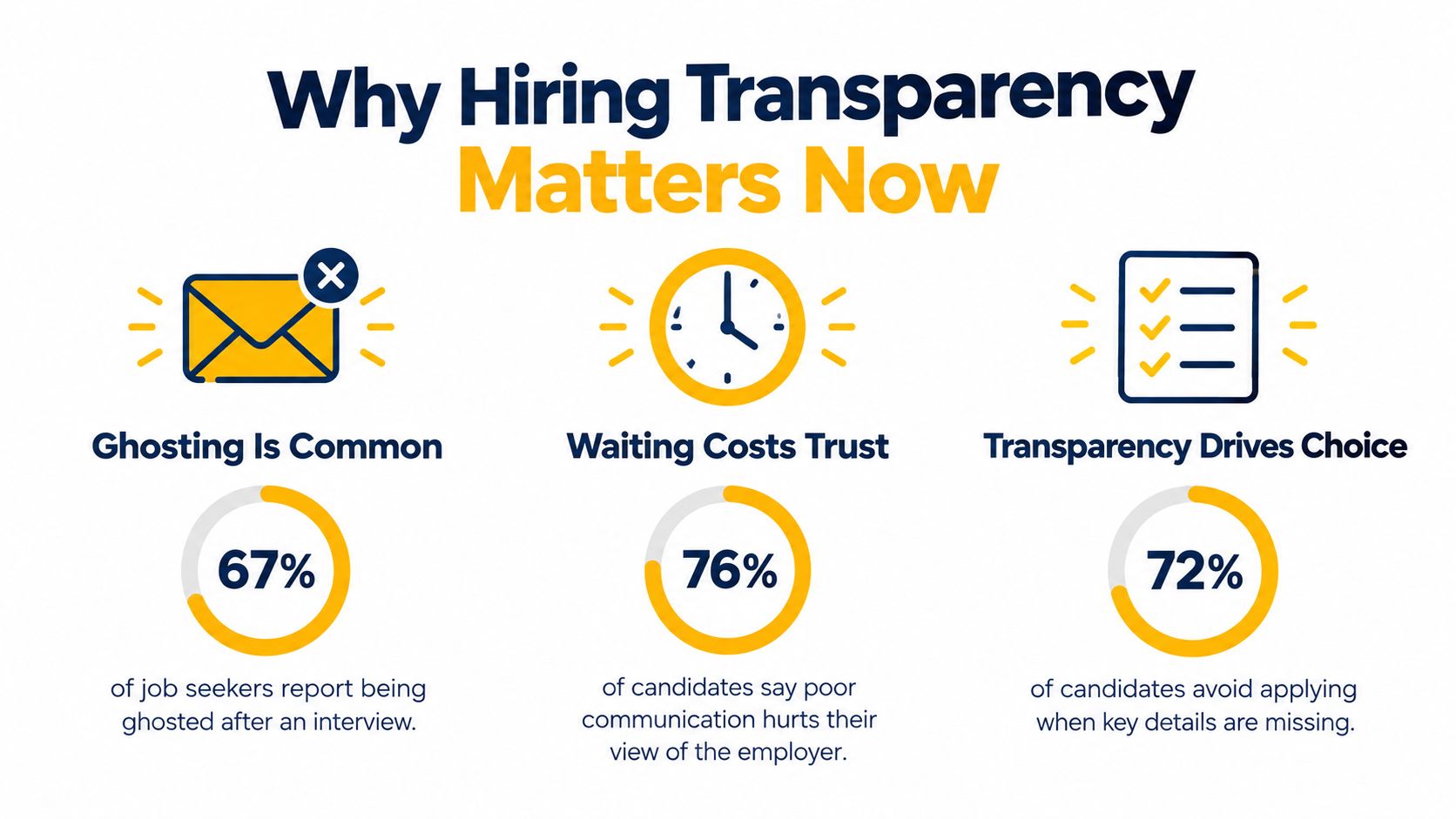
Transparency is process visibility, not just information disclosure
A job post can be public and still be opaque. True transparency means candidates can verify what happens after they apply, not just what the role pays or requires. The difference matters because silence leaves people unable to tell whether they were rejected, paused, or ignored.
Practical rule: if a company only discloses role details but not process behavior, the candidate still lacks the information needed to plan their search.
The better test is whether the employer leaves an auditable trail of communication. That includes acknowledging applications, setting expectations for response, and closing the loop when a role is filled or paused. Candidates don't need perfect certainty. They need enough process signal to avoid treating a dead application like a live one.
What Hiring Transparency Actually Includes
Pay disclosure is only one layer. The broader system includes the timing of updates, the visibility of hiring stages, and whether automation shapes screening or ranking decisions. The Council of the EU's pay-transparency framework makes salary disclosure a candidate information right across the EU, but candidates still face uncertainty if the employer won't say how long hiring takes or who makes decisions.
The signals candidates can actually verify
| Transparency Signal | What It Covers | Why Candidates Value It |
|---|---|---|
| Pay range | Starting salary or pay band | Reduces guessing before investing time |
| Hiring timeline | Expected process length and decision dates | Helps candidates plan their search |
| Stage updates | Application, screening, interview, final decision | Shows whether the process is still active |
| Automation disclosure | Whether AI or automated screening is used | Clarifies how decisions are shaped |
| Closure notices | Whether a role is paused, filled, or closed | Prevents candidates from assuming silence means progress |
A salary band without response expectations still leaves a large blind spot. Candidates want to know whether the requisition is active, who will decide, and when they should expect a decision. That's why process transparency often matters just as much as compensation transparency.
The internal question is simple, and it's more demanding than “Is the pay posted?” A candidate wants to know whether the employer's process is understandable enough to invest time in. The company hiring-practices discussion becomes more useful when it treats those signals as separate, checkable pieces instead of one vague standard.
From Pay Disclosure to Process Accountability
Pay transparency became a legal issue before it became a common hiring norm. The EU adopted Directive (EU) 2023/970 in 2023, and the Council describes it as requiring stronger equal-pay and pay-transparency rules, including informing job seekers of starting salary or pay range in the vacancy notice or before the interview and preventing employers from asking about pay history. That's an important shift because disclosure stopped being only an employer choice and became a candidate right within a regulatory framework.
Legal disclosure is not the same as operational transparency
Compliance and experience aren't identical. A company can meet a salary-disclosure rule and still leave candidates in the dark once interviews begin. The law addresses one hidden variable, compensation, but candidates still face uncertainty around timing, stage progression, and closure. That's why process metrics matter alongside wage data.
A useful comparison is between written claims and observed behavior. Traditional employer reviews often mix opinions, one-off experiences, and broad sentiment. Aggregated outcome records are narrower, but they're easier to audit because they track what happened after applications were submitted. That distinction matters when a candidate wants a signal they can check before applying, not a retrospective story after the search is over.
A transparent hiring system has to hold up under counting, not just branding.
The most stable systems set clear rules for what counts as a response, when silence becomes meaningful, and how many eligible outcomes are needed before a percentage is shown. That's how transparency stops being a marketing phrase and starts behaving like a measurement standard.
How Aggregated Outcome Data Improves Clarity
Structured outcome records solve a basic problem. Candidates don't need a long narrative about a company's values, they need a consistent record of how often people get responses, how often communication stops, and whether the company closes the loop. The candidate-experience data discussion is most useful when it separates counts from percentages and applies rules before outcomes are published.

What makes an outcome record reliable
First, the record needs eligible outcomes, not just anecdotes. A single application can't support a credible company-level percentage, which is why minimum sample thresholds matter. Second, the system should show raw counts alongside rates, so readers can see whether a percentage rests on a large pattern or a tiny pool. Third, the rules must be public and consistent, or else the metric becomes too easy to game.
A report can also protect privacy while still exposing the pattern. Individual names, applications, and dates stay private, but the company-level trend becomes visible. That's the main advantage of aggregated data over written reviews. It reveals behavior without turning every applicant into a public case study.
Candidates can use the same logic before applying. If a company's record has enough outcomes to be meaningful, the pattern is more useful than a polished careers page. If the sample is too thin, the absence of data should be treated as uncertainty, not proof of good behavior.
Tools Candidates Can Use to Assess Employers
Candidates need tools that let them compare employers before they invest time in a funnel. The useful signals are measurable, company-level response patterns, private tracking of each application, and whether the employer behaves the way it says it will. GhostedBy is one option in that category, because it lets candidates review aggregated response and ghosting records while privately tracking applications and outcomes.
For a deeper comparison of structured outcome records versus traditional employer reviews, see the employer-reviews discussion.
A practical verification routine
- Check the company record first: Look at how often candidates report a response versus silence before deciding where to apply.
- Track each application privately: Keep the role, stage, and date in one place so a slow process does not blur into a forgotten one.
- Use the 21-day window correctly: Silence can count after 21 days without a response following the last relevant contact, but the clock should reset when the employer sends a meaningful update.
- Separate stages in your notes: An application, screening call, and final interview should not all be treated as the same event.
- Keep communication organized: A dedicated job-search inbox or application board reduces the chance that a reply gets buried.
The point is not to turn one metric into a verdict. It is to reduce the chance of spending time on a company whose process already shows signs of silence. If a company regularly leaves candidates hanging, that pattern is itself a data point worth seeing before you apply.
A candidate does not need perfect information to make a better decision. They need enough structured evidence to compare employers with less guesswork and fewer surprises.
How Employers Can Build Verifiable Transparency
Employers often assume salary disclosure is the main event. It isn't. A company can list a pay band and still lose trust if it never acknowledges applications, misses its own timelines, or leaves automation unexplained. That's why transparency has to be operational, not decorative.
Commit to behavior, not just wording
Start with response expectations. If a team says it will acknowledge applications promptly, that promise should show up in the actual process. Then add stage updates, clear closure notices, and a realistic timeline for each phase. Candidates don't need a perfect recruiting machine, but they do need a process that behaves predictably.
The same logic applies to automation. If screening uses software, disclose where it appears in the process, what it evaluates, and whether a human reviews the outcome. The candidate should know whether the process is machine-assisted, human-led, or both.
Operational rule: publish what the process does, then check whether the process really does it.
Employers should also be careful with outcome reporting. Small samples can distort company-level percentages, and definitions have to be set before the data is published. If a company wants transparency to be credible, it has to align its promises with observable behavior over time.
Common Misconceptions About Hiring Transparency
A pay range doesn't solve everything. Candidates still want to know how long hiring will take, whether the role is active, and how decisions are made. Salary disclosure is useful, but it's only one variable in a much larger experience.
The same problem appears with AI disclosure. Telling candidates that automation exists is not the same as explaining its role. If the process isn't understandable or challengeable, the disclosure can feel more like a label than transparency. That's especially true when silence follows an automated rejection, because the candidate can't tell whether the decision was human, algorithmic, eligibility-based, or the result of an administrative miss.
Published timelines can also backfire when they're routinely missed. A timeline that looks clear on paper but is ignored in practice erodes trust faster than a more modest promise that the employer can reliably meet. That's why the best transparency systems are closed loops. Candidates track the outcome, employers match behavior to the promise, and both sides can see when the process breaks down.
GhostedBy makes candidate experience visible by turning response behavior into a shared company-level record. If you want to compare employers using aggregated outcomes instead of guesswork, visit GhostedBy and check how the process looks before you apply.