You interviewed, the conversation went well, and the inbox has been empty since. Being ghosted by an employer after an interview is harder to shrug off than silence after an application, because you have already given them your time. Before you leave the interview, set a date for each follow-up and a date to stop waiting.
How Often Employers Ghost Candidates After an Interview
In Greenhouse's 2024 State of Job Hunting report, a survey of 2,500 workers across the US, UK and Germany, 61% of job seekers said they had been ghosted after a job interview, a nine percentage point increase since April 2024. Historically underrepresented job seekers reported it more often, at 66% compared with 59% of white candidates.
Indeed survey data reported by HRO Today, drawn mainly from US respondents, found 40% of job seekers were ghosted after a second- or third-round interview in 2023, up from 30% in 2022.
Indeed UK research with 1,000 UK workers and 1,000 hiring professionals found 86% of workers would rather receive a clear rejection than hear nothing, and a 2026 LiveCareer survey of 1,008 US workers found 48% would not apply to a company again after being ghosted during hiring.
Why Employers Go Quiet After an Interview
Silence after an interview often has little to do with how you performed. It tends to come from one of these:
- The team is still interviewing and has not ranked candidates, so nobody wants to reject a strong second choice.
- An offer is out to someone else, and the rest of the shortlist is on hold until it is signed.
- Approval has stalled on budget sign-off, a reorganisation or a senior hire.
- The process has no owner. The recruiter has moved on to other roles and the hiring manager assumes someone else is sending updates.
UK hiring has also slowed down. Totaljobs research with 900 HR leaders and 2,000 candidates found the average time to hire stretched to eight weeks in 2025, up from 4.8 weeks in 2024, with larger organisations taking up to nine weeks. A long process is different from ghosting, but it means the gaps between contacts are longer than they used to be. Our guide on why recruiters ghost candidates covers the recruiter side in more detail, and some listings were never live at all, which our guide to ghost jobs in the UK explains.
The 21-Day Rule
With processes running to eight weeks, it helps to separate slow from silent. GhostedBy uses 21 days. An application can be reported as ghosted once 21 days have passed with no contact from the employer, counted from their last contact with you.
Say you applied on 1 March and were invited to interview on 20 March. Your 21 days start on 20 March, so the earliest you could count that application as ghosted is 10 April. If the recruiter emails on 2 April to say the team is still deciding, the count starts again and runs to 23 April.
The rule measures gaps in contact, so a long process with regular updates never reaches 21 days.
A Day-by-Day Follow-Up Plan
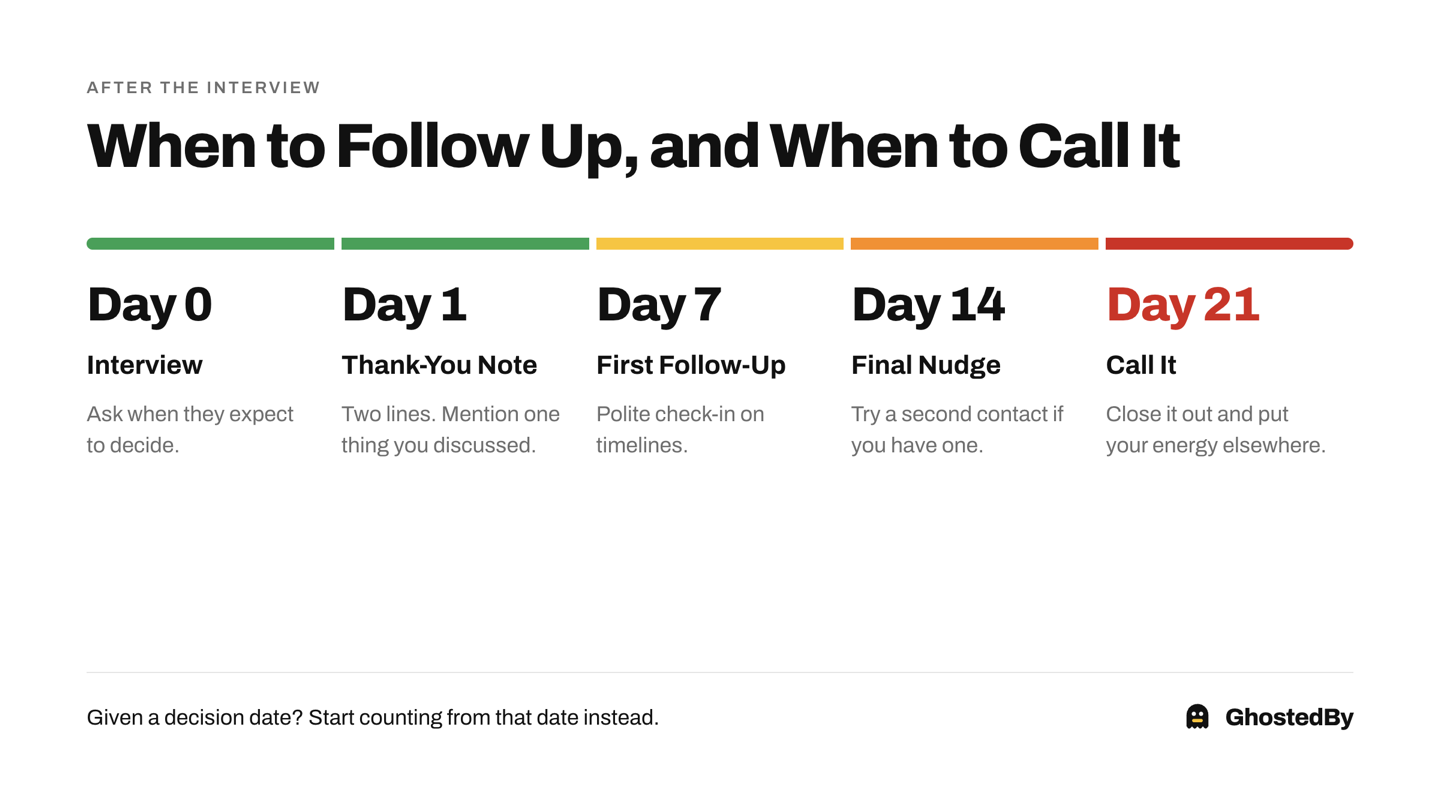
Day 0: The Interview
Before the call ends, ask when they expect to decide and how they will let you know. If they give you a decision date, count from that date for the steps below.
Day 1: Thank-You Note
Send two lines to your interviewer. Mention one thing you discussed, so the note could only have come from you.
Day 7: First Follow-Up
If you have heard nothing, send one short message to your main contact. This version works for most roles:
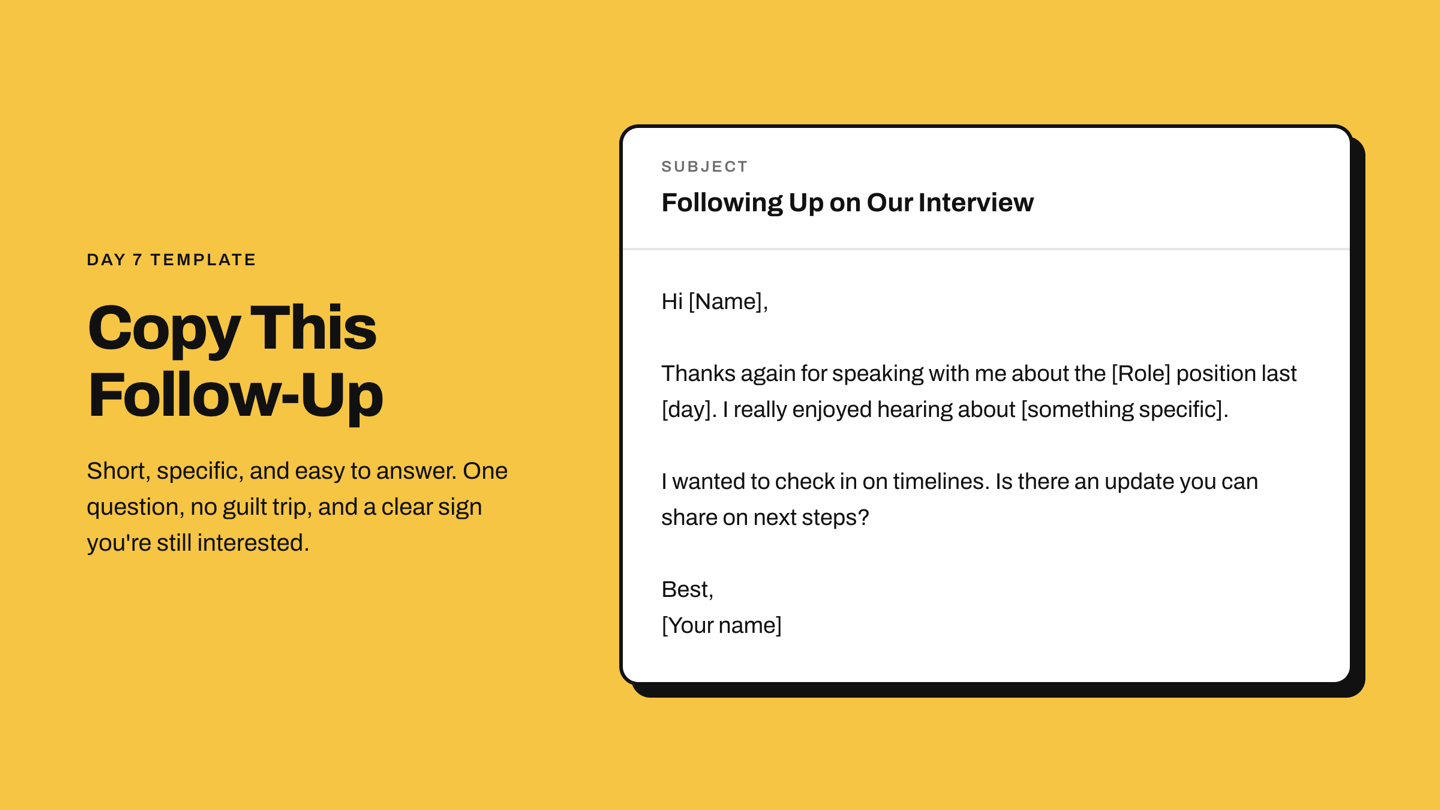
Subject: Following Up on Our Interview
Hi [Name], thanks again for speaking with me about the [Role] position last [day]. I really enjoyed hearing about [something specific]. I wanted to check in on timelines. Is there an update you can share on next steps?
Best, [Your name]
It names the role, shows you were listening, and ends with one question that is easy to answer.
Day 14: Final Nudge
If the first message got no reply, send a second and final one. If you have a second contact, such as the hiring manager, copy them in. Give a date: say you would like to know where things stand, and that if you have not heard by a specific day, you will assume the team has gone ahead with other candidates.
Hi [Name], I'm following up on my interview for the [Role] position on [date]. Could you let me know where things stand? If I haven't heard by [date], I'll assume you've gone ahead with other candidates.
Best, [Your name]
Day 21: Call It
Close the application in your own planning and put your energy elsewhere. If the employer comes back later, you can pick the conversation up again.
Keep Your Search Moving
Pausing other applications while you wait on one process wastes weeks. With time to hire averaging eight weeks, three weeks of waiting can easily turn into two months with nothing else in progress. A second live process also helps if the first employer does come back, because you can tell them honestly that you have other interviews under way.
Frequently Asked Questions
How Long Is Too Long to Hear Back After an Interview?
If an employer has not contacted you for 21 days, treat the application as ghosted. If they gave you a decision date, wait until the day after it passes before you follow up.
Is One Week Too Soon to Follow Up After an Interview?
No. One polite follow-up at day 7 is reasonable, especially if no decision date was given.
Should I Follow Up More Than Twice?
Two messages give the employer a fair chance to reply. A third takes time away from your other applications and seldom changes the outcome.
Does Being Ghosted Mean I Did Badly in the Interview?
Not necessarily. Silence usually comes from stalled decisions, offers out to other candidates or overloaded teams, so it is a weak signal of your performance.
Report the Outcome
If you track your applications on GhostedBy, the tracker counts the 21 days for you and shows when an application becomes eligible to report. You can then report it as ghosted, along with the furthest stage you reached.
Your report adds to the employer's Ghosted Rating. Once a company has five or more reported outcomes, its page also breaks the rating down by stage, so the next candidate can see whether that employer tends to go quiet after applications or after final rounds. If the company gets back to you after you report, correct the outcome in your tracker and the rating updates with it.
Sources
- Greenhouse, 2024 State of Job Hunting report, December 2024
- HRO Today, reporting Indeed's Ghosting in Hiring survey
- HRreview, 10 May 2024, reporting Indeed UK research
- Allwork.Space, July 2026, reporting LiveCareer's Ghosting Consequences Report
- Personnel Today, 30 October 2025, reporting Totaljobs research