
Greenhouse found that roughly 18% to 22% of roles posted on its platform in 2024 were ghost jobs, and at least 70% of companies using the platform had posted one or more. That makes the problem measurable, widespread, and large enough to distort how candidates spend time, attention, and confidence during a job search.
Table of Contents
- Why Ghost Jobs Matter Right Now
- What a Ghost Job Actually Is
- Why Employers Post Ghost Jobs
- How Candidate Ghosting Feeds the Problem
- How to Evaluate Whether a Job Posting Is Real
- How GhostedBy Makes Hiring Outcomes Visible
- Why Accountability Helps Candidates and Employers
Why Ghost Jobs Matter Right Now
The main shift is not just that ghost jobs exist, it is that recruiters are now describing them as part of normal hiring operations rather than an edge case. In a 2024 survey of 753 U.S. recruiters, 81% said their employers had posted jobs that were already filled or did not exist. In some cases, respondents said fake or already filled postings made up a quarter, half, or even three-quarters of their ads.
That matters because it changes how candidates should read a posting. A visible listing can still be stale, duplicated, or posted to build a pipeline rather than to fill an open seat. A role may also be genuinely open but so slow to move that the applicant never gets a useful signal back. Those are different situations, and they call for different judgments.
The Congressional Research Service adds an important caution. There is no official statistic that directly measures ghost jobs, and a gap between postings and hires does not, by itself, prove that postings are fictitious (CRS on ghost jobs). That caveat keeps the discussion grounded. A posting can be real and still be inactive, duplicated, repeatedly reposted, or nonresponsive.
Why the distinction matters
Candidates are affected long before a role is formally closed. They spend time tailoring resumes, tracking application portals, and waiting for updates that may never come. The problem is not only wasted effort. It is also a weaker hiring signal, because a live posting no longer tells applicants much about whether the employer is moving, pausing, or merely keeping a requisition visible.
The practical consequence is that job seekers need a sharper way to read listings. A posting that is live is not the same as a posting that is actionable.
That is the point of separating unfilled, inactive, duplicated, repeatedly reposted, and nonresponsive roles. Each label points to a different hiring condition, and each one changes how much confidence a candidate should place in the ad.
What a Ghost Job Actually Is
A ghost job isn't one thing, and treating it as one thing causes most of the confusion. Some roles are posted with no approved opening. Some were real once, then went stale. Some are duplicated across boards. Some stay up because the employer wants a pipeline. Others are open but never produce a hire. The label matters because the evidence needed to identify each case is different.
A practical classification framework
| Posting Type | Typical Signs | Likely Cause |
|---|---|---|
| Unfilled | The role is active, interviews happen, no hire yet | Genuine vacancy, slow process, or hard-to-fill role |
| Inactive | Posting stays live but no interviews or updates appear | Hiring pause, budget delay, or low-priority requisition |
| Duplicated | Same role appears across boards or with slight wording changes | Aggregator lag or repeated syndication |
| Repeatedly reposted | The same role returns after short gaps | Pipeline building or turnover management |
| Nonresponsive | Application acknowledged, then silence | Employer delay, process breakdown, or weak follow-through |
The Congressional Research Service notes that there's no official statistic that measures ghost jobs and cautions that a gap between postings and hires doesn't by itself prove that postings are fictitious (CRS on ghost jobs). That distinction matters. A posting can be real and still be a poor use of a candidate's time.
What evidence can and can't tell you
A single clue rarely settles the question. Posting age helps, but age alone doesn't prove deception. Repeated reposting is more telling, but even that can reflect high turnover or a changing requisition. If you want to judge a listing accurately, look for a cluster of signals, not a single red flag.
A real hiring signal usually has a trail, a clear description, active interviewing, and some kind of closure path.
The most useful language is also the least dramatic. Instead of asking whether a company is “lying,” ask whether the role is actionable. That's a narrower and more useful question. It lets you separate a role that's paused from one that's duplicated, and it avoids turning every stale post into an accusation.
Why Employers Post Ghost Jobs
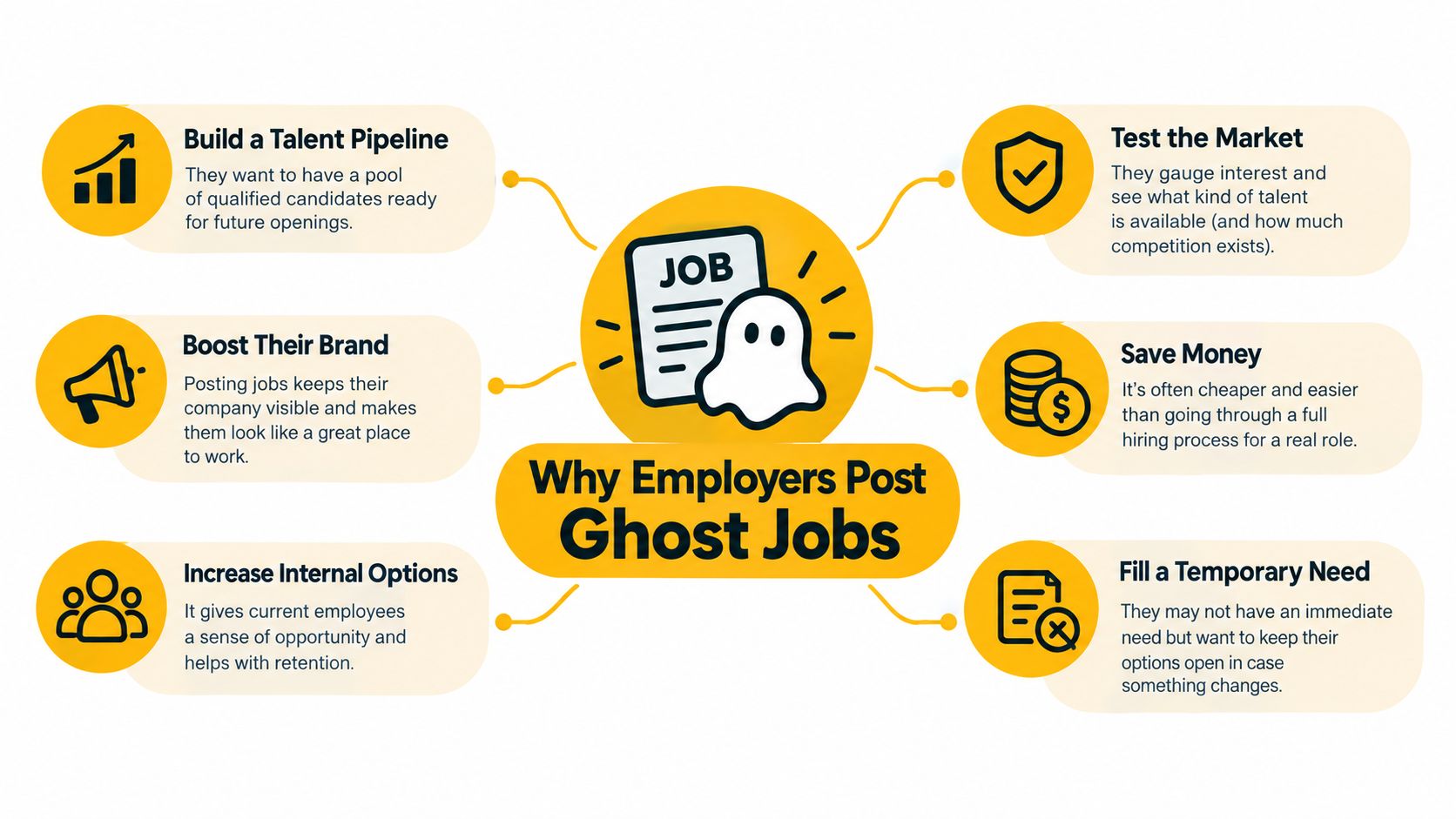
Employers post ghost jobs for reasons that are often structural, not theatrical. Some listings are used to gauge market interest. Some keep a candidate pipeline warm. Some stay visible on job boards to signal growth or maintain presence. Others are simple process failures, where a filled role is never removed or the requisition status does not sync cleanly to the board.
The incentives are mixed
Greenhouse's 2024 State of Job Hunting report found that recruiters described several motives for posts that were not tied to an active opening, including testing response to hard-to-fill roles, maintaining a presence during periods without active hiring, evaluating job-description effectiveness, and building a future talent pool (Greenhouse's 2024 State of Job Hunting report).
Those motives create different candidate experiences. A market-test listing can attract applications that never reach a live requisition. A filled-role listing creates a different kind of failure, one that looks like process drift. In both cases, the candidate sees a live ad, but the employer's internal status does not match what the board suggests.
Intent and process failure are not the same
The useful distinction is between strategy and breakdown. Strategy includes pipeline building and market testing. Breakdown includes stale listings, paused budgets, and ATS-to-board sync failures. Candidates should read those differently because the odds of follow-through are not the same.
Useful operational split: ask whether the role is “no approved opening,” “future pipeline,” “filled but not removed,” or “paused for budget.”
That split matters for employers too. A company that wants to collect future candidates should say so internally and manage the record accordingly. A company that leaves a filled role live should treat that as a process problem, not a branding tactic. Either way, the posting itself does not tell the whole story.
How Candidate Ghosting Feeds the Problem
Hiring silence changes how candidates behave, and those reactions feed back into the market. When applicants stop hearing back, they have to decide whether a role is active, already filled, or never intended to move. That uncertainty weakens trust, and weaker trust makes every posting harder to read.
Silence is part of the same loop
Indeed's 2023 U.S. research found that 35% of job seekers said an employer did not acknowledge their application, up from 32% in 2022 (Indeed's Ghosting in Hiring report). The same report found that 40% were ghosted after a second- or third-round interview in 2023, up from 30% in 2022, from the same Indeed report. The second figure matters more operationally. Silence after an interview arrives after more time has been invested, and after the employer has already signaled some level of interest.
The loop runs in both directions. Once candidates expect non-response, they hedge by applying more broadly and treating postings with more caution. That changes the employer's inbox mix, which can make response gaps wider and less informative. The result is not just frustration. It is a weaker hiring signal on both sides.
Candidate expectations are shorter than hiring delays
iHire found that 66.1% of job seekers preferred employer contact within 24 hours, with 5.3% wanting a response within one hour, 18.3% same day, and 42.5% the next day (iHire communication survey). That does not set a universal deadline for every process, but it explains why the gap between candidate expectations and employer cadence keeps widening.
Candidate ghosting also appears in the employer-facing data here, which matters because hiring silence is not only a candidate-side pattern. Employers who fail to close the loop create the same uncertainty they later see in applicant behavior.
The core issue is not only that people disappear. It is that they disappear at different points in a process that never clearly says what happened.
How to Evaluate Whether a Job Posting Is Real
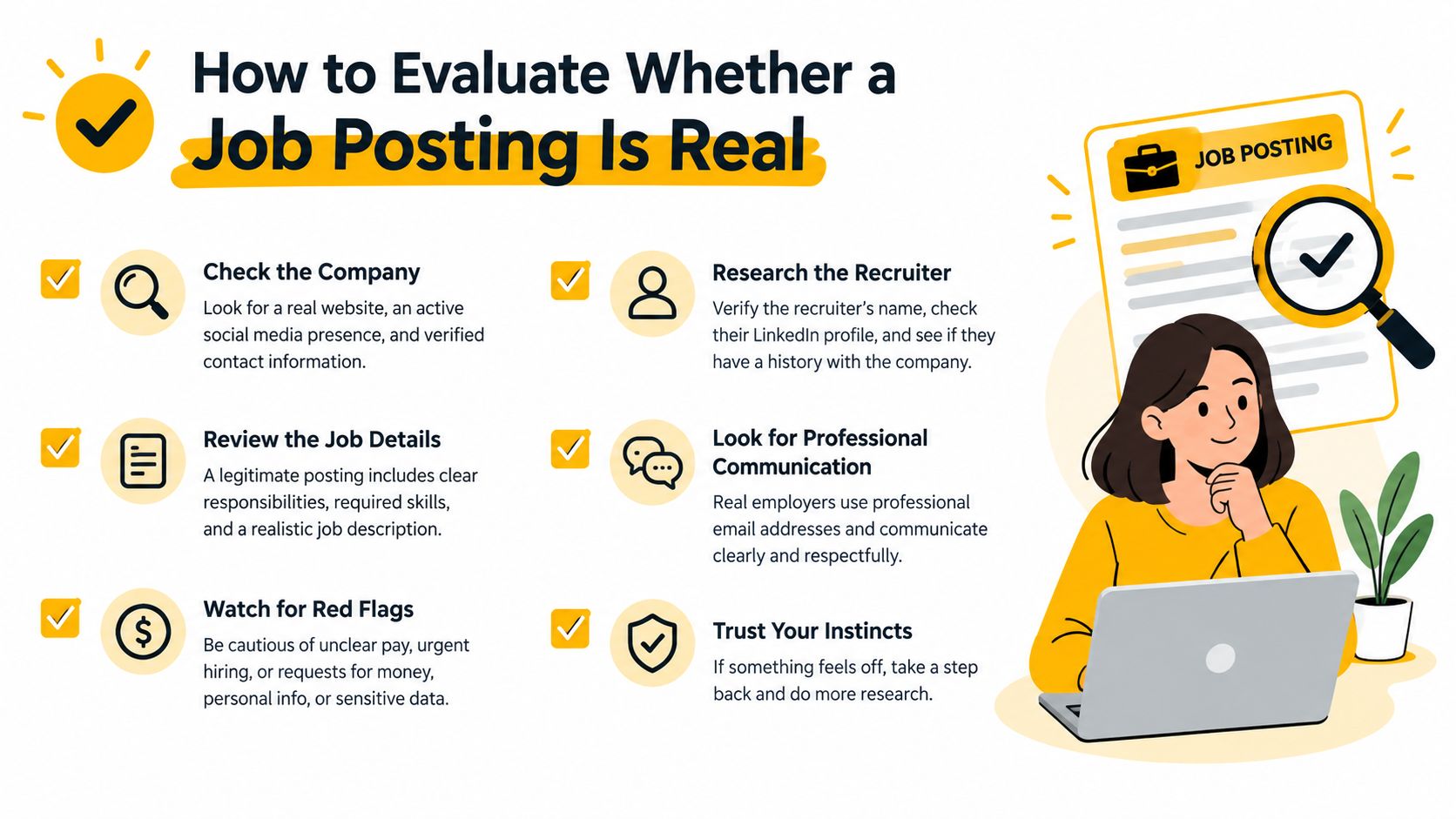
A candidate doesn't need certainty. They need a good enough filter to decide where to spend energy. The strongest approach is to combine several weak signals into one practical judgment. Posting age, refresh frequency, repeated reposting, source-page consistency, acknowledgment behavior, and closure updates all matter more together than alone.
Start with the source, not the aggregator
A listing that appears on a job board but not on the company's own careers page deserves caution. Aggregators can lag behind the source system, and stale syncs can make a dead role look fresh. If the company's own site shows a different status, treat the board listing as lower-confidence evidence.
The most reliable screening habit is simple. Check whether the role is recent, specific, and consistent across sources. A vague description, a long-lived post, and no visible activity together are more telling than any one of those clues alone.
Use a short checklist before you apply
- Check the posting date: recent posts usually carry more signal than roles that have sat unchanged for a long time.
- Compare wording across boards: identical or nearly identical postings can reveal duplication or feed lag.
- Look for interview evidence: active hiring usually leaves traces such as screening steps, follow-up requests, or status updates.
- Notice whether acknowledgment exists: an automated confirmation isn't the same as meaningful movement, but total silence is a warning sign.
- Watch for closure behavior: employers that close roles or send status updates create stronger evidence that the posting is active and managed.
If a role passes some of those checks but not others, treat it as probabilistic. A posting doesn't have to be fake to be low-value. The question is whether it's worth your time right now.
Hiring transparency is easier to assess when employers preserve a clear record of what happened. That's more useful than guessing from the job title alone, because the title doesn't tell you whether the process is active, paused, or abandoned.
How GhostedBy Makes Hiring Outcomes Visible
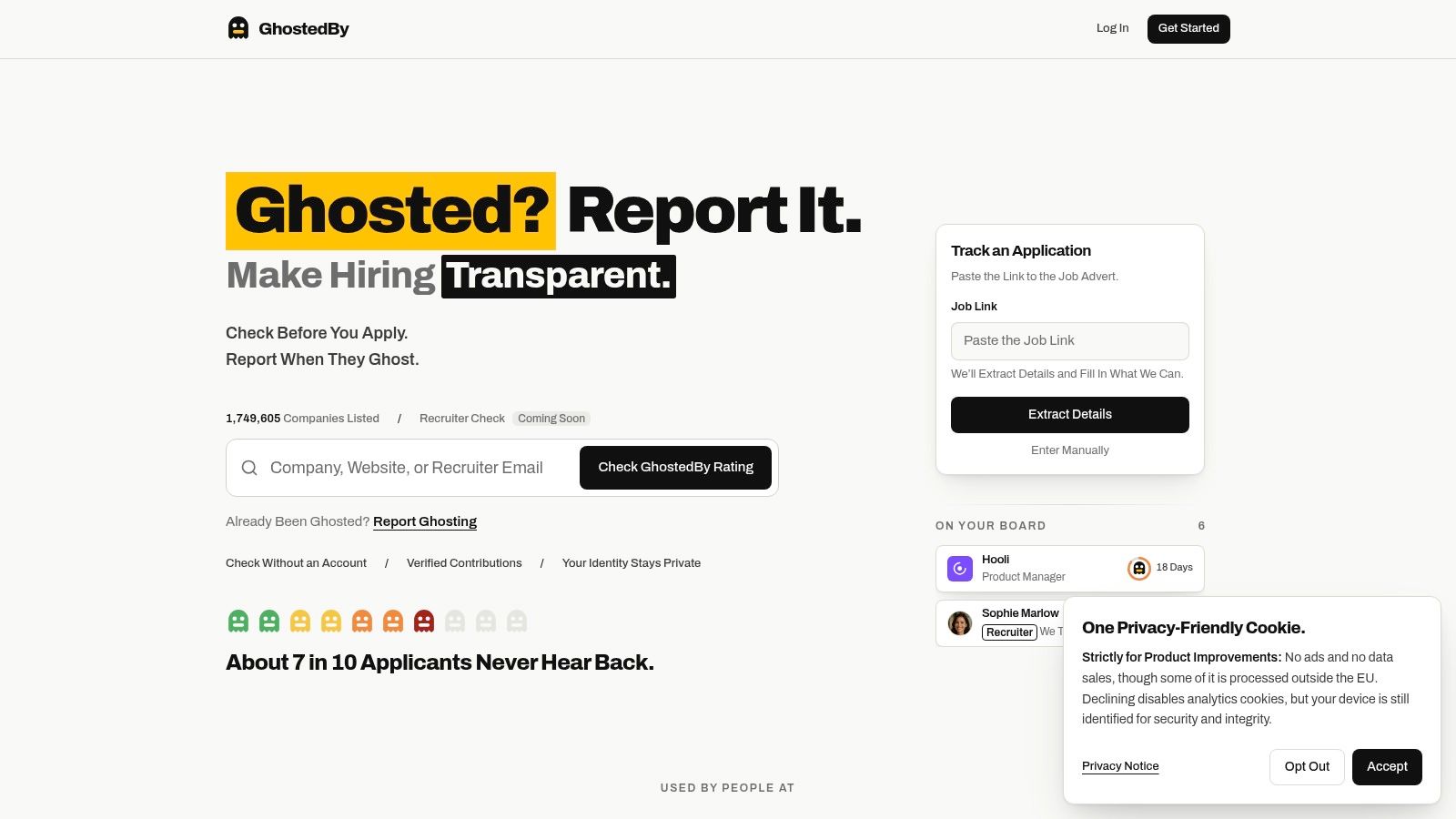
GhostedBy is built around a simple idea. Candidates shouldn't have to infer company behavior from one-off experiences, and companies shouldn't be able to hide behind silence. It turns individual job-search outcomes into a shared company-level record, so candidates can see how often people report a response versus being ghosted.
What the record shows
The core output is a Ghosted Rating, which reflects reported response and ghosting outcomes rather than written reviews or subjective scoring. Candidates can also keep a private application board that tracks roles, stages, dates, and outcomes in one place. That matters because a single search often includes dozens of moving parts, and scattered notes make it harder to see which employers follow through.
The platform also uses an agentic inbox to keep job-search email tied to the right application, so responses don't get lost in a crowded inbox. Reports are tied to a verified email address, and the individual identity, application details, role, and dates stay private while the company-level pattern becomes visible.
Why structured outcomes matter
Anonymous comments are easy to post and hard to interpret. Outcome records are narrower, but they're more actionable. A company record built from responses, closures, and ghosting reports gives candidates something they can compare before they apply.
GhostedBy also uses a 21-day ghosting window, meaning silence can count as ghosting after 21 days without a response following the last relevant contact. That gives the process a clear threshold instead of forcing candidates to improvise one. Companies need at least five eligible outcomes before a percentage is shown, which keeps the record from overreacting to tiny sample sizes.
Practical value: structured outcomes make hiring behavior visible without turning every bad experience into a public rant.
Why Accountability Helps Candidates and Employers
Accountability makes hiring easier to read. Candidates waste less time on roles that don't move, and employers send a clearer signal about how they handle people once an application is in the system. That doesn't eliminate ghost jobs, but it does make them easier to distinguish from ordinary hiring delays.
For candidates, the benefit is lower uncertainty. A company with a visible record of responses, closures, and ghosting patterns gives them a way to rank opportunities before they apply. For employers, the benefit is operational. Clear closure habits reduce confusion, and consistent communication can make the hiring process look more deliberate even when the role itself is competitive.
The deeper point is that silence has a cost whether it comes from a stale posting or from an interview process that never closes. A healthier hiring record doesn't require perfect speed. It requires visible outcomes, consistent updates, and a way to tell the difference between a live role and a dead one.
If you want a clearer read on which employers move candidates forward, use GhostedBy to check company-level response patterns, track your applications privately, and report outcomes after the process goes quiet. It's a practical way to separate actionable openings from ghost jobs before you invest more time.