
53% of candidates report experiencing employer ghosting, with silence occurring most often after an application, according to a 2025 survey of 1,024 candidates by iHire. That figure changes what an employer review site needs to measure. A workplace opinion can help someone assess culture, management, or pay. It can't, by itself, answer a more immediate question: if I apply, will this company communicate with me?
Employer-review platforms grew because candidates had little reliable information before entering a hiring process. Today, the strongest systems are moving beyond anonymous narratives and broad ratings toward structured records of observable events. The difference matters. A review tells you how someone interpreted an experience. An outcome record tells you what happened, when it happened, and how many comparable reports support the pattern.
Table of Contents
- Why Employer Review Sites Exist in 2026
- How the Category Grew Into a Global Hiring Layer
- How Employer Review Sites Collect and Show Feedback
- What These Sites Actually Do to Job Search Behavior
- Where Traditional Reviews Fall Short
- How Outcome-Based Signals Differ From Opinion Reviews
- Design Choices That Build Trust in Any Review System
- What Candidates Should Look For Next
Why Employer Review Sites Exist in 2026
Applying for a job requires candidates to disclose time, effort, and personal information before an employer has to provide much in return. People can spend hours tailoring applications, completing assessments, and attending interviews, then receive no clear closure. A compiled candidate-experience report cites 35% of U.S. job seekers saying an employer never acknowledged their application, while 36% waited one to two months or longer for next steps.
That imbalance created the demand for the employer review site. Candidates needed a public record that could reveal what careers pages rarely explain: whether managers communicate clearly, whether compensation matches expectations, and whether applicants receive a decision after investing effort. The original promise was simple, turn private experiences into searchable company-level information.
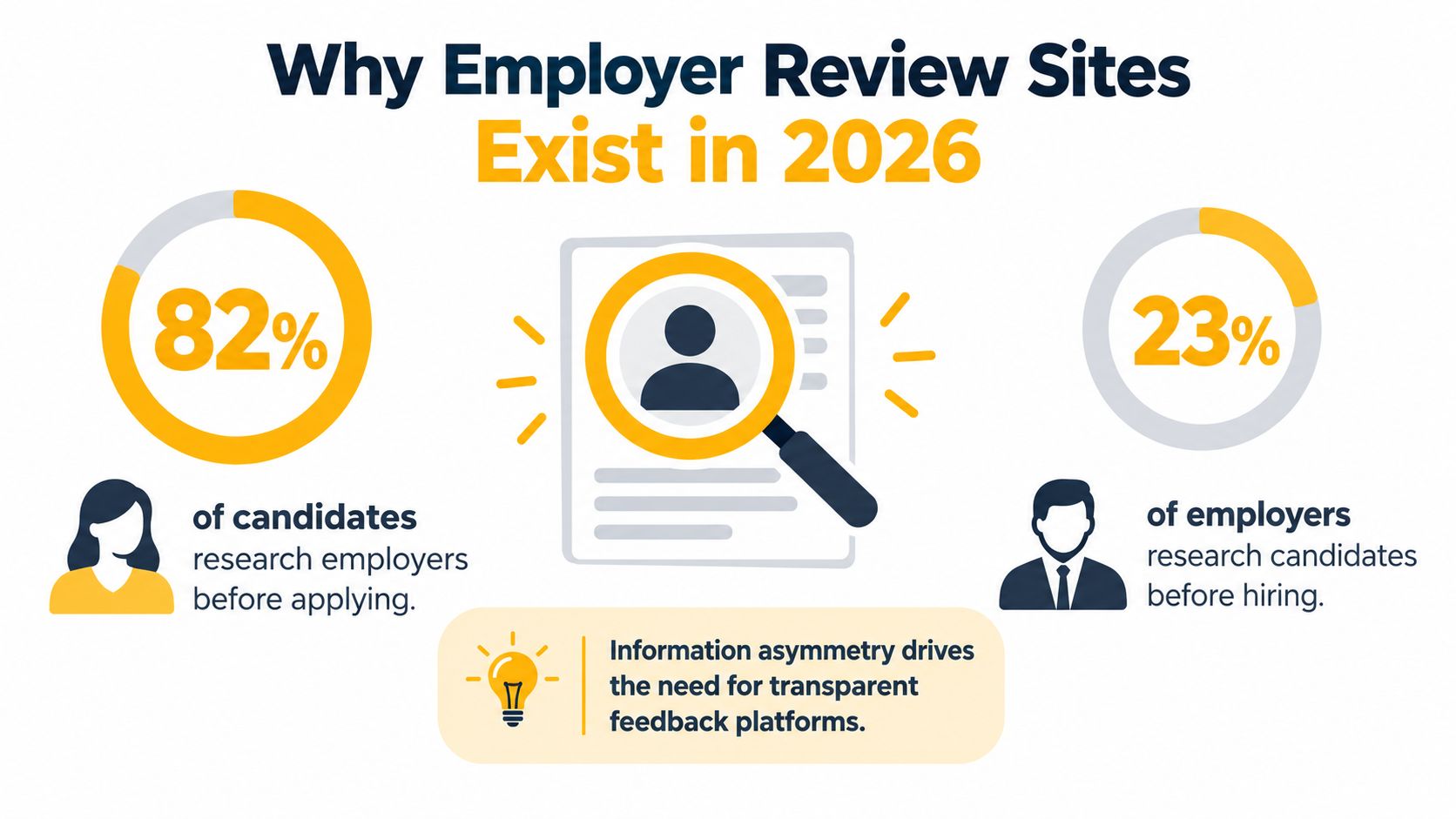
The information gap before the application
Traditional employer reviews usually describe the workplace from the perspective of current or former employees. That perspective is valuable, especially for questions about management, workload, flexibility, inclusion, and pay. But the candidate journey begins earlier than employment. The first interaction may be an application that receives an acknowledgement, a rejection, an interview invitation, or nothing at all.
That distinction creates two different research questions:
- Workplace question: What is it like to work here?
- Process question: What happens after I apply?
A star rating may help with the first question, but it rarely answers the second. Candidate communication often fails at several points, including after application submission, after an interview, during assessments, and during compensation discussions. A useful platform therefore needs to preserve the stage and timing of each event rather than compressing every experience into a single emotional score.
Practical rule: Treat employer reputation and candidate communication as related signals, not interchangeable measurements.
The category now exists for a broader reason than workplace transparency. It gives candidates a way to price the risk of entering a hiring process. A company with limited public information may still be worth considering, but a company with a documented pattern of silence presents a different decision. The best employer review site helps users distinguish those situations without pretending that a small or selective sample represents every applicant.
How the Category Grew Into a Global Hiring Layer
Glassdoor's rise helps explain why employer-review sites moved from a fringe idea to a standard part of job search. Founded in 2007, it organized anonymous employer reviews, salary entries, and workplace commentary into searchable company profiles. That shifted part of workplace information away from employer-controlled messaging and toward public, user-generated records.
By 2024, Glassdoor was reported to have about 55 million monthly unique visitors, roughly 180 million reviews and salary submissions, and profiles for around 2.5 million employers, according to reported Glassdoor statistics. Those figures show reach, not representativeness. A platform can be large and still mix different contribution types, time periods, and user groups in ways that complicate interpretation. Even so, this level of scale shows that employer review sites became a durable layer in the hiring market, not a temporary side channel.
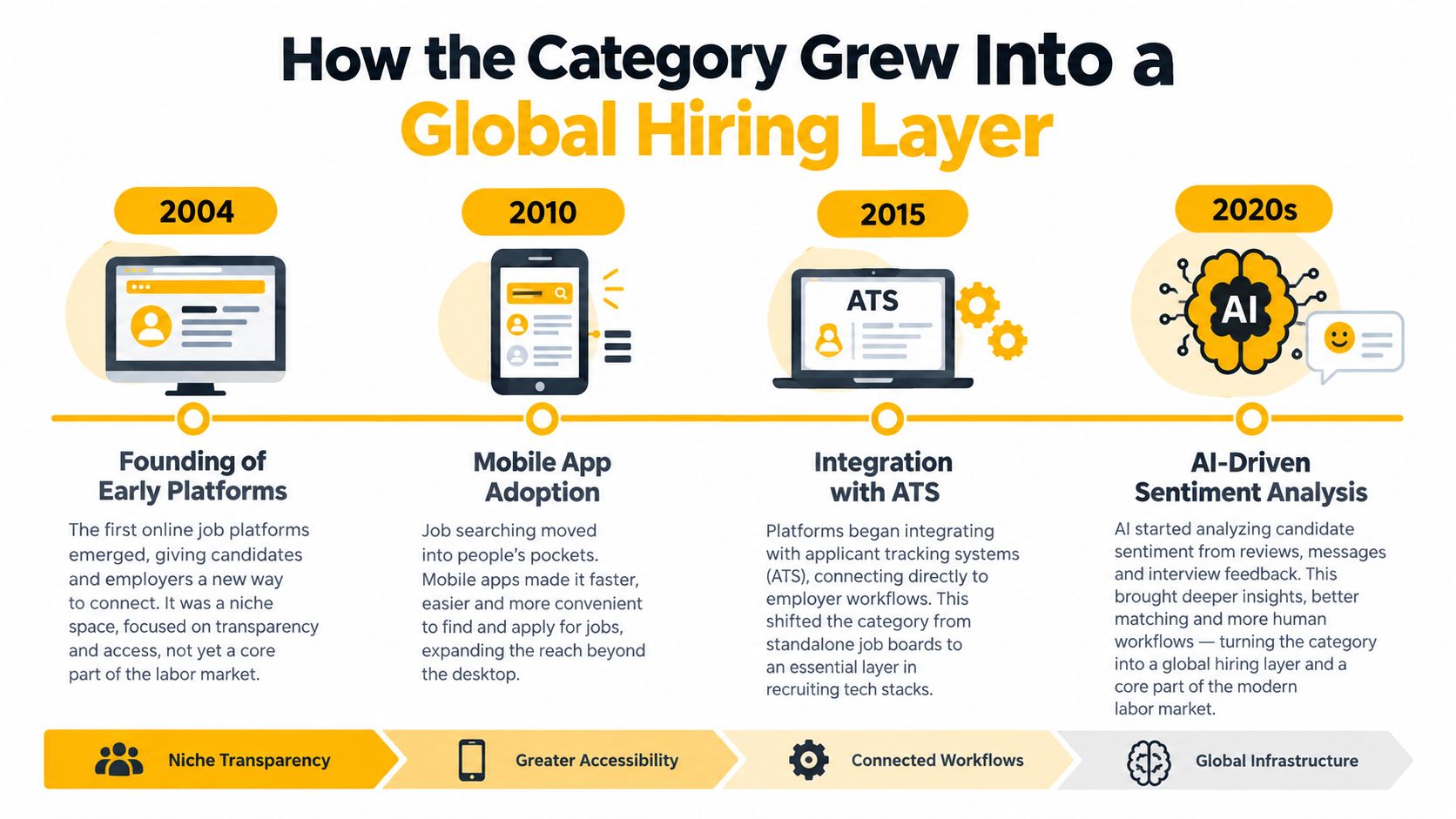
Scale creates both value and risk
Large networks make these platforms useful because repeated submissions can reveal patterns that a single applicant would miss. They can surface recurring concerns about management, compensation, or interview handling, and they give smaller employers a visible public profile beyond a careers page.
Scale also creates a measurement problem. Opinion volume is not the same as decision-quality evidence. If a platform does not separate current employees from former ones, recent submissions from older ones, or workplace reviews from candidate-process reports, users may see a clear-looking score that hides incompatible inputs. The result is broad visibility with uncertain meaning.
That trade-off matters because job seekers are usually trying to answer more than one question. They may want to know what employees think of leadership, but they also want to know whether applicants hear back, how long interview stages take, and whether a pattern reflects a few vivid complaints or a stable trend. A review system helps only when its design makes those distinctions visible through sample thresholds, time windows, and basic verification rules.
Glassdoor's acquisition by Recruit Holdings for approximately $1.2 billion in 2018 also signaled that employer information had become commercially important infrastructure in recruiting. The business milestone mattered less than what it implied. Employer reputation data had become valuable at scale, even though platforms still faced the harder task of showing users which signals reflected opinion, which reflected outcomes, and which were too thin to support a decision.
An employer review site now competes on coverage and interpretability. Coverage answers whether information exists. Measurement design determines whether that information helps someone decide where to apply.
How Employer Review Sites Collect and Show Feedback
Most employer-review systems begin with eligibility. A contributor may need to confirm a relationship with a current or former employer, use an email address associated with that relationship, or satisfy another platform rule. The purpose isn't to eliminate every possibility of bias. It establishes a basic connection between the contributor and the company being discussed.
SEEK's documented approach illustrates a practical sequence. Its employer-review guidelines describe anonymous display, removal of fraudulent or duplicated submissions, and a three-stage process involving eligibility checks, automated screening, and user reporting followed by re-evaluation. That separation is important. Privacy protects contributors, while moderation controls the public record.
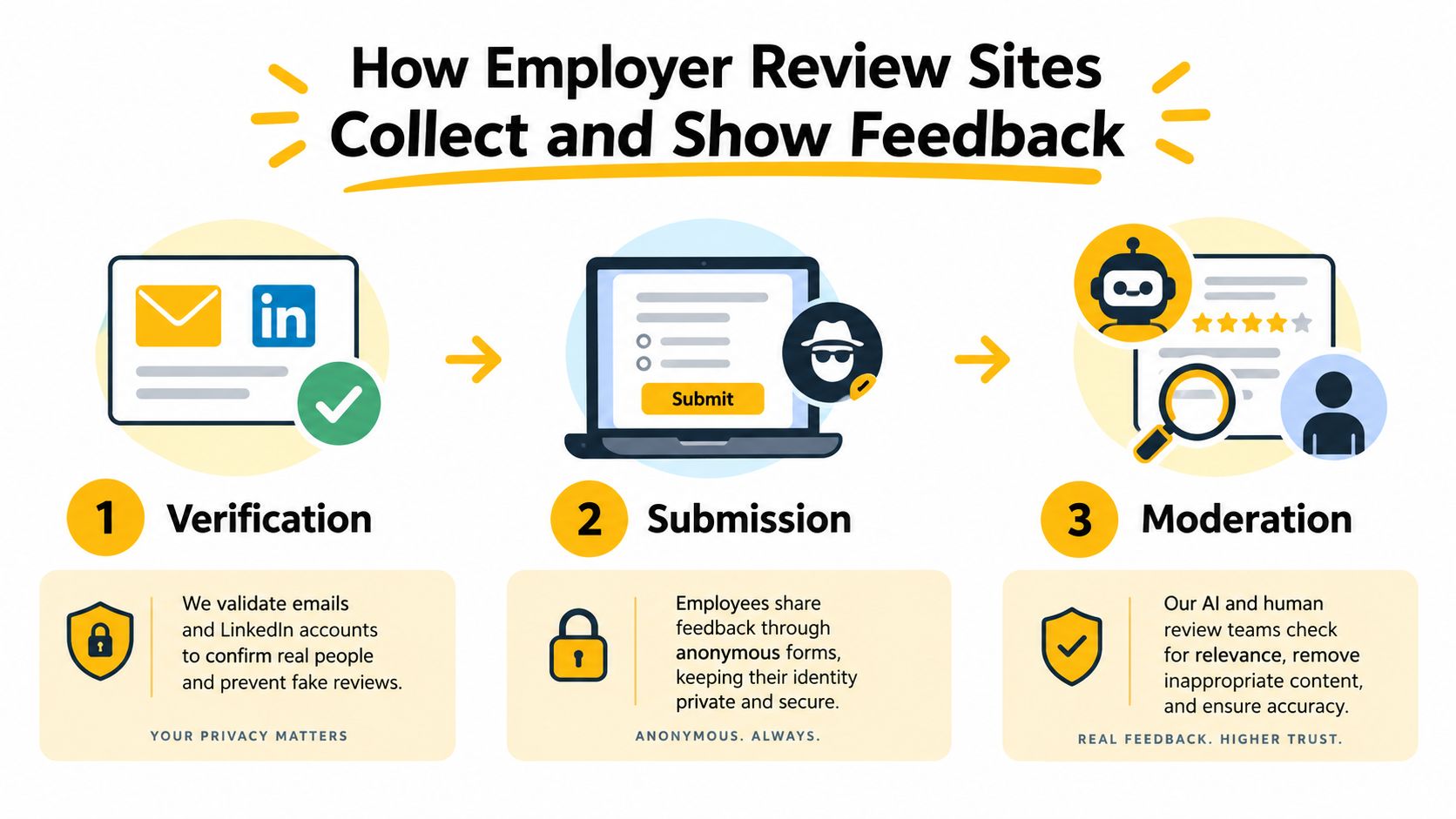
From contribution to company page
A submission can contain several kinds of information:
- Written review: An account of workplace experience, usually interpreted through the contributor's perspective.
- Salary information: Compensation data that may be useful when role, location, and timing are clear.
- Interview experience: Questions, stages, and impressions of the recruiting process.
- Rating: A compressed assessment that makes profiles easier to scan but removes context.
The platform then aggregates contributions into a company page. Search results may show a rating, review count, salary information, or an interview snippet before a candidate opens the full profile. That first impression can shape whether the candidate investigates further. The user sees an output, but the important work happened earlier in the pipeline, through eligibility rules, moderation, categorization, and aggregation.
Anonymity isn't the same as neutrality
Anonymity can make it safer for people to report sensitive experiences. It can also make individual records difficult for readers to verify. A private verification step offers one compromise. A platform can check eligibility without publishing a contributor's name, role, application, or contact details.
That approach resembles the distinction examined in a 2025 analysis of anonymous and employment-verified contributions. Verification may increase confidence that a contributor has a relevant connection to an employer, but it doesn't guarantee that the contribution is representative or unbiased.
Candidates evaluating an employer review site should therefore inspect the mechanics, not just the interface. The candidate experience data methodology should make clear what qualifies as an eligible report, how duplicates are handled, what moderation can remove, and which information remains private. A polished company page is only as reliable as the system that produced it.
What These Sites Actually Do to Job Search Behavior
Employer-review platforms influence decisions before a recruiter reads an application. A National Bureau of Economic Research study found that 48% of surveyed U.S. job seekers had used Glassdoor, described in the study as the largest U.S. employer-review website. The researchers also analyzed 188,623 U.S. employer reviews posted between 2013 and 2016 in the NBER working paper.
The behavior extends beyond browsing. Earlier global employer-brand research reported that 96% of employees who changed jobs checked a prospective employer's reputation, while 31% of candidates consulted at least one online or offline resource before applying. The same research reported that 91% of job seekers abandoned an application after reading negative reviews, although that figure comes from an industry survey and shouldn't be treated as a universal causal estimate.
Reputation enters the funnel early
These findings make employer reviews an active part of recruitment, not a passive archive. Candidates use them to decide whether an employer deserves more time, and employers can lose applicants before their selection process begins. A negative review may describe one unusual incident, but the candidate still has to decide how much risk to accept when the company controls the next step.
That influence creates a measurement distinction. Opinion-based reviews are good at surfacing themes. They can reveal concerns that formal employer surveys miss because people describe specific experiences in their own language. But a theme isn't the same as a rate, and an emotional account isn't the same as a recorded event.
Candidates don't only ask whether a workplace is good. They ask whether the employer will behave predictably during a process that already demands their effort.
An employer review site changes job-search behavior most responsibly when it helps candidates separate those questions. Reputation data can inform a broader judgment about the workplace. Outcome data can answer whether a company responded, closed a process, or stopped communicating after a defined stage.
Where Traditional Reviews Fall Short
A review can be accurate about an experience and still weak as a decision signal. That problem starts with the unit of measurement. Traditional employer reviews usually combine observed events with interpretation: a delayed reply becomes "disorganized hiring," a tense exchange becomes "toxic culture," and one manager stands in for the company. Those accounts can surface real problems, but readers rarely know which part is directly witnessed, which part is inference, and which part reflects role, timing, or personal expectations.
Platform design makes that ambiguity more important, not less. Research comparing employer-review platforms found that verification does not remove selection bias, and that different platform rules can make different aspects of workplace culture appear more prominent, as shown in this analysis of measurement bias in employer-review data. In other words, the review interface is not a neutral window onto employer quality. It shapes what gets submitted and what becomes visible.
Small samples create unstable scores
Sample size is the second limitation. A company with five observations can show a rate that looks as settled as a company with 100 observations, even though those numbers do not carry the same weight. One additional report changes a five-report rate by 20 percentage points. With 100 observations, one additional report changes the rate by 1 percentage point.
That is a measurement issue with direct consequences for job seekers. A high percentage based on a thin sample may justify caution, but it does not establish a stable employer pattern. If a platform hides the denominator, readers are left with the appearance of precision rather than precision itself.
Verification helps with one narrow question. It can support that a contributor has some legitimate connection to the employer. It cannot show that the reported experience is representative, current, or comparable across teams. Hiring can shift quickly because of recruiter workload, a pause in headcount, a departmental bottleneck, or changes in business conditions. Reviews posted across different periods may collapse those changes into one reputation snapshot.
A stronger transparency system makes its rules visible. Candidates should ask four basic questions:
- Observation rules: Does the platform separate reported events from general sentiment?
- Time windows: Can readers tell whether submissions reflect current conditions?
- Denominators: Does every displayed rate include the number of eligible records?
- Selection limits: Does the site explain who is likely to contribute, and what verification cannot prove?
The limits of employer reviews become clearer once reviews are treated as bounded evidence rather than a final verdict. They are useful for identifying themes and possible risks. They are less reliable when presented as precise outcome measures without enough context.
How Outcome-Based Signals Differ From Opinion Reviews
An opinion review asks, “How did this experience feel?” An outcome record asks, “What happened?” Both questions have value, but they support different decisions.
A structured candidate report can map each contribution to a mutually defined event, such as response received, process closed, or no response after a defined interval. The categories are narrower than free-text sentiment, which makes them easier to compare across companies and over time. They also reduce the temptation to turn a complex workplace into a single popularity score.
The 21-day window adds a common reference point
GhostedBy uses a 21-day window for silence after the last relevant contact and requires at least five eligible outcomes before displaying a Ghosted Rating percentage. Until that threshold is met, counts provide context instead of presenting a thin sample as a precise rate. These rules don't make the data complete, but they make the calculation inspectable.
The threshold also addresses volatility. One report can have a large effect when the denominator is small, so a system should show users whether a percentage rests on a sparse record. A defined time window creates another safeguard. It prevents a platform from treating every delay as ghosting without considering how long the candidate has been waiting.
| Signal type | Primary question | Main strength | Main limitation |
|---|---|---|---|
| Written review | What did the contributor think happened? | Rich context and detail | Interpretation and selection bias |
| Star rating | How positive or negative is the summary? | Fast comparison | Compresses context and can hide sample size |
| Outcome report | Did a defined event occur? | Reproducible company-level measurement | Narrower view of the experience |
| Stage-specific record | Where did communication stop? | Operational diagnosis | Requires consistent stage definitions |
The distinction doesn't make outcome reporting a replacement for workplace reviews. A response rate can't tell a candidate whether a manager is supportive or whether workloads are sustainable. It can tell them something more specific about process reliability. Candidates choosing where to apply should match the signal to the decision. Use opinion data to investigate workplace conditions, and outcome data to evaluate whether an employer's hiring process produces the communication it promises.
Design Choices That Build Trust in Any Review System
Trust comes from rules users can inspect. The first rule is contributor eligibility. A platform should explain whether it verifies an email address, employment relationship, application, or another relevant connection. Verification should protect the public record without exposing a contributor's identity.
The second rule is event definition. “Ghosting” can't mean any delay that feels frustrating. It needs a stated point of last relevant contact and a stated period of silence. Candidates generally expect faster communication than a 21-day silence threshold. The 2024 iCIMS Talent Experience Report reports that 45% of recruiters provide candidate status updates every two weeks, with email used by 48% and phone calls by 30%. Those figures offer context for evaluating a longer period without meaningful contact.
A practical trust checklist
- Check the denominator: A percentage without its count is incomplete.
- Check the window: Recent reports and old reports shouldn't be blended without explanation.
- Check the stage: Application silence differs from post-interview silence.
- Check privacy: Individual applications, identities, roles, and dates should remain private by default.
- Check independence: Employers shouldn't be able to pay to remove valid outcomes or improve a rating.
Minimum thresholds are especially important. Publishing counts before a percentage gives users evidence without overstating precision. A platform can also retain separate categories for response received, process closed, and no response, rather than treating every non-positive event as identical.
Moderation should be visible too. The published moderation rules should explain eligibility, duplicate detection, reporting, review, and appeal procedures. No control removes selection bias entirely, but clear rules let users judge what kind of bias may remain.
Finally, trust depends on incentives. A company may respond to criticism, improve communication, or dispute an inaccurate record, but it shouldn't be able to purchase a better public result. The platform's job is to preserve the distinction between a company's explanation and the candidate-level outcome being measured.
What Candidates Should Look For Next
Candidates shouldn't abandon employer review sites because their data is imperfect. They should read them with the discipline used for any measurement system.
Start with the question you need answered. If you're assessing management, culture, compensation, or workload, written reviews can provide useful leads. If you're asking whether an employer communicates after applications and interviews, look for structured outcomes, stage definitions, reporting windows, and visible sample counts.
Three habits improve the quality of your decision:
- Treat star ratings as one signal. Read the underlying reviews and check whether recent contributions describe the role and location you're considering.
- Prefer disclosed methodology. A platform should explain verification, moderation, time windows, thresholds, and how it handles small samples.
- Separate employer behavior from candidate behavior. A missed interview and an employer's failure to respond are different events, even though both affect the hiring process.
The category is also moving toward privacy-preserving verification. An employer review site can protect contributor identity while improving confidence that a report comes from someone with a relevant connection. That won't make the record perfectly representative, but it can make the limits easier to understand.
The most useful transparency tools won't merely rank employers. They'll show what was measured, how much evidence supports it, and where uncertainty remains. Candidates deserve that level of precision before they spend their time.
GhostedBy turns candidate communication into an aggregated company-level record, showing reported responses and silence while keeping individual applications and identities private. Check a company's record, track your own applications, and report outcomes through GhostedBy before deciding where to invest your next application.