You've probably got the same mess open right now, a half-finished spreadsheet, a few email tabs, one browser bookmark you meant to clean up, and at least two roles you can't remember whether you already followed up on. Job searching gets frustrating fast when every application lives in a different place and every reply, or lack of reply, feels like it might matter. A good job search tracking tool doesn't just store names and dates, it gives you a way to see what's happening, what's stalled, and where your effort is paying off.
Table of Contents
- Why Job Applications Feel Impossible to Manage
- What a Job Search Tracking Tool Really Does
- How to Track Silence Without Guessing
- Core Features Worth Paying Attention To
- A Simple Weekly Workflow That Keeps You in Control
- Privacy and Trust Rules for Tracking Applications
- How GhostedBy Complements Your Tracking System
Why Job Applications Feel Impossible to Manage
The chaos usually starts small. You apply to three roles, then five more, then a recruiter asks for a portfolio link, then someone schedules an interview, then another company goes silent. After a while, the problem isn't effort, it's recall, because memory breaks down once applications stop fitting in your head.
Email search helps until it doesn't. You can find a company name, but not always the last meaningful contact, the stage you were in, or whether a reply was real progress or just a form message. A tracker matters because it gives you one place to record the facts before the details blur together.
Practical rule: if you can't answer “what happened last?” in ten seconds, the search already needs a system.
That system also reduces the emotional drain. When every job feels equally important, it's easy to react to whatever is loudest in your inbox instead of what's most likely to move forward. A tracker gives you a calmer view, so you can stop guessing and start acting on patterns.
One useful way to think about it is simple. Without structure, you're trying to manage a search with scattered notes and memory. With structure, you're managing a pipeline, where each role has a place, a stage, and a next step.
What a Job Search Tracking Tool Really Does
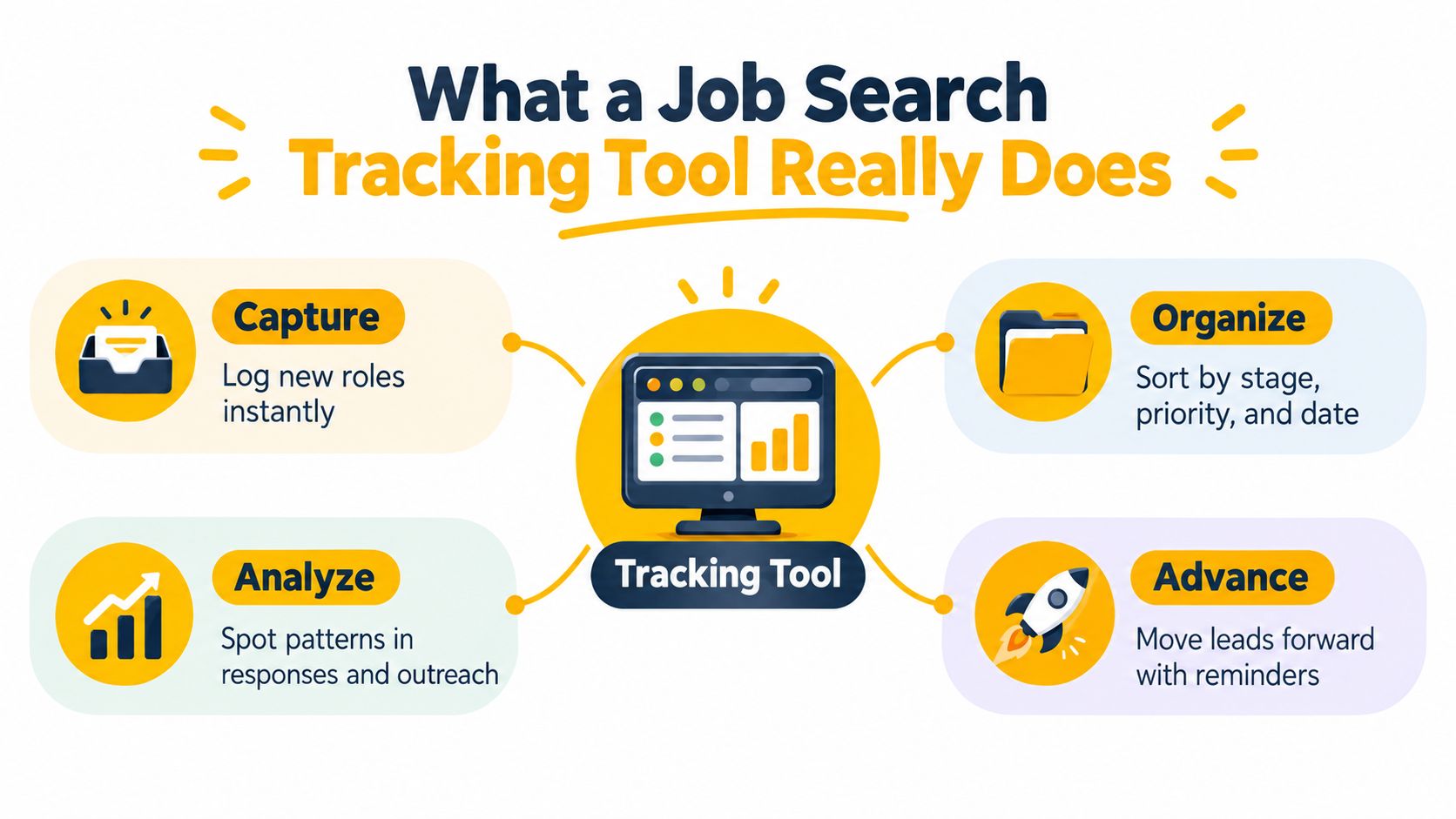
A job search tracking tool works like a mission control board. It doesn't just list applications, it keeps the moving parts attached to each other so you can see the full path from first click to final outcome. That difference matters because a search isn't one event, it's a chain of events.
The fields that actually matter
At minimum, a useful tracker should keep company, role, stage, date applied, contacts, and next action together. That gives you enough structure to know not just where an application sits, but what you're supposed to do next. If a recruiter calls, the record should make it obvious which application that call belongs to.
Automation helps when it keeps updates attached to the right role. If your inbox links to the board, a recruiter's message about a screening call stays with the application instead of becoming another lost thread. That saves time, and it prevents the same role from slipping through the cracks twice.
Stages need plain language
A screening stage is not the same thing as an interview stage, and an interview stage is not the same thing as an offer. If you blur them together, your tracker stops telling you where momentum exists. A strong tool makes those distinctions visible without forcing you to invent your own system from scratch.
The simplest test is this. Can you open the board and immediately see what's active, what's waiting, and what needs follow-up? If the answer is yes, the tool is doing real work. If the answer is no, it's just a prettier list.
How to Track Silence Without Guessing
Silence is the hardest part of a search to interpret because it can mean patience, delay, closure, or indifference. The data shows why that matters. A 2024 survey of 2,500 workers across the United States, the United Kingdom, and Germany found that 61% of job seekers had been ghosted after a job interview, up 9 percentage points from April 2024, and exposure was higher among historically underrepresented job seekers at 66% compared with 59% of white candidates, according to the Greenhouse 2024 State of Job Hunting Report. A separate survey of 625 hiring managers found that about 80% had ghosted candidates by stopping communication without giving a reason.
That's why a tracker has to measure communication quality, not just application status. If you only mark “applied” or “interviewed,” you miss the difference between normal waiting and a meaningful lack of response. A clean record should separate no response after application, post-interview silence, delayed rejection, process closure, and candidate withdrawal.
Use a fixed silence rule
A fixed rule keeps you from labeling a role too early. Different people tolerate different waiting periods, and stage matters, but the point is to decide in advance what counts as silence. Otherwise, every quiet day feels personal.
Silence is easiest to misread when you don't have a timestamp for the last real contact.
That timestamp is the anchor. Record the last email, call, or interview date, then mark when the follow-up window starts and ends. Once that window passes without a meaningful reply, your tracker can flag the role as silent instead of leaving it in a vague “maybe.”
Compare the reply, not just the reply date
A reply that confirms receipt is not the same as a reply that moves you to the next step. The content matters, the tone matters, and the speed matters together. That's why a smart tracker treats silence as a status with evidence behind it, not a mood you assign on a bad day.
A 2025 survey found that 53% of job seekers had been ghosted, with 28% experiencing it after submitting an application, 11% after multiple interview rounds, 9% after a skills assessment, and 4% during salary or benefits negotiation, according to iHire's State of Online Recruiting 2025. Those stages aren't interchangeable, so your records shouldn't be either.
Core Features Worth Paying Attention To
Not every tracker needs the same depth. A spreadsheet can work for basic organization, a generic task board can help with reminders, and a dedicated tracker can connect applications, inboxes, and outcomes in one place. The right choice depends on whether you need simple memory support or a real evidence system.
| Capability | Spreadsheet | Dedicated tracker |
|---|---|---|
| Basic role list | Yes | Yes |
| Stage tracking | Manual | Built in |
| Follow-up reminders | Manual or separate calendar | Usually built in |
| Inbox connection | No | Often available |
| Outcome reporting | Hard to maintain | Designed for it |
| Effort-to-outcome view | Requires setup | Usually easier to review |
For most overwhelmed applicants, the key question isn't “How many fields can it store?” It's “How much work does it remove every week?” If a tool saves you from retyping the same company data and keeps contacts attached to the right role, it's doing the part that matters.
Choose features by pain point
If you mostly forget follow-ups, reminders matter most. If you lose track of where a role stands, stage views matter more. If your inbox is full of hiring noise, a dedicated job-search mailbox may be the difference between staying organized and giving up halfway through the week.
One option in this category is GhostedBy's application tracker, which is built around roles, stages, outcomes, and company-level patterns. That kind of setup is useful when you want the tracker to do more than hold notes.
Short test: the best feature is the one that prevents the same mistake from happening twice.
A Simple Weekly Workflow That Keeps You in Control
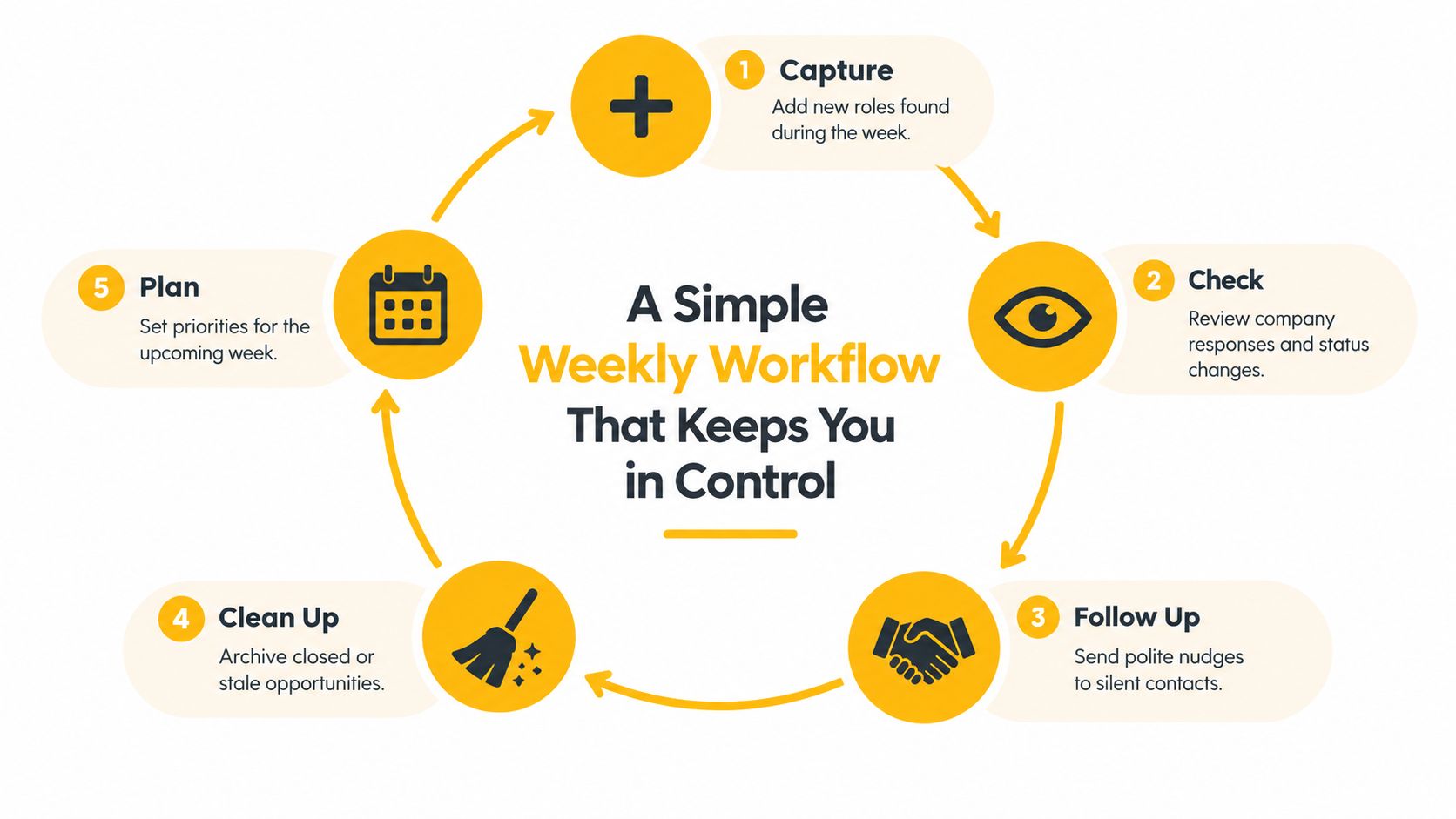
A tracker only helps if you use it on a schedule that fits real life. Weekly works better than constant checking, because it gives you enough time for responses to arrive without turning the process into a full-time job. The point is to create a loop you can repeat.
Start with capture, then check the company record
When you find a role worth applying to, log it immediately. Add the company, role, stage, and date before you close the tab, because memory gets sloppy fast. Then check whether that company has a history of leaving candidates hanging, since that changes how much time you want to spend there.
That shift matters. Instead of applying everywhere and hoping, you begin to prioritize employers that respond. Over time, your tracker shows which channels produce movement and which ones create busywork.
Update the loop before the week ends
If a recruiter replies, change the stage right away. If no one responds, record the last contact date and the silence window. If a role closes, archive it so it stops cluttering your active list.
A clean weekly cycle usually includes these actions:
- Capture new roles before they disappear from view.
- Review company response history before sending another application.
- Update stages and dates after every meaningful contact.
- Follow up politely when a role has gone quiet.
- Archive stale opportunities so your board stays readable.
The result isn't just organization. It's a clearer sense of where your time is going and which roles deserve another hour of effort. That makes your search feel less random and more like a sequence of decisions.
Privacy and Trust Rules for Tracking Applications
A tracker becomes more useful when it protects your data as carefully as it organizes it. The European Data Protection Board says personal data can't be stored indefinitely, retention has to match the purpose it was collected for, and information should be deleted or anonymized once it is no longer needed, according to EDPB guidance on data retention and applicant information. That matters when your tracker holds application history, conversations, dates, and outcomes.
Keep the private record private
Individual application details do not need to be public to be useful. A safer system keeps identities, exact dates, and role-level specifics private while still letting patterns emerge at the company level. You keep the memory without exposing the person.
Retention works the same way. Employment-focused GDPR guidance says applicants need to be told how and why their data will be processed, and that applicant information generally cannot be kept forever. A recruiter guide also notes that records tied to vacancy advertising and job applications should generally be kept for at least six months, and sometimes longer depending on claim deadlines and jurisdiction, as outlined in the Eploy GDPR guide for recruiters and candidate rights. When eligibility, retention, and anonymization are clear, as described in the GhostedBy privacy policy, the tracker feels less like a storage bin and more like a responsible record-keeping system.
Aggregated outcomes build trust
The safest public record is an aggregate, not a diary. If a system publishes company-level counts and percentages instead of names and raw application details, it can still show patterns without exposing contributors. That fits job seekers who want honesty without giving away each other's private histories.
Trust rule: if the system cannot explain how long it keeps data and what it publishes, it is asking you to trust a black box.
Published rules matter because they show how the record works. Clear eligibility, retention, and anonymization turn a tracker into a responsible record-keeping system, not a storage bin.
How GhostedBy Complements Your Tracking System
GhostedBy fits best as a response-aware layer on top of your own tracking habits. It gives candidates a private board for roles, stages, and outcomes, plus company-level reporting so you can see how often people say they got a response versus being ghosted. That turns the tracker from a personal notebook into a way to compare experiences across employers.
Criteria Corp's 2024–2025 Hiring Benchmark Report adds another reason to keep definitions clear. It surveyed more than 425 hiring professionals, with responses collected in July 2024, and found that only one in five hiring professionals admitted to ghosting a candidate. In contrast, a separate candidate survey in the same report found that 38% of candidates said they had been ghosted within the previous year. Those two views don't match neatly, which is exactly why consistent records and published rules matter.
Why it works alongside a tracker
GhostedBy uses verified contributors, private application records, and a 21-day ghosting window so silence can be classified consistently after the last relevant contact. It also keeps the core candidate experience free, and it doesn't use pay-to-influence rules to alter the public record. That combination makes it useful if you want a system that tracks outcomes without turning your job search into a public profile.
The practical upside is simple. You can check a company before applying, keep your own search organized, and report what happened once there's enough information to do so responsibly. If you want a tool that reflects the way candidates experience hiring, GhostedBy is a relevant place to look.
If you want a cleaner way to track companies, silence, and outcomes, visit GhostedBy and use it as part of your weekly search routine. It helps you keep applications private, compare company response patterns, and report what happened after you apply.