One hard number should change how you run a search: the U.S. Bureau of Labor Statistics found that jobseekers had a 26.24% chance of getting a job offer overall, but that rose to 30.89% for people who submitted 21 to 80 applications before dropping to 20.36% for those who sent 81 or more. That's the point most job search advice misses. More activity helps until it doesn't, and after that, sloppy volume just burns time.
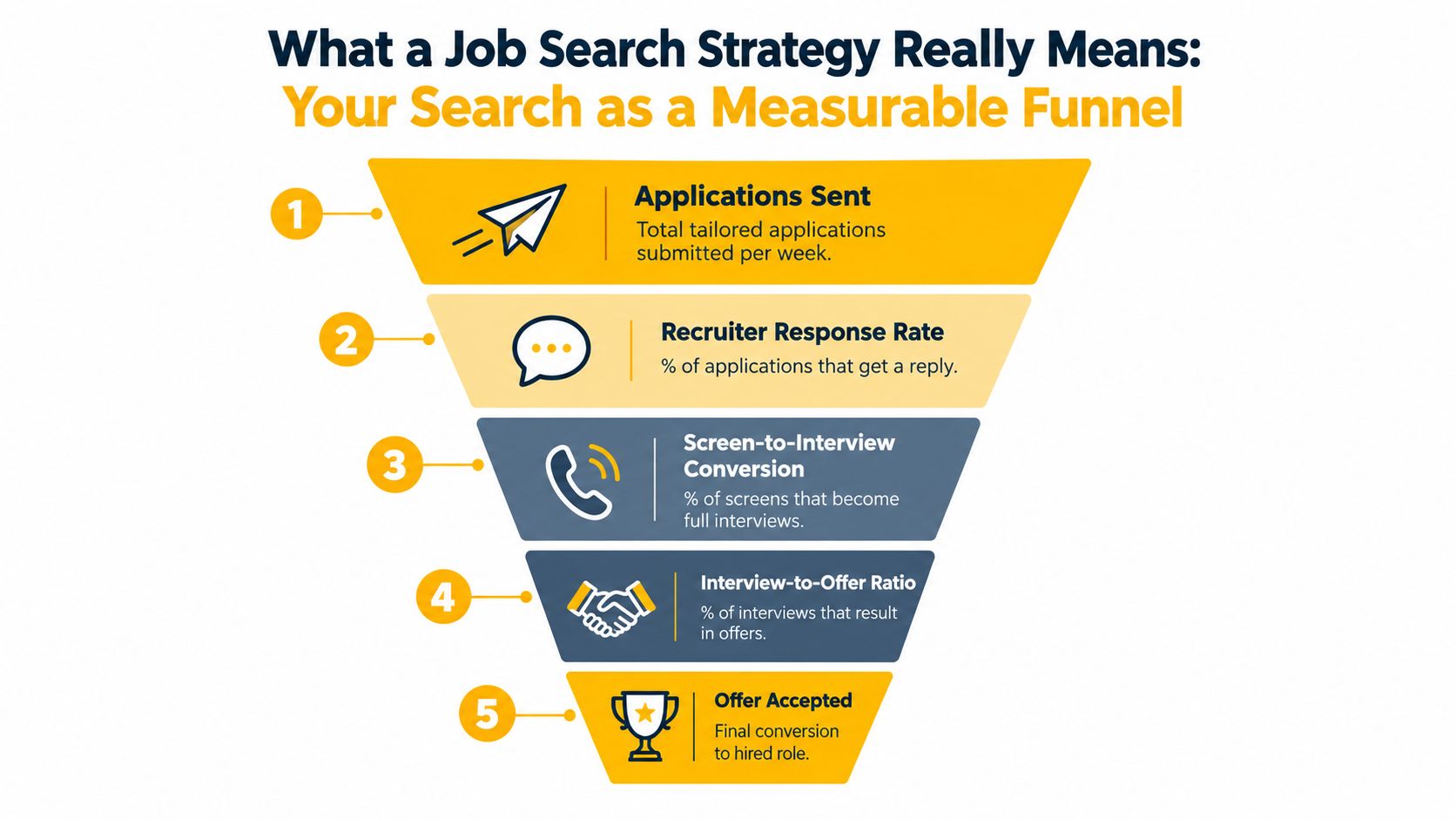
A good job search strategy treats the search like a funnel, not a mood. Applications, responses, screens, interviews, offers, each stage has a rate, and each rate tells you something useful. If you don't track those stages, you end up confusing motion with progress.
Table of Contents
- What a Job Search Strategy Really Means
- Setting Goals and Choosing Where to Apply
- Building a Daily and Weekly Search Cadence
- Choosing Channels That Actually Convert
- Tracking Applications, Follow-Ups, and Silence
- Reading the Numbers and Adjusting Your Approach
- Keeping the Search Going When Results Are Slow
What a Job Search Strategy Really Means
A real search strategy starts with numbers that tell the truth. Applications sent tells you output. Recruiter response rate tells you whether your targeting and channel choice are working. Screen-to-interview conversion tells you whether your resume and first conversations are coherent. Interview-to-offer ratio shows whether you're competitive once you get in the room. Days to first response tells you how fast a company behaves.
Stop counting effort that doesn't predict outcomes
Hours spent tweaking a resume feel productive. So does scrolling listings for an hour and calling it “research.” Neither tells you whether the search is working. A candidate sending 50 applications with no responses is doing worse than one sending 15 targeted applications and booking 4 screens. That's true even if the second person spends less time “working” at it.
Practical rule: judge the search by response and conversion, not by how busy it feels.
The BLS analysis also found that jobseekers needed about 6 applications to get one interview BLS analysis. That's a useful baseline because it tells you a search is a funnel with friction, not a yes-or-no test of your worth. Once you accept that, the right questions get sharper. Which channels get replies. Which roles move. Which companies stall.
A cleaner way to think about the search is this. Track the smallest set of inputs and outputs that change your next move. If a channel produces replies, use more of it. If a role type never gets screened, stop pretending it just needs one more polished sentence.
Setting Goals and Choosing Where to Apply
Start with the outcome, then work backward. If you want one accepted offer by a certain date, you need enough final rounds to make that likely, and enough screens to produce those final rounds. The exact volume depends on channel mix, but the logic doesn't change. You don't “hope” into an offer. You build a funnel that can produce one.
Build the target list before you spray applications
A useful shortlist is a set of companies you can compare, not a giant folder of maybe-roles. Score firms by industry fit, hiring signal, and role match, then split them into A, B, and C lists. A-list companies deserve deeper research and warm outreach. C-list companies get efficient batch applications. That keeps your best energy where it can change the outcome.
Companies that are hiring loudly deserve more attention than companies that just look impressive on paper.
Role choice matters too. A title that feels flattering can still be a bad bet if it's historically slow to hire or badly matched to your background. Prioritize roles with a clear fit and a reasonable path to response, then widen only when the funnel is weak in a specific segment. I'd rather see a candidate apply cleanly to fewer roles with a sane chance of conversion than scatter across titles that all look good in a spreadsheet and none of which get answered.
The other mistake is applying wherever the internet is loudest. High-volume boards are fine for discovery, but they're weak if you need a real conversation. Use them as one input, not the whole plan. If your search relies on one channel alone, you're letting the platform decide your odds.
| Reverse-engineering your monthly application goal | |
|---|---|
| Funnel Stage | Volume Needed for 1 Offer |
| Applications | Enough to produce screens at your current response level |
| Screens | Enough to produce final rounds |
| Final rounds | Enough to produce one accepted offer |
| Offer acceptance | The end point, not the starting assumption |
For company research, use a source that helps you compare employers before you waste time on them, such as company review sites that focus on candidate experience. I'd rather know how a company behaves before I spend an hour tailoring for it.
Building a Daily and Weekly Search Cadence
A search gets messy when you treat every day like a blank slate. It gets even worse when you binge-apply for six hours and then do nothing for three days. A steadier cadence wins because it creates repeatable inputs, which means your results can be read and improved.
Keep the week balanced
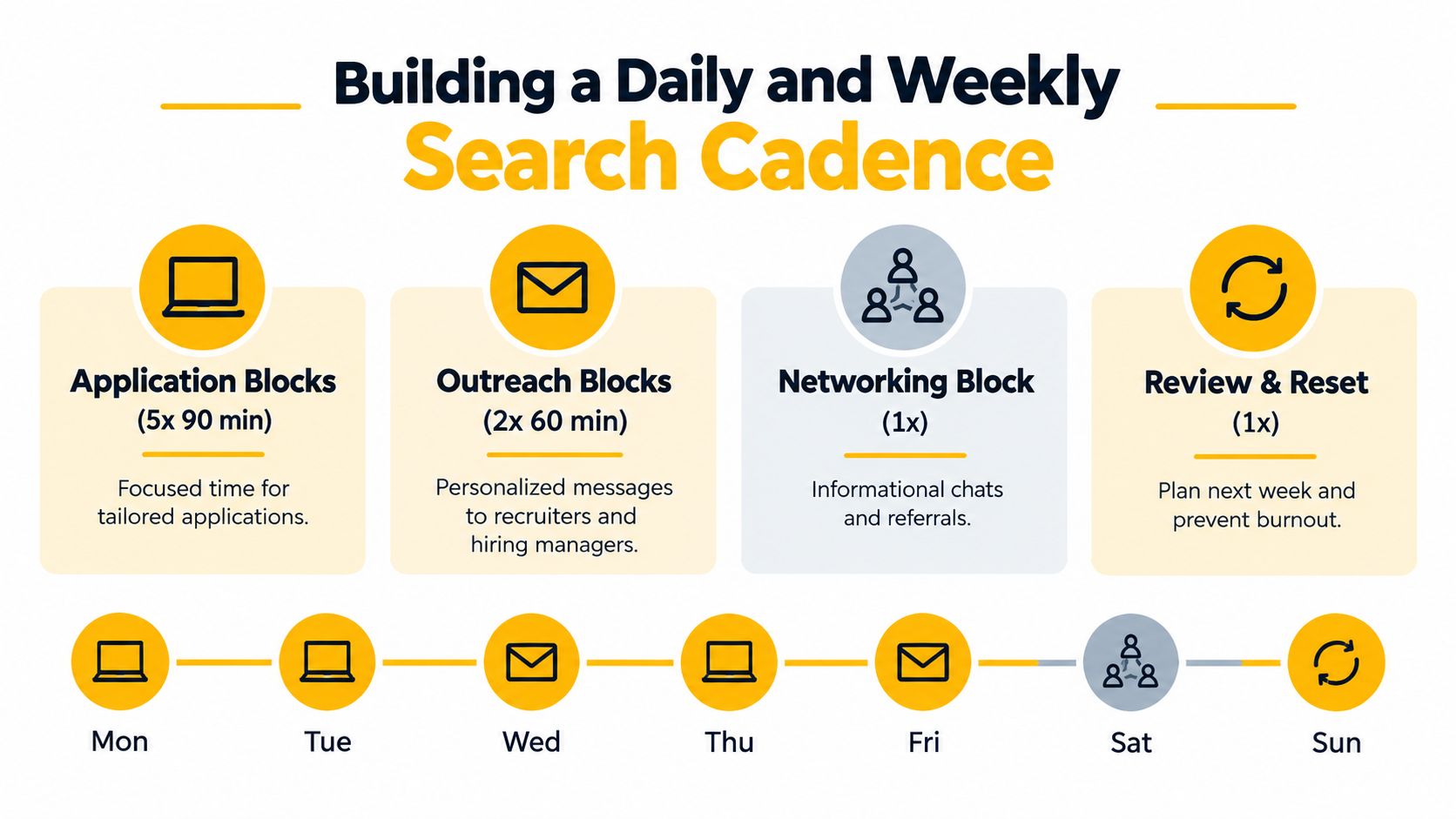
Use blocks, not vibes. Five application blocks of 90 minutes, two outreach blocks of 60 minutes, one networking block, and one review session is enough structure to keep the search moving without turning it into a second job you hate. The point is consistency. If the week only looks good when you're panicking, it isn't a good week.
Daily work should mix channels. Don't do all your easy applications in one miserable pile and call that efficiency. Research first, tailor the resume second, write the opener third, log the application fourth. That sequence matters because it keeps you from sending polished nonsense to the wrong company.
If you're using practical job-hunting tips for staying organized, the search stays less chaotic. I'm still a fan of the basic rule that a search should leave a paper trail, even if that paper trail lives in a spreadsheet.
Follow up on a schedule, then move on
Silence needs a timer. A reasonable cadence is a Day 5 nudge, a Day 12 second touch, a Day 21 breakup message, then mark the lead cold. That keeps you from rereading the same unanswered application like it might suddenly develop a conscience.
The follow-up should add value. Reference the original application, mention one detail that is still relevant, and give them an easy reason to reopen the file. Don't ask, “Just checking in.” Everyone knows what that means, and it usually means they already forgot you.
If a company can't keep a simple timeline, treat that as data, not insult.
Choosing Channels That Actually Convert
Channel choice is where most searches leak time. People keep applying through whatever is easiest to click, then blame the market when nothing happens. The market is part of it. Bad channel selection is the other part.
Put warm paths first
Use referrals and direct outreach as the front of the line. In classic job-search research, the public employment service was used by 26% of searchers, friends and relatives by 24.8%, and direct applications to employers by 22.3% job search methods study summary. That old pattern still says something useful. People rarely get hired by pretending the search is purely transactional.
Networking and referrals keep winning because a warm path cuts through the pile. A contact gets your name associated with a real person instead of another file in a queue. That doesn't guarantee an interview, but it changes the odds in a way cold submissions usually don't.
Use boards as support, not as the whole strategy
Different channels convert differently, and the gap is big enough that you can feel it in a week. Application-level data shows response rates of 11.3% on Google Jobs, 8.7% on GovernmentJobs, and 6.0% on Wellfound, while LinkedIn sits at 3.1%, ZipRecruiter at 2.8%, and Dice at 0.35% channel response-rate data. That's why a board-heavy search often feels busy and goes nowhere.
A practical allocation is simple. Spend 60% of your time on referral and direct outreach, 25% on targeted company applications, and 15% on high-volume boards. Aggregators like Indeed or ZipRecruiter can help when you're searching broadly or applying to hourly roles across regions. They waste time when you're aiming at mid-level professional jobs in a competitive market and expecting the platform itself to carry the search.
Here's the diagnostic I use. If you've sent 50 listings and haven't booked a screen, the channel mix is probably wrong. If your warm outreach gets replies while your cold applications sit there untouched, stop pretending those channels are equal.
Tracking Applications, Follow-Ups, and Silence
A search without tracking turns into folklore. You remember the roles that felt promising and forget the ones that went nowhere. That distorts your read on the funnel and leads to bad calls.
Use a simple board, not a complicated system
A spreadsheet or Notion board is enough. Track company, role, channel, application date, follow-up dates, response type, and stage. That is the minimum set that shows whether a lead is alive, stalled, or dead.
Silence needs to be visible. Independent hiring-data coverage reports that only 24% of applications received any employer contact within 30 days hiring data coverage. If you do not timestamp the process, you will keep treating silence like a mystery when it is often just normal hiring behavior. For a clearer read on company hiring practices, log what happens after each touch, not just whether you applied.
Treat silence as a process signal
Use stage-based follow-up rules. For LinkedIn applications, follow up on Day 5. For email submissions, Day 7 works better. For referrals, Day 10 makes sense because the path is warmer. Then send one final nudge at Day 14.
After 21 days with no useful response, close the lead unless there is a second contact path worth trying. That matches candidate-experience tracking norms that treat silence as ghosting after a defined waiting period. If you want to compare how employers behave over time, GhostedBy lets candidates privately track applications and see which companies respond and which ones disappear.
Follow-up script rule: do not ask for an update, add a reason to reopen the thread.
A second-touch note should reference the original role, mention one new project or credential, and make the next step easy. If you have already interviewed and the company goes quiet, that is a different signal from silence after a cold application. Log both. They mean different things.
Reading the Numbers and Adjusting Your Approach
Weekly review is where the search either gets smarter or drifts. Thirty minutes is enough if you use it to answer three questions. Which channels produced screen calls. Which role types converted. Where did applications stall.
Look at the funnel by segment
Break the data into company size, seniority, and industry. That's where the useful pattern usually shows up. Some candidates discover that small companies reply faster. Others find that one function moves cleanly while another just drains time. If you only look at totals, you'll miss that.
Use the response rate as your first warning light. Under 8% across 20 applications means targeting is off. Under 3% means the resume or channel mix needs work. Those are not moral judgments. They're signals that something in the funnel is weak enough to deserve a change.
Know when to quit a lead
I'm blunt about this. Three applications, zero responses, and no internal advocate is enough to walk away from a target company. A warm intro plus a partial screen that went cold is different, because there's still evidence of interest. Push those. Drop the dead ones.
The point isn't to be impatient. It's to stop feeding time into companies that have already told you, through behavior, that they're unlikely to move. A search gets better when you compare employers by what they do, not by how polished they look.
| Weekly review question | What to do if the answer is weak |
|---|---|
| Which channels produced screen calls | Shift time away from the weak channel |
| Which role types converted | Narrow the target set |
| Where applications stalled | Fix the step with the drop-off |
If both your best segment and your weakest segment are underperforming, expand the target list. If one segment is clearly working, double down there first. That's the entire game. Find the part of the funnel that still has life, then stop wasting effort on the parts that don't.
Keeping the Search Going When Results Are Slow
Slow results are normal, which is exactly why the search needs discipline. People fall apart when they mistake a quiet week for a verdict. A search should run on rules, not on the emotional temperature of Tuesday afternoon.
Protect the minimum, then adjust the mix
Keep a fixed weekly minimum of qualified applications and warm outreaches. That minimum should be separate from casual browsing, which tends to feel useful while producing very little. Browsing is how you spend time. Scheduled outreach is how you move the search.
A candidate at week six with a 3% application-to-screen rate should shift 50% of effort to referrals and recruiters, not double down on generic applications. That's the kind of correction people avoid because it feels like admitting the first plan didn't work. It isn't failure. It's maintenance.
Review on a calendar, not a feeling
Use a monthly targeting review to cut weak channels and replace them. Don't just pile on more volume because the week felt slow. A bad week is noise. A pattern over several weeks is data.
Week 4 should answer whether the channel mix is producing contact. Week 8 should show whether the role mix is too broad. Week 12 should force a decision on whether the whole search needs a reset. If you reach those checkpoints and still haven't changed anything, you're doing ritual, not strategy.
Keep the search steady enough that the numbers mean something. That's the part many job seekers skip, because it doesn't feel dramatic. It does, however, get you closer to an offer.
If you want a clearer view of which companies reply, GhostedBy helps you check candidate-ghosting patterns before you apply and track your own search without losing the thread. Use GhostedBy to organize applications, spot dead-end employers, and compare how companies behave when the process goes quiet.